• Request Info
  • Visit
  • Apply
  • Give
  • Request Info
  • Visit
  • Apply
  • Give

Search

A-Z Index Map

Physics & Astronomy

  • About
    • Honors
    • Administration
    • Faculty Resources
    • Nielsen Spaces
  • Research
    • Research Partners & Facilities
    • Condensed Matter
    • Particle / HEP
    • Biophysics / Soft Matter
    • Nuclear / Astrophysics
    • Quantum Information
  • People
    • Faculty
    • Staff
    • Joint Research & Adjunct Faculty
    • Post Docs
    • Graduate Students
  • Undergraduate
    • Why Physics
    • What Our Grads Do
    • Career Resources
    • Degree Programs
    • Research
    • Scholarships
    • Student Organizations
  • Graduate
    • Join Our Program
    • FAQs
    • Fellowships & Assistantships
    • Bains Fellowship
    • Where Our Grads Go
    • Research
    • Resources
  • News & Events
    • Newsletters
    • News
    • Colloquia Series
    • Events
    • In the Media
  • Outreach
    • Astronomy Outreach
    • Cool Things in the Sky this Month
    • Physics Outreach & High School Lecture Series
  • Alumni
    • Distinguished Alumni Award
    • Giving Opportunities
    • Share Your News
A banner showing a model of an atom and elementary particles

News

December 2025

Archives for December 2025

An etched translucent sign in green reading cosmicrayn, seeing the unseen

Cosmic Collaboration: Students Join Forces to Bring the Invisible to Life

December 16, 2025

Every moment of every day, invisible particles from space pass silently through your body. Traveling to Earth at nearly the speed of light, cosmic rays are everywhere but detectable only through specialized tools. But now—thanks to a partnership that blends science with design—the public can see, hear, and feel the celestial phenomenon firsthand through an immersive exhibit created by interior architecture and physics students. 

The multisensory installation—Cosmic Rayn: Seeing the Unseen—is the culmination of a yearlong project led by Assistant Professor of Physics Lawrence Lee and Professor David Matthews from the School of Interior Architecture. Funded by a $1 million National Science Foundation CAREER Award granted to Lee, the project reflects the university’s increasing emphasis on experiential learning, giving students the chance to turn classroom theory into real-world applications.

Read the rest of the story at the College of Architecture and Design website.

December 16, 2025  |  Filed Under: Featured News, News, Particle

A graphic showing the evolution of chromosome separation in E. coli.

UT’s Biophysics Group Investigates How Chromosomes Separate

December 16, 2025

Biologically speaking, family stories are written in chromosomes. For the story to continue, those chromosomes have to be copied and passed on to the next generation. In recently published findings, UT’s biophysicists took a deeper look at how this works in Escherichia coli (E. coli) to better understand the process.

A Simple System with a Multi-Step Process

Chromosomes are long strands of DNA that wrap around proteins. A key part of a cell’s life cycle is chromosome replication and the transfer of genetic material to daughter cells. Professor Jaan Mannik’s and Adjunct Assistant Professor Max Lavrentovich’s groups wanted to understand how that mechanism is organized and carried out in bacteria (specifically E. coli).

“Chromosomes must be equally divided between the two daughter cells during cell division, otherwise the cell that lacks a full genome will die,” Mannik explained. “In human cells, the mitotic spindle is responsible for separating the chromosomes before cell division starts. However, bacteria lack a mitotic spindle. The question arises how the bacteria separate their chromosomes.”

He explained that “it is expected, based on polymer physics models, that two new DNA strands forming during replication in cylindrical confined conditions repel from each other due to an entropic force (entropic segregation mechanism).”

The Upside of Unmet Expectations

Graduate student Chathuddasie I. Amarasinghe (a first-time first author) took on the challenge to test this mechanism experimentally. She was joined by Graduate Student Mu-Hung Chang, who tackled the same question via modeling.

A photo of Jaan Mannik
Jaan Mannik
A photo of Mu-Hung Chang
Mu-Hung Chang
A photo of Chathuddasie I. Amarasinghe
Chathuddasie I. Amarasinghe

Using high-throughput fluorescence microscopy, Amarasinghe said the group imaged thousands of cells using microfluidic devices (also called lab-on-a-chip) in a single experiment.

“We take time-lapse images of our cells and then use MATLAB and Python functions to analyze the data in different ways, both quantitatively and qualitatively, including still images and movies,” she explained.

Amarasinghe said when she first created this new strain of cells with a fluorescent tag on ribosomes, she “expected it to produce very straightforward results that would match theoretical predictions from the entropic mechanism perfectly.”

That wasn’t exactly what happened.

Working on the experiment she learned of another model proposing how the dynamics of mRNA–ribosome complexes could affect DNA segregation. Messenger RNA copies genetic material from a DNA strand and carries that information to the ribosome, which makes proteins. Amarasinghe et al. found that once the replication process is roughly at the halfway point, the accumulation of messenger RNA and ribosomes in the middle of E. coli chromosomes becomes strong enough to start driving the two daughter DNA strands away from each other. This process continues past the point when the two chromosomes lose contact with each other and separate.

In parallel to this process, Amarasinghe and co-workers found that the daughter chromosomes are also separated by the closing constriction, a final “pinching” of the cell. During constriction the cell envelope bends inward and physically pushes the chromosomes apart.

The evolution of chromosome separation in E. coli. Top left: Diagram of an E. coli cell showing polysomes pushing sister chromosomes apart.  Bottom: Heatmaps show cell-cycle-dependent changes in DNA and ribosome density distributions, and constriction formation. The top right corner shows normalized mid cell amounts from these heatmaps (integrated between the dashed horizontal lines).

Chang led development of the model, which used partial differential equations to describe the evolution of DNA, polyribosomes, and ribosomal subunits in E. coli cells.

“The model correctly predicts a local maximum in ribosome density at the cell middle in the early stages, which gives a good qualitative explanation to the DNA and ribosome correlation patterns observed in experiment,” he explained. “However, it failed to capture the exact time-scale of the accumulation of ribosomes in the cell middle in the later stages of the cell cycle. We expect this discrepancy could be potentially reduced if we extend the model to 3D in future work.” 

The results of the experiment are published in the Proceedings of the National Academy of Sciences. PNAS is a peer-reviewed journal of the National Academy of Sciences covering the biological, physical, and social sciences. In addition to Amarasinghe (first author), Chang, Lavrentovich, and Mannik, other contributors are Jaana Mannik (a research scientist with UT Physics) and Scott T. Retterer of Oak Ridge National Laboratory.

Diving into Deep Questions

Biophysics captured Chang’s attention during his first year in the physics graduate program. Lavrentovich (then on UT’s faculty) introduced his work to new students, and Chang said “the mysterious phase transition patterns occurring in living beings attracted me.”

Within a couple of years, he joined the biophysics group.

“I started studying the organization pattern of E. coli DNA, which shows phase separation behavior between different species similar to some phase transition patterns Max showed before,” he said.

Chang defended his PhD dissertation this fall and will continue working with the Mannik group while applying for postdoctoral positions.

Amarasinghe came to biophysics a little earlier, taking a biophysics course as an undergraduate.

“For my undergraduate research, I developed antimicrobial packaging materials, which gave me hands-on experience with microbiology techniques that confirmed my interest in microbial research,” she said.

When she came to UT for graduate studies and learned of Mannik’s research, she was immediately interested in becoming part of the work.

“His research focuses on understanding how life self-organizes from seemingly simple components using the model organism E. coli, which is one of the deepest open questions in biology,” she said.

December 16, 2025  |  Filed Under: Featured News, News, Soft Matter

A group of people seated along three long tables having lunch.

WiP Closes Fall Term with Lunch & Networking

December 9, 2025

Women in Physics finished the semester December 3 with their fall WiP lunch. The goal of these meetings is to allow all interested physics undergraduate and graduate students, as well as post-docs and faculty, to exchange experiences and advice while enjoying great food.

The lunches have had departmental support for 20 years and keep breaking attendance records, with almost 50 participants for this latest event. The next meeting will be on May 7, 2026, with the aim to set a new record and keep building a strong physics community for anyone who wants to participate.

December 9, 2025  |  Filed Under: Featured News, News

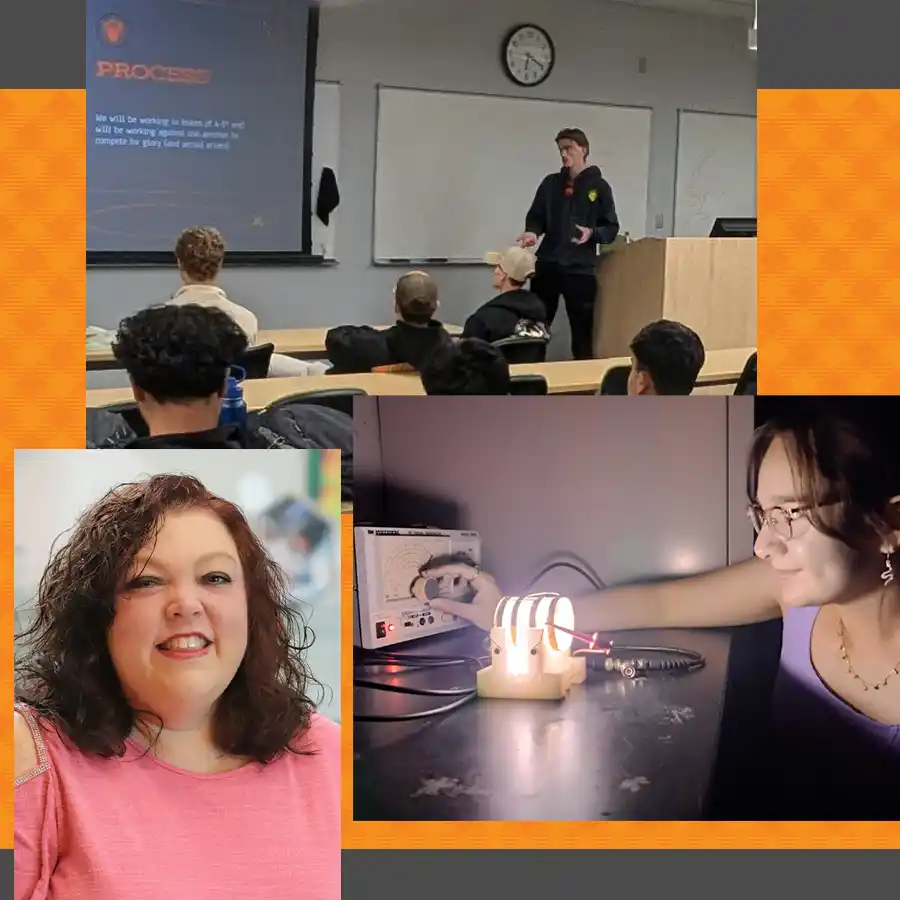
A group of three photos showing students in a physics lab and giving a presentation and an image of a program coordinator

Work-Study Provides Early Research Advantages for Physics Undergraduates

December 5, 2025

A photo of a presenter and an audience seven people
Alex Berry (Standing)
A photo of a student in a physics lab
Amelia Sandoval
A portrait photo of a woman in a pink top
Cheryl Huskey

Alex Berry and Amelia Sandoval learn about physics in the classroom, but that’s just the beginning. They are two of 15 undergraduate physics majors contributing to and gaining from departmental research this year through the Federal Work-Study (FWS) program. These students get an early start seeing science in action while gaining needed experience for life after college—be that a job or an advanced degree.

Books and Building

Berry is a junior double-majoring in physics (BA track) and electrical engineering. He spent the fall 2025 term working with Professor Christine Nattrass in nuclear physics. He organized and formatted archival data so that it could be published, building a foundation for further studies.

“Through such, I have been able to build my strengths in programming and data allotment, which directly coincides across my academics,” he explained.

He said the most valuable asset of the program for him is “exposure of environment.”

With work-study, “I can discuss and work on problems that in many ways complement both of my academic pursuits quite splendidly,” he said. “The opportunities provided are quite extensive, and I am more than grateful for the ability to collaborate over them.”

His physics research ties nicely with Berry’s work as founder and president of Book to Build, the largest interdisciplinary student-led engineering organization at the university. Through events like workshops, tutoring, and internship preparation, they take ideas and concepts learned from the classroom (the book) to create and foster new ideas (the build).

Sandoval has been building as well. She has worked with Professor Nadia Fomin and Assistant Professor Dien Nguyen since spring 2024, when she was a freshman. Her main responsibility has been the establishment of a Helium-3 Metastability Exchange Optical Pumping (MEOP) polarization lab on campus: helping build the apparatus, learning the optical system, training to use Class 4 lasers and wire circuits, and learning how to write Labview code.

“This project is primarily concerned with developing a polarization technique to support target development for scattering experiments at (Thomas Jefferson National Accelerator Facility),” she explained. “I am still working on that project, and have taken on a leadership role as well as presented my research at SESAPS 2025.”

While MEOP is her focus, she helps out with other experiments and has plans next summer to work on electron-ion collider detector testing with a collaboration including Los Alamos National Laboratory and CERN.

“This funding has allowed me to start undergraduate research early, and it has ensured that I have not had to take on a second job,” Sandoval explained. “I am so incredibly thankful for all of the opportunities that my incredible mentors have been able to give to me due to the funding that work-study provides. Without it, I do not believe that I would have been able to start research as early as I did. This work has been incredibly important to me, and I am excited for the future that it has opened up for me.”

Getting Everyone on Board

Cheryl Huskey is responsible for the department’s success in aligning students with work-study opportunities. As the Undergraduate Administrative Associate, she gets them on the right track to meaningful research experiences, including anticipating and answering their questions. 

“Students often think work-study is automatically awarded or guaranteed, when in reality they must qualify through their FAFSA and have remaining financial need,” she explained. “Another common misconception is that work-study positions are assigned. Instead, students must actively apply and interview for available roles. (They) also sometimes think work-study funds are paid upfront, but the funds are earned through hours worked and received in regular paychecks.”

Huskey helps students navigate every step of the process, from understanding eligibility and connecting them with available positions to supporting them as they transition into their research roles.

“Throughout their employment, I help with onboarding tasks, timesheets, and any questions about expectations or scheduling,” she said. “We also collaborate closely with supervisors to ensure students have a positive, productive experience and gain practical skills.”

More than half of the undergraduates participating in physics research are supported by work-study funding. Huskey said there is no limit to how many work-study students the department can employ, as long as they are eligible for the program and there are appropriate roles available.

She also laid out a helpful checklist for interested students:

  • First complete the FAFSA and qualify for federal work-study based on financial need.
  • Search for open positions through the university’s student employment portal (Job X).
  • Submit an application directly to the hiring department. (For physics, Huskey will help students set up interviews.)
  • Once selected for a spot, complete onboarding documents and hiring requirements and then get started on research!
Learn more about the Federal Work–Study (FWS) program at UT

December 5, 2025  |  Filed Under: Featured News, News

Physics & Astronomy

College of Arts and Sciences

401 Nielsen Physics Building
1408 Circle Drive
Knoxville TN 37996-1200
Phone: 865-974-3342
Email: [email protected]

Facebook Icon    X Icon

The University of Tennessee, Knoxville
Knoxville, Tennessee 37996
865-974-1000

The flagship campus of the University of Tennessee System and partner in the Tennessee Transfer Pathway.

ADA Privacy Safety Title IX