
A SULI Summer for Physics Undergraduates
Physics majors are back in class this fall, many of them returning with a summer’s worth of research experience. Six of our undergraduates spent their summer break working on physics projects at national laboratories through the Department of Energy (DOE) Science Undergraduate Laboratory Internship (SULI) program.
SULI places students at 17 participating DOE laboratories and facilities to work with mentors on initiatives supporting the agency’s mission. The program gives undergraduates an opportunity to try out different areas of science, see how research is done at state-of-the-art facilities, and earn a stipend while expanding their professional networks.
Meet our Summer 2026 SULI Alumni!
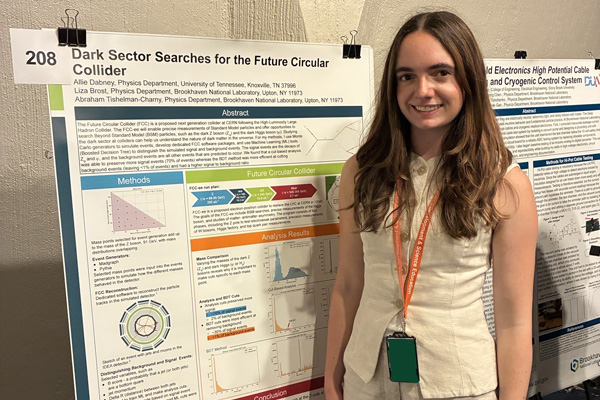
Allie Dabney
Senior from Murfreesboro, Tennessee
SULI Site: Brookhaven National Laboratory, Upton, New York
Project: Dark sector searches for the Future Circular Collider
Mentor: Elizabeth Brost
Internship Highlight(s): The best part of my SULI experience was connecting with my mentor, Liza Brost. She has taught me so much about physics research and possibilities in the career field. Liza is someone who I look up to as a role model for my future.

Langa Lunga
Sophomore from Knoxville, Tennessee
SULI Site: SLAC National Accelerator Laboratory, Menlo Park, CA
Project: Cryogenic Characterization of a 28nm Chip for Device Characterization
In general terms I focused on testing microchips in extreme temperatures for their applications in dark matter and quantum computing experiments. I assisted in the debugging of the ASIC chip board at room temperature first and with the creation of an automated test bench that will run experiments autonomously in the cold environments, which at SLAC get down to 77 K and at LBNL (our collaborating lab) gets down to 4K.
Note: Langa finished first at SLAC and second nationwide in the 2026 IGNITE off! Competition among more than 135 competitors.
Mentor: Aldo Pena Perez
Internship Highlight(s): “Curiosity and optimism are the keys to the doors of success.” I feel like this quote is very fitting for my time at SLAC as I tried to live by it as much as possible. In doing so, I’ve been able to meet incredible scientists working on groundbreaking research, entrepreneurs who’ve raised and invested millions of dollars into companies, and ambitious peers like me seeking to make their own mark in the world. By being curious about other people and optimistic (about) their willingness to speak with me, I’ve learned an incredible amount in such a short time.
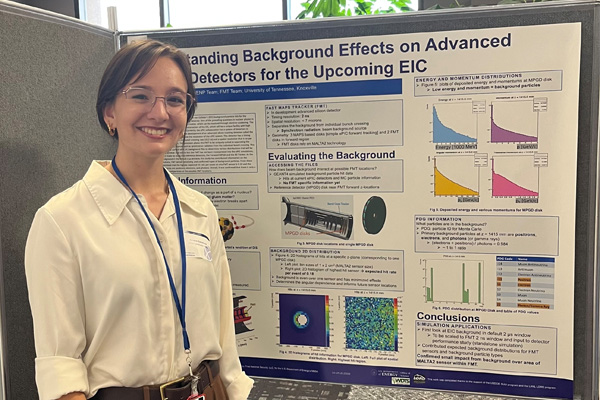
Amelia Sandoval
Senior from Knoxville, Tennessee
SULI Site: Los Alamos National Laboratory, Los Alamos, New Mexico
Project: My project was focused on analyzing simulated background particle hits on ePIC detectors for the development of an advanced silicon detector for the upcoming Electron-Ion Collider (EIC). My group is working on an advanced silicon detector called the Fast MAPS Tracker (FMT) which aims to improve the precision of the current simulated detectors that the ePIC collaboration has developed. The FMT specializes in separating background events from the individual bunch crossings due to its high timing resolution of 2 ns.
My part of this project involved plotting various distributions from the Geant4 ePIC simulated background hit files by using reference detectors located close to the proposed FMT locations due to the fact that the FMT is not a part of the ePIC simulation yet. These distributions yielded important information about the background, such as the expected hit rate per event over one FMT sensor, spatial distributions of the background, and the particle composition of the background. All of this information will be scaled to the FMT timing window and input into a detector performance study so that my group can do a standalone simulation. Over the course of this project, I greatly improved my understanding of coding, and I learned how to use ROOT, which will be invaluable in the future. I am so thankful that I got this opportunity and I am excited to see where this project goes!
Mentor: Xuan Li
Internship Highlight(s): The best part about my SULI experience was that I got to spend 10 weeks doing what I want my career to be in the future: doing research at a national lab.

Dylan Stewart
Post-Grad (Bachelor’s in Physics, Spring 2026) from Knoxville, Tennessee
SULI Site: Oak Ridge National Laboratory
Project: Minimizing Uncertainty on Particle Energy Measurements in the Nab Experiment
During my appointment at the Nab experiment, I contributed to the development of one of the world’s most precise neutron decay experiments. Precision measurements of neutron decay provide a stringent test of the best theory describing fundamental particles and forces. Discrepancies between experimental results and theoretical predictions could point to previously undiscovered physics, making it essential to reduce experimental uncertainties that could obscure evidence of new physics. My research focused on improving the reliability, precision, and efficiency of the Nab experiment by reducing systematic uncertainties that could affect its measurements. I implemented new control systems for the detector calibration hardware and the high-voltage power supply, replacing outdated and error-prone procedures while automating key aspects of the experiment. I also developed optimization algorithms for detector calibration to determine the optimal configuration for each detector channel, improving the accuracy of energy measurements while reducing unwanted electronic noise.
In addition, I investigated how changes in the experiment’s magnetic field affect the angle at which protons strike the detector. By combining these measurements with detector simulations, I demonstrated that this technique provides a powerful new method for studying energy losses at the detector surface and used it to identify previously unrecognized damage in the experiment’s upper detector. These findings directly improved the collaboration’s understanding of an important source of systematic uncertainty. Together, these contributions improved the Nab experiment’s accuracy, automation, and reliability, strengthening its ability to collect the years of high-quality data needed to achieve its precision goals. Through this appointment, I gained experience in detector instrumentation, detector calibration, optimization algorithms, data analysis, simulation, and collaborative scientific research, strengthening the technical and professional skills needed for a career in experimental physics.
Mentor: Wolfgang Schreyer
Internship Highlight(s): Unlike other research experiences that I’ve gotten to do, SULI is unique in the amount of professional development, lectures, and workshops that were put together for us interns to attend outside of our own research projects. I had a lot of cool opportunities to learn not just about other areas of science but real technical skills that contributed to my ability to produce high-quality research.
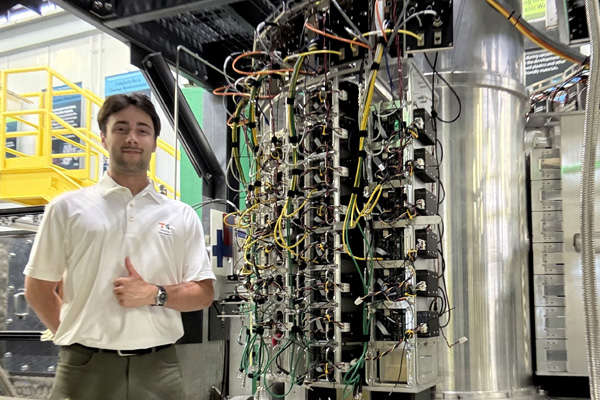
Evan Toon
Senior from Knoxville, Tennessee
SULI Site: Oak Ridge National Laboratory
Project: At the High Flux Isotope Reactor (HFIR), future polarized Neutron Macromolecular Crystallography (NMC) studies are in need of a new Dynamic Nuclear Polarization (DNP) enhanced sample space to enable the accurate determination of hydrogen locations within protein structures of interest, as polarized NMC can greatly increase the signal to noise ratio and significantly shorten the data acquisition time for these neutron diffraction measurements. Mapping these hydrogen positions is essential for understanding biological function and molecular interactions and can drive advancements in structural biology and pharmaceutical research.
My work included the installation and commissioning of the major components required for this DNP enhanced sample space. Specifically, a new 1 K cryostat, 5 T superconducting magnet, microwave transmission, nuclear magnetic resonance (NMR) electronics, and a new cryogenic sample space capable of positioning protein crystals in multiple orientations for thorough neutron diffraction measurements. Integrating this new DNP instrument along the IMAGINE-X beamline will enable upcoming and highly anticipated protein crystallography studies by providing various samples of interest the high degree of nuclear polarization required to accurately determine the hydrogen locations throughout the crystalline lattice.
Mentor: Josh Pierce
Internship Highlight(s): The best part of my SULI experience was seeing how the physics I learned in the classroom comes together in a real experiment while working alongside various other scientists, engineers, and technicians who make this cutting edge research possible. It showed me what large scale research at a national laboratory truly looks like and reinforced that this is absolutely the career I want to pursue.