
CMS Breakthrough and DOE SCGSR Awards for UT Physics
The physics department’s latest student accolades break new ground while continuing a long record of success.
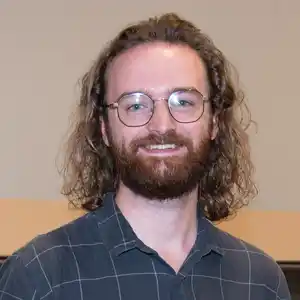
Inaugural CMS Breakthrough Prize PhD Award
Graduate Student Johnny Lawless, who works with Associate Professor Larry Lee, is one of nine students chosen for the first-ever CMS Breakthrough Prize PhD Awards.
In 2025, the Compact Muon Solenoid (CMS) collaboration at CERN shared the Breakthrough Prize in Fundamental Physics. They donated their $1 million share of the prize to fund doctoral students from CMS member institutes. The CMS Breakthrough Prize PhD Awards provide early-career researchers with dedicated research time at CERN in recognition of their exceptional contributions and promise.
Lawless searches for new particles produced in collisions at the Large Hadron Collider (LHC) in one of the most difficult signatures possible: a final state with only hadrons. These signatures are buried in large backgrounds that are difficult to model and could easily hide signs of new physics. He focuses on problems of large combinatorial complexity and high dimensionality, perfectly suited for machine-learning-based observables. Based at CERN, he’s also working on the CMS Experiment’s tracker upgrade for the High Luminosity LHC, scheduled to come online in 2030.

DOE Office of Science Graduate Student Research Award
Graduate Student Colby Thompson, also of the department’s collider physics group, is one of 75 students selected for the latest cohort of the U.S. Department of Energy Office of Science Graduate Student Research (SCGSR) program. Providing participants with world-class training and access to state-of-the-art facilities at national laboratories, the initiative prepares doctoral candidates for careers strengthening the DOE mission.
Thompson’s SCGSR project is “Advanced Accelerator and Advanced Detector Technology Research and Development in High Energy Physics,” based at Oak Ridge National Laboratory. He studies the effectiveness of anisotropic conductive paste (ACP) as a bonding material in silicon electronics. The goal is to see how ACP bonding compares to the more common bump bonding method in a particle detector context.
Thompson is the 12th UT Physics graduate student selected for an SCGSR award since 2020. This latest cohort also includes Jesse Farr, who earned a bachelor’s degree in physics at UT before enrolling in the physics graduate program at Yale University.