
• Request Info
  • Visit
  • Apply
  • Give
  • Request Info
  • Visit
  • Apply
  • Give

Search

  • A-Z Index
  • Map

Physics & Astronomy

  • About
    • Honors
    • Administration
    • Faculty Resources
  • Research
    • Research Partners & Facilities
    • Condensed Matter
    • Particle / HEP
    • Biophysics / Soft Matter
    • Nuclear / Astrophysics
    • Quantum Information
  • People
    • Faculty
    • Staff
    • Joint Research & Adjunct Faculty
    • Post Docs
    • Graduate Students
  • Undergraduate
    • Why Physics
    • What Our Grads Do
    • Career Resources
    • Degree Programs
    • Research
    • Scholarships
    • Student Organizations
  • Graduate
    • Join Our Program
    • FAQs
    • Fellowships & Assistantships
    • Bains Fellowship
    • Where Our Grads Go
    • Research
    • Resources
  • News & Events
    • Newsletters
    • News
    • Colloquia Series
    • Events
    • In the Media
  • Outreach
    • Astronomy Outreach
    • Cool Things in the Sky this Month
    • Physics Outreach & High School Lecture Series
  • Alumni
    • Distinguished Alumni Award
    • Giving Opportunities
    • Share Your News
A banner showing a model of an atom and elementary particles

News

Author: Catherine Longmire
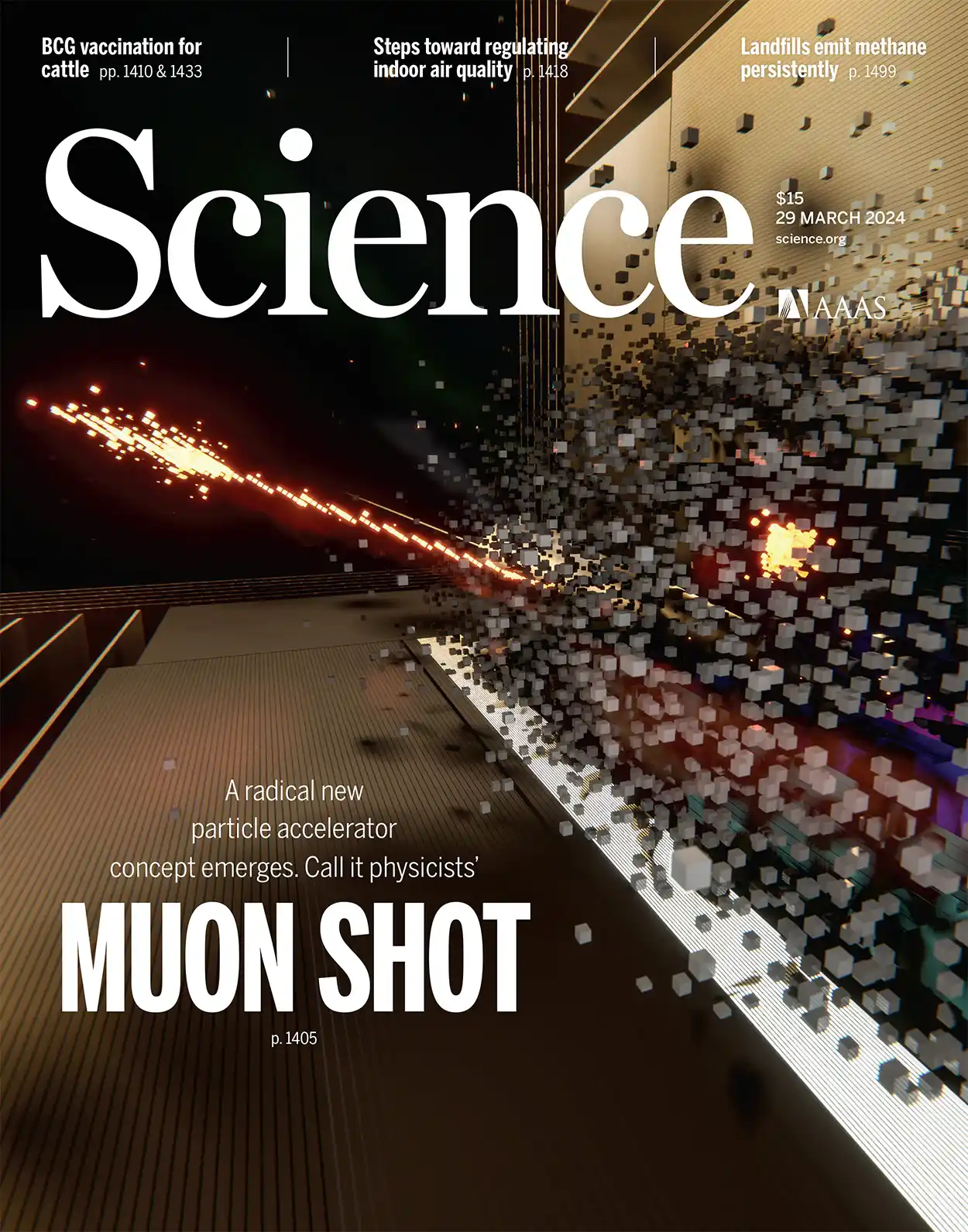
Cover Image of Science Magazine 29 March 2024, Used with Permission

The Art of Muon Collisions

April 3, 2024

Image of Science Magazine Cover 29 March 2024, Used with Permission
Credit: Reprinted with permission from AAAS; See Terms & Conditions below
Image of Tova Holmes
An image of Lawrence Lee
Charles Bell

Tova Holmes, Larry Lee, and Charles Bell

Assistant Professors Tova Holmes and Larry Lee are particle physicists and in their line of work, to think big, you have to think small. That’s where muons come in, and it’s how they became part of a Science Magazine story—including creating the cover art.

In “The Dream Machine,” journalist Adrian Cho reviews the newly-drawn roadmap for particle physics research in the United States. For the past century, physicists have designed, built, and deployed powerful accelerators that rev up and collide particles, precisely measuring the fragments and tracking the escapees to learn more about the building blocks of matter that make up the universe. With current instruments here and abroad reaching their energy limits, American physicists are looking at three possible types of colliders to replace them. Among them is a muon collider.

Will the Muon Have Its Moment?

Muons are fundamental particles. They’re quite a bit like electrons, but roughly 200 times heavier. Until now protons and electrons have been the particles of choice for collider physics, but with their extra mass muons are good candidates for collisions at energy scales up to 10 times higher than that of the Large Hadron Collider, the current world leader. As an early-career scientist, Holmes explained to Cho that waiting something like another five decades for a next-generation collider means the particle physics research she’s so passionate about would pass her by.

“I will be definitely not still working, possibly not alive,” she said.

That’s why she and Lee have spent nearly four years creating designs for a possible muon collider. Holmes coordinates the US-based research and development program for tracking detectors. (Her work has won her a Department of Energy Early Career Research Award, as well as place among the 2024 Class of Cottrell Scholars.) In her conversation with Cho she referred him to Lee as a source for images that could further describe the muon collider vision and enhance the article. Like Holmes, Lee has a strong belief in the power of imagery to convey scientific concepts, so he gladly accepted the assignment.

Renaissance and Romance

Planning for a muon collider is one thing. Promoting the idea to stakeholders is another. Holmes and Lee saw right away that the imagery accompanying those pitches didn’t always match the excitement for the collider’s promise.

In particle physics, “we have a long history of making what are called event displays,” Lee explained, which are simply visualizations of individual collision events. He said scientists have field-specific tools to create those displays, but the results look technical and aren’t particularly engaging.

“One thing I’ve wanted to do for a long time was bring in modern 3D environment modeling to essentially do the same thing, but in a slicker way,” he said.

With UT’s particle physicists’ involvement in the muon collider—specifically a conceptual design for a detector—he saw a fantastic opportunity.

“Right now, if we’re talking about the detector, we’re just in the design phase,” Holmes explained. “We write down some parameters, we try and visualize it, we simulate it, we shoot fake particles into it in our simulation, (and) we see what we can do to reconstruct it.”;

Lee enlisted Undergraduate Physics Major Charles Bell to help create a visualization of the detector and what the particles inside it might look like. They started with proprietary formats familiar to particle physics and brought in industry standard tools, ultimately incorporating Unreal Engine, a creative suite used for an array of simulation purposes. The resulting images were stunning enough to land on the cover of Science and alongside Cho’s article.

While standard event displays are great for showing off technical details, the new artistic images add another layer of strategic communication.

“Larry was trying to make a version of them that took advantage of all the tools that are out there to make them both useful and beautiful,” Holmes said. “Improving this kind of visual translation is really important for the future of our field because we have to be able to explain the kind of exploration we’re doing through visual media.”

Holmes said the muon collider’s success is dependent on audiences both inside and outside physics. At present only a few hundred scientists the world over are involved in the project.

“There have been past versions of this muon collider effort where the technology was not really close enough to ready for people to take it seriously as the next thing,” she said. “It needs to grow to happen. That means getting more people interested. It also needs the engagement of the field to get support from funding agencies. Being able to communicate clearly the excitement, and make sure that communication gets in people’s laps, matters.”

She’s hopeful Lee’s images will inspire a “renaissance” where researchers look at the technological progress surrounding the muon collider and see its potential in a new light. They both also want the public to become more excited about the science behind, literally, everything.

“In astrophysics it’s very easy to visualize because we take literal photographs of the universe,” Holmes said. “For us (in particle physics), we can’t take literal photographs. We do something similar with our detector reconstruction, but it doesn’t look like a photo.”

Lee said he wants images like those he created for the muon collider project to tie in to the “romantic big picture” of fundamental science and capture human imagination.

“We both feel very strongly that it’s important to make things visually compelling, because once you do, people remember them,” he said, even if they don’t fully understand the science behind the pictures.

“This was something we’ve been talking about in the muon collider effort because you’re asking the public to embrace a big project and if you can’t explain what it’s for, you have a real problem,” Holmes said.

This isn’t her first foray into art where the collider’s concerned: she created a poster that’s hanging in a good many physics departments as well as swag to promote the project.

Holmes and Lee believe that prioritizing compelling science communication isn’t just a feel-good pursuit: it’s a key to helping serious science thrive.

“This work is important,” Lee said. “It’s not purely outreach; it’s not purely just for fun. It really pushes us to the literal front of the journal.”

Terms and Conditions re: reprinted AAAS material: Readers may view, browse, and/or download material for temporary copying purposes only, provided these uses are for noncommercial personal purposes. Except as provided by law, this material may not be further reproduced, distributed, transmitted, modified, adapted, performed, displayed, published, or sold in whole or in part, without prior written permission from the publisher.


April 3, 2024  |  Filed Under: Featured News, News, Particle, Uncategorized

A photo of Steve Johnston

Steve Johnston Named Bains Professor

March 4, 2024

A photo of Steve Johnston
Johnston

Steve Johnston wants to save time. And though he never met them, Elizabeth and Jim Bains are going to help.

Johnston knows that while silicon has long played a dominant role in industry, quantum materials will shape technology’s future. The challenge is that these atomic-scale materials are hardly straightforward. Like any good mystery, they come with intricacies, entanglements, and surprises that require case-by-case study. A theorist working in condensed matter physics, Johnston and his research group are developing a library of codes to simplify those investigations. Now, as the Elizabeth M. Bains and James A. Bains Professor of Physics and Astronomy, he’ll have resources to build that library faster.

Tennessee SmoQy Codes

While Johnston’s appointment as the Bains Professor began February 1, he first joined the physics faculty in 2014 as an assistant professor. He’s been busy ever since. He directs the department’s graduate program and teaches graduate-level courses. He’s won a National Science Foundation CAREER Award, secured funding to design quantum materials, and played a role in UT’s successful proposal for the NSF-funded Center for Advanced Materials and Manufacturing (CAMM). His work with Chancellor’s Professor Hanno Weitering on chiral superconductivity made the cover of Nature Physics.

Now, with a professorship supported by an endowed bequest from Elizabeth and Jim Bains, he’ll have additional funding to work in areas beyond the confined focus of funding agencies.

“What I’m really looking forward to is using (this support) for exploratory work,” Johnston said. “If I’m interested in pursuing some new line of research, this gives me a little bit of flexibility to do that. My group is investing a lot of time and effort in developing some open source software and, at least for this first year, I’m planning on using (funding) to shore up that effort.”

The heart of this effort is the SmoQy Suite, a collection of codes to help map the quantum landscape.

Scientists confront a host of challenges in defining the properties of quantum materials, one of the first steps in figuring out how and where they’ll be useful. The problem is that the quantum world doesn’t abide by the laws and equations that physicists have spent generations refining. Among the trickier issues is the many-body problem. In microscopic systems, how particles interact is much more complex than in macroscopic environments. And the more particles you have (especially electrons), the more unwieldy the situation becomes. So as researchers developed new quantum materials, physicists were spending more and more time calculating their properties.

“We used to do things (where) our codes were written to simulate one-off models,” Johnston said. “Whenever a new material comes out, we figure out what model it actually needs, then we have to re-write that code for that model. It’s very reactive.”

The SmoQy codes are a much more proactive approach.

“You build the tools upfront and that way when new discoveries come along we’re able to jump on them immediately and do more right away,” Johnston explained. “It’s also an attempt to make a version-control record of these things.”

His postdoc, Benjamin Cohen-Stead, is the lead developer on SmoQy. The Bains Professorship will allow Johnston to support him as he continues to develop resources and make them available to other scientists working in quantum materials.

“He invested a lot of time building a very versatile code and a bunch of frameworks that we can now use to build other codes,” Johnston said.

In true It Takes a Volunteer fashion, he added the group “would like to get some of the many-body methods that we’re using to a stage where anyone can download and use them. We’re trying to really highlight this as a good tool for the community. We’ve also begun to go after new funding to further expand these codes.”

If you’re wondering how the name SmoQy came about, there’s a Volunteer connection there too.

“We wanted something that was in line with the Tennessee spirit,” Johnston said.

They chose to feature the Smoky Mountains, but with a q to highlight the quantum many-body problem. Johnston explained that SmoQy is actually a play on another many-body software package called ALPS (Algorithms and Libraries for Physics Simulations).

“All many-body codes appear to have to be named after mountain ranges, so we decided to stick with that,” he said.

(Johnston noted that he’s also gotten quite a few emails from people asking him about Smokey, UT’s beloved mascot.)

Johnston’s group is spearheading the SmoQy effort, but he said eventually he’d like to involve more students and partner with UT’s Min H. Kao Department of Electrical Engineering and Computer Science on code development. He’s already working with Physics Professor and Department Head Adrian Del Maestro (who holds a joint appointment with that department) to add codes to the SmoQy library.

“Professor Johnston has an incredible impact across the teaching, research, and service mission of the department,” Del Maestro said. “As the Elizabeth M. Bains and James A. Bains Professor of Physics and Astronomy, I look forward to his transformative contributions to quantum materials research that will help shape future technologies for Tennesseans and beyond.”

These opportunities to expand the department’s quantum materials portfolio are possible because of a young couple who met five decades ago not far from Johnston’s office in the Nielsen Physics Building.

When Liz Met Jim

When Elizabeth (Liz) Miller enrolled in the master’s program in the mid-1960s her primary interests were atomic and nuclear physics. She changed her life—and many others’—when she decided to pursue ultrasonics instead. That’s where she got serious with fellow graduate student Jim Bains. The couple married and earned PhDs before settling in Texas to pursue their careers. When Liz and Jim passed away (in 2015 and 2020, respectively), they left the physics department its largest-ever gift.

In the fall of 2022 that bequest funded the first Bains Graduate Fellowship, which helped Shruti Agarwal get an early start on research. Now the Bains Professorship will help Johnston accelerate quantum materials research and in turn help the broader materials community.

“I’m very appreciative to the college and the department for giving me this,” he said. “As we’re trying to look at all kinds of new materials, we want our codes to respond to those materials. It’s not just about the problems I care about solving but also the problems that other people care about solving.”

With the new appointment Johnston becomes the third faculty member to hold a named professorship, alongside Cristian Batista (Lincoln Chair Professor) and Anthony Mezzacappa (Newton W. and Wilma C. Thomas Endowed Chair).

March 4, 2024  |  Filed Under: Condensed Matter, Featured News, News

A photo of Elbio Dagotto

Elbio Dagotto Wins SEC Faculty Achievement Award

February 23, 2024

A photo of Elbio Dagotto
Dagotto

Elbio Dagotto is a condensed matter theorist who hears “football” and automatically thinks “soccer.” Now he’s a Southeastern Conference champion, not for football (American or otherwise), but for his outstanding work as a professor.

Since 2012 the SEC has acknowledged one exceptional faculty member from each member university to celebrate their success in teaching, research, and service. Dagotto, a distinguished professor of physics and a distinguished scientist at Oak Ridge National Laboratory, is this year’s University of Tennessee, Knoxville, recipient of the SEC Faculty Achievement Award. He will be among the 14 professors considered for the 2024 SEC Professor of the Year honor, to be announced later in the spring.

“I am deeply honored to be selected among so many distinguished faculty to represent the University of Tennessee for the SEC academic award,” Dagotto said. “I am proud to be a Volunteer, proud to be a faculty member of the department of physics and our wonderful university at large, proud of my state of Tennessee, and proud to live in the South of the USA.”

As Adrian Del Maestro, professor and department head, remarked, “Professor Dagotto represents all the best qualities of a university professor and member of the SEC community where ‘it just means more.’ He is a dedicated teacher, beloved by his students, and he is internationally recognized for his fundamental research on how materials can be coaxed to exhibit astounding and useful quantum phenomena that enable the modern technologies we use every day.”

Dagotto joined the faculty in 2004, bringing with him a research program dedicated to understanding strongly correlated electrons: the effects when the properties of one individual electron depend strongly on what the rest of the ensemble of many other electrons is doing. These interactions can be especially difficult to calculate, and untangling them is Dagotto’s specialty. The findings are particularly useful to figure out quantum systems, where the parameters may include only a few atoms and traditional laws of physics don’t apply. In terms of devices and applications, quantum science will take over where silicon meets its limits, and Dagotto’s work is important for exploring this new frontier. He lends his expertise to UT’s research cluster on Quantum Materials for Future Technologies, as well as ORNL’s Materials Science and Technology Division.

“In my 20 years here, I have witnessed the steep positive trajectory of our academic efforts in many fields of research,” he said. “Everybody in the national and international scientific community now knows that ‘something big is brewing’ in East Tennessee, in conjunction with our partner institution, Oak Ridge National Laboratory.”

The SEC award is one of many on Dagotto’s long list of honors. In 2022 he won the American Physical Society’s Adler Award in Materials Physics for his pioneering work on the theoretical framework of correlated electron systems and his gift for describing their importance through elegant written and oral communications. (His top five publications have been cited more than 11,000 times, and in 2004 he was listed among the 250 most highly-cited physicists.) A Fellow of both the American Physical Society and the American Association for the Advancement of Science, he has written or edited numerous works on condensed matter physics principles, properties, and potential applications; including books, journals, and invited review articles.

Dagotto shares his knowledge in the classroom and has impressed students with his teaching ability, especially in the introductory quantum mechanics course for undergraduates. Last spring he won the UT Society of Physics Students Teacher of the Year Award for the third time in five years (2019, 2021, 2023). At the 2023 Academic Honors Banquet UT recognized Dagotto’s university contributions with the Alexander Prize. Named for former UT president and Tennessee senator Lamar Alexander and his wife, Honey, the award honors a faculty member who is “an exceptional undergraduate teacher whose scholarship is also distinguished.”

A native of Argentina who earned undergraduate and graduate degrees in physics at the Instituto Balseiro in Bariloche, Dagotto’s service extends beyond research and teaching. Along with Professor Adriana Moreo, he helps organize campus lunches for Hispanic physicists at all levels so they feel welcome both in the department and in the field. They also like to discuss what Dagotto good-naturedly calls “real football” (meaning soccer). And he’s pleased with the evolving perception that the SEC no longer means just sports.

“The SEC is slowly but surely transforming from an athletic conference to a broader powerhouse that certainly includes the STEM (science, technology, engineering, and math) arena,” he said. “Our future is bright, and I am happy to have contributed to these developments.”

February 23, 2024  |  Filed Under: Condensed Matter, Featured News, News

Women in Physics Lunch at the University of Tennessee, Knoxville, December 11, 2023

Fall 2023 Women in Physics Lunch

December 11, 2023

Women in Physics Lunch at the University of Tennessee, Knoxville, December 11, 2023

The Fall 2023 edition of the Women in Physics Lunch was held on December 7. We had a large group of almost 40 female undergraduates, graduate students, post-docs, and faculty. This was an occasion to get together and get to know each other while enjoying excellent food and discussions. We are very thankful for the support provided by the Department of Physics, and we are looking forward to our next meeting, the Spring edition, on May 8, 2024.

Courtesy of Professor Adriana Moreo

December 11, 2023  |  Filed Under: Featured News, News

  • « Previous Page
  • 1
  • …
  • 5
  • 6
  • 7

Physics & Astronomy

College of Arts and Sciences

401 Nielsen Physics Building
1408 Circle Drive
Knoxville TN 37996-1200
Phone: 865-974-3342
Email: physics@utk.edu

Facebook Icon    X Icon

The University of Tennessee, Knoxville
Knoxville, Tennessee 37996
865-974-1000

The flagship campus of the University of Tennessee System and partner in the Tennessee Transfer Pathway.

ADA Privacy Safety Title IX