• Request Info
  • Visit
  • Apply
  • Give
  • Request Info
  • Visit
  • Apply
  • Give

Search

  • A-Z Index
  • Map

Physics & Astronomy

  • About
    • Honors
    • Administration
    • Faculty Resources
  • Research
    • Research Partners & Facilities
    • Condensed Matter
    • Particle / HEP
    • Biophysics / Soft Matter
    • Nuclear / Astrophysics
    • Quantum Information
  • People
    • Faculty
    • Staff
    • Joint Research & Adjunct Faculty
    • Post Docs
    • Graduate Students
  • Undergraduate
    • Why Physics
    • What Our Grads Do
    • Career Resources
    • Degree Programs
    • Research
    • Scholarships
    • Student Organizations
  • Graduate
    • Join Our Program
    • FAQs
    • Fellowships & Assistantships
    • Bains Fellowship
    • Where Our Grads Go
    • Research
    • Resources
  • News & Events
    • Newsletters
    • News
    • Colloquia Series
    • Events
    • In the Media
  • Outreach
    • Astronomy Outreach
    • Cool Things in the Sky this Month
    • Physics Outreach & High School Lecture Series
  • Alumni
    • Distinguished Alumni Award
    • Giving Opportunities
    • Share Your News
A banner showing a model of an atom and elementary particles

News

Author: physweb
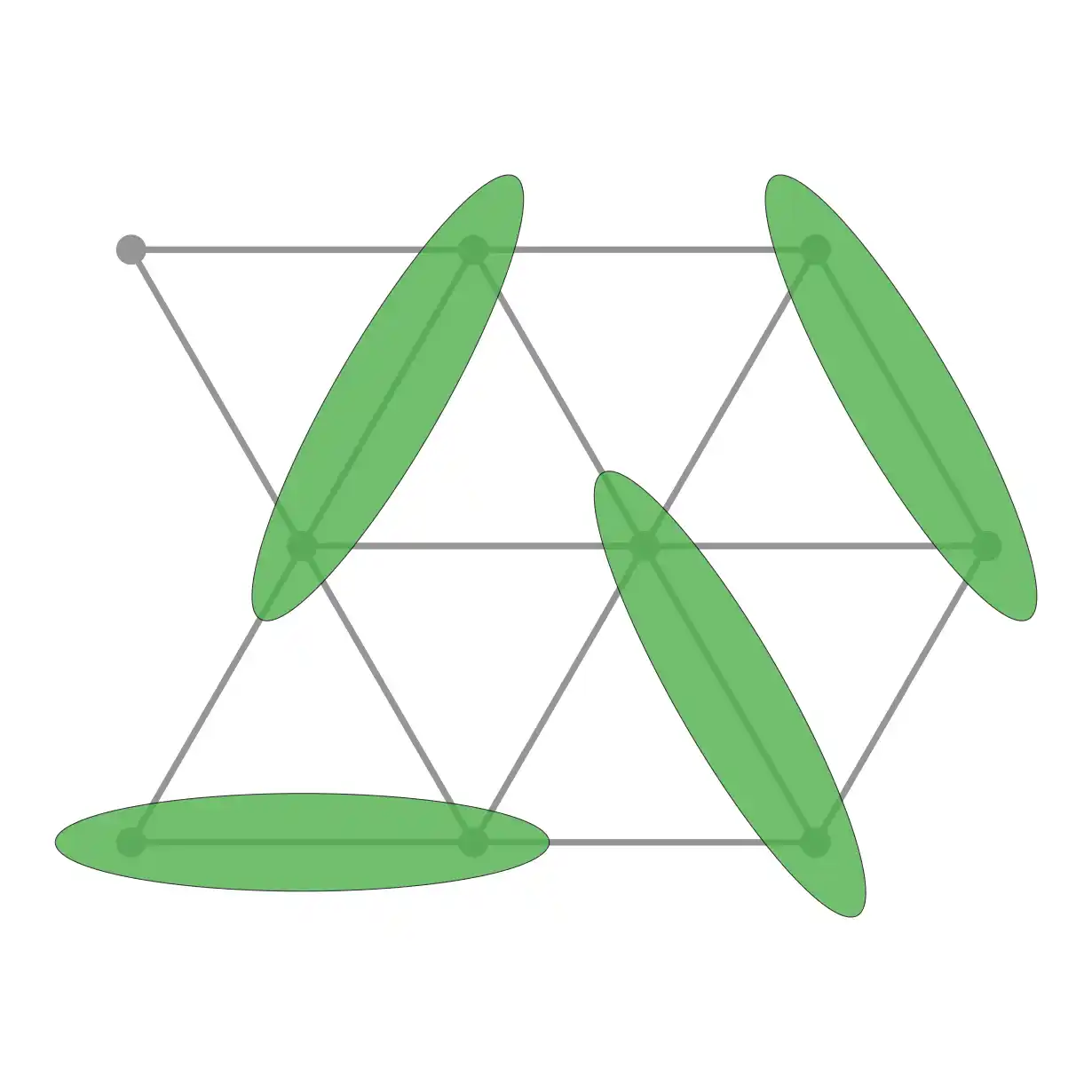
An illustration of the lattice examined by Phil Anderson in the early '70s.

Finding the Elusive Quantum Spin Liquid by Taking the Road Less Traveled
December 7, 2023

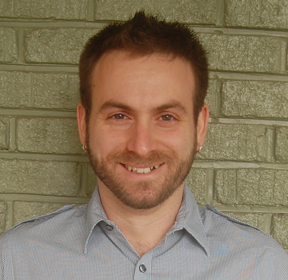
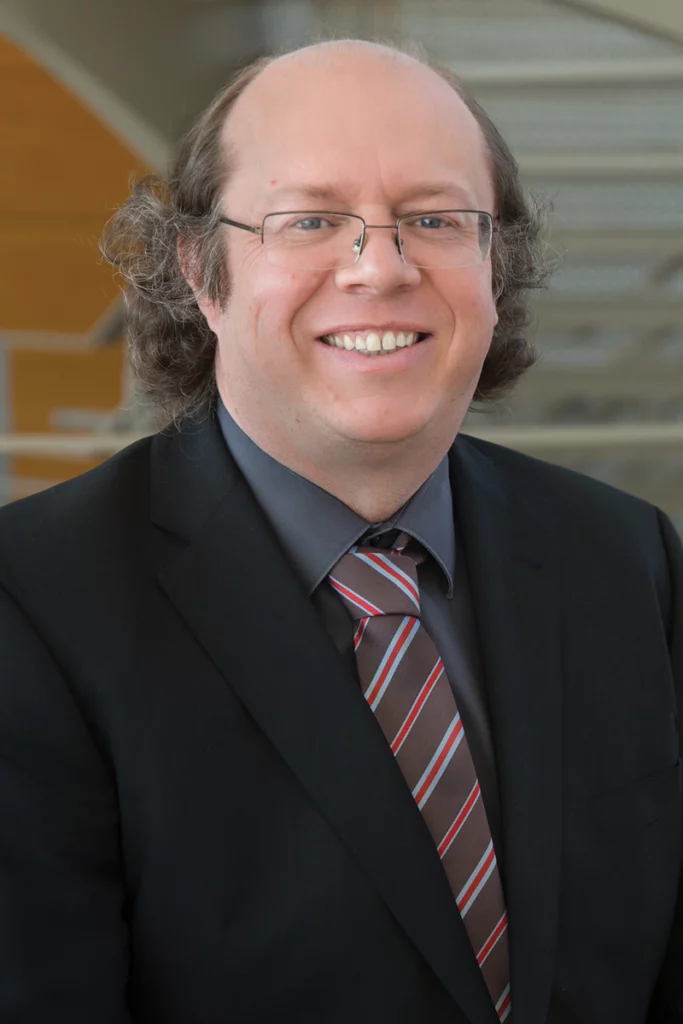
A photo of Alan Tennant
Tennant
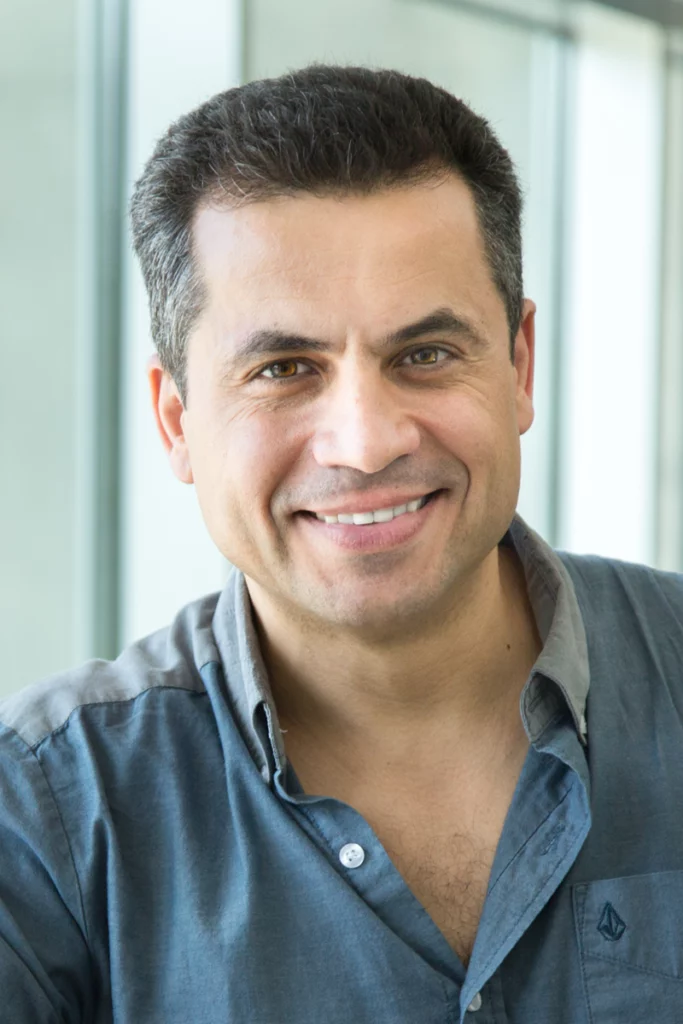
A photo of Cristian Batista
Batista

They couldn’t hide forever.

With combined expertise and sophisticated tools, scientists like UT’s Alan Tennant and Cristian Batista are revealing even the most well-concealed secrets of quantum materials.
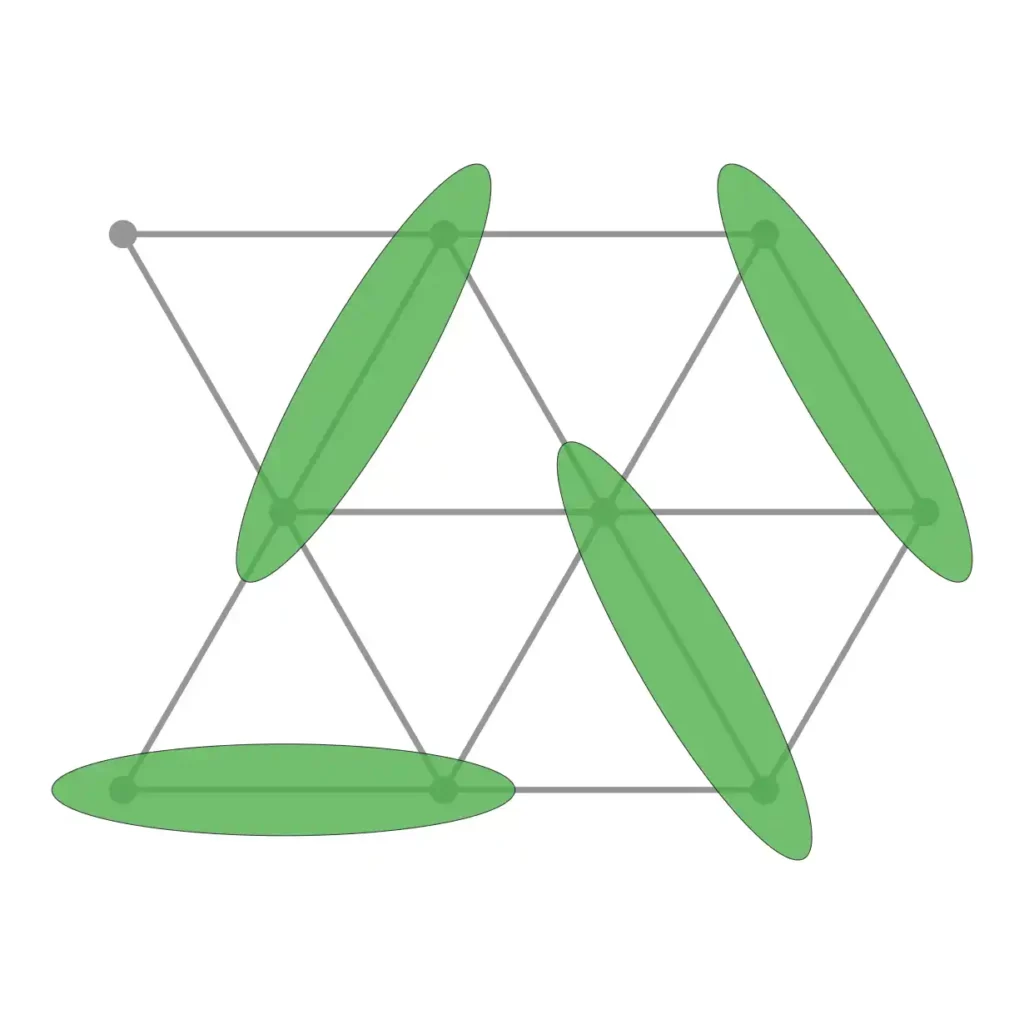
An illustration of the lattice examined by Phil Anderson in the early '70s.
An illustration of the lattice examined by Phil Anderson in the early ’70s. Shown as green ellipses, pairs of quantum particles fluctuated among multiple combinations to produce a spin liquid state. Credit: Allen Scheie/Los Alamos National Laboratory, U.S. Dept. of Energy (via ORNL)

Professors Tennant and Batista are part of the scientific team that confirmed the presence of quantum spin liquid (QSL) behavior in a new material: KYbSe2. QSLs are an elusive state of matter with a promising role to play in next-generation quantum information technologies. They’re also notoriously hard to find.

So what, exactly, is a QSL? It’s a bit of a magnetic outlier. Typical magnetic materials like iron or nickel arrange their magnetic moments (the source of their magnetic fields) in an ordered pattern. Things are messier and a bit more free-flowing in QSLs (hence “liquid” in the name). Here, magnetic moments exist in a highly entangled, fluctuating state. To complicate the picture, QSLs also come with exotic quasiparticles, which aren’t actually particles but instead are the collective behavior of particles in close quarters. All this makes it extraordinarily difficult to locate a QSL state in a material.

Tennant and Batista were joined by a collaboration of scientists from national laboratories, universities, and institutes to track down a QSL by taking the road less traveled. Many studies go searching for these exotic states by looking for what’s not there: missing magnetic order, for example. They decided instead to look for what they call “positive evidence”—a highly-entangled state or exotic quasiparticles. They found both in a material comprising potassium, ytterbium, and selenium by using powerful neutron science facilities at Oak Ridge National Laboratory and combined theorical, experimental, and computational resources. The findings were published in Nature Physics.

The teamwork approach to solving problems is nothing out of the ordinary for Tennant and Batista, both of whom are part of UT’s research cluster on Quantum Materials for Future Technologies, the Shull Wollan Center, and the Quantum Science Center (which is one of five US National Quantum Information Science Centers run by the Department of Energy). Each of these initiatives pools resources to solve complex problems and draws on the unique convergence of scientific talent and tools in East Tennessee.

As Tennant pointed out, “Quantum problems like these are too hard for individual researchers to solve alone. The combination of the best research facilities with forefront researchers is vital and East Tennessee is starting to be recognized as a leader for this kind of team science.”


December 7, 2023  |  Filed Under: Condensed Matter, Featured News, News

A photo of Abhyuday Sharda

In Search of the Beautiful and Unexpected

December 4, 2023

Abhyuday Sharda Wins JLab Fellowship

Abhyuday Sharda likes an open question. For him, that’s where the real beauty of science lies. His search for answers will be supported this academic year with a new graduate fellowship from the U.S. Department of Energy’s Thomas Jefferson National Accelerator Facility, commonly known as JLab.

Sharda is a graduate student who’s been working with Professor Nadia Fomin since 2022.

Abhyuday Sharda
Abhyuday Sharda

“What I am working on in JLab is studying the structure of the atomic nucleus,” he explained. “The nucleus is more than 99 percent of the visible universe by mass but it is not completely understood. My research is an attempt to understand how protons and neutrons (and their underlying quark distributions) change when inside the nucleus as compared to a free proton or a neutron. We do this by scattering energetic electrons off of nuclei. The way they scatter allows us to infer information about the nucleus.”

With his experimental component complete, Sharda said he’s now analyzing data, the results of which he said are anticipated by the hadronic physics community in general. The JLab graduate fellowship (one of nine granted this year) will support this work, which Fomin pointed out has been rated as high-priority and high-impact by JLab’s Program Advisory Committee.

Going Beyond the Familiar

Sharda’s hometown is Delhi, India, and he traveled across the globe to UT to earn a master’s degree in physics. He said he had such a positive grad school experience he decided to stay on for a PhD. Nuclear physics in particular speaks to his wide-open view of science, and the world in general.

“What I find interesting about it is that the atomic nucleus can be called the building block of the matter in the universe, yet we don’t completely understand it,” he said. “Any open question in physics often leads to beautiful and unexpected discoveries.”

This willingness to embrace the unknown underlies Sharda’s personal philosophy about what science can achieve, summed up nicely by one of his favorite quotes (from Physicist Lisa Randall):

“In the history of physics, every time we’ve looked beyond the scales and energies we were familiar with, we’ve found things that we wouldn’t have thought were there. You look inside the atom and eventually you discover quarks. Who would have thought that? It’s hubris to think that the way we see things is everything there is.”

December 4, 2023  |  Filed Under: Featured News, News, Nuclear

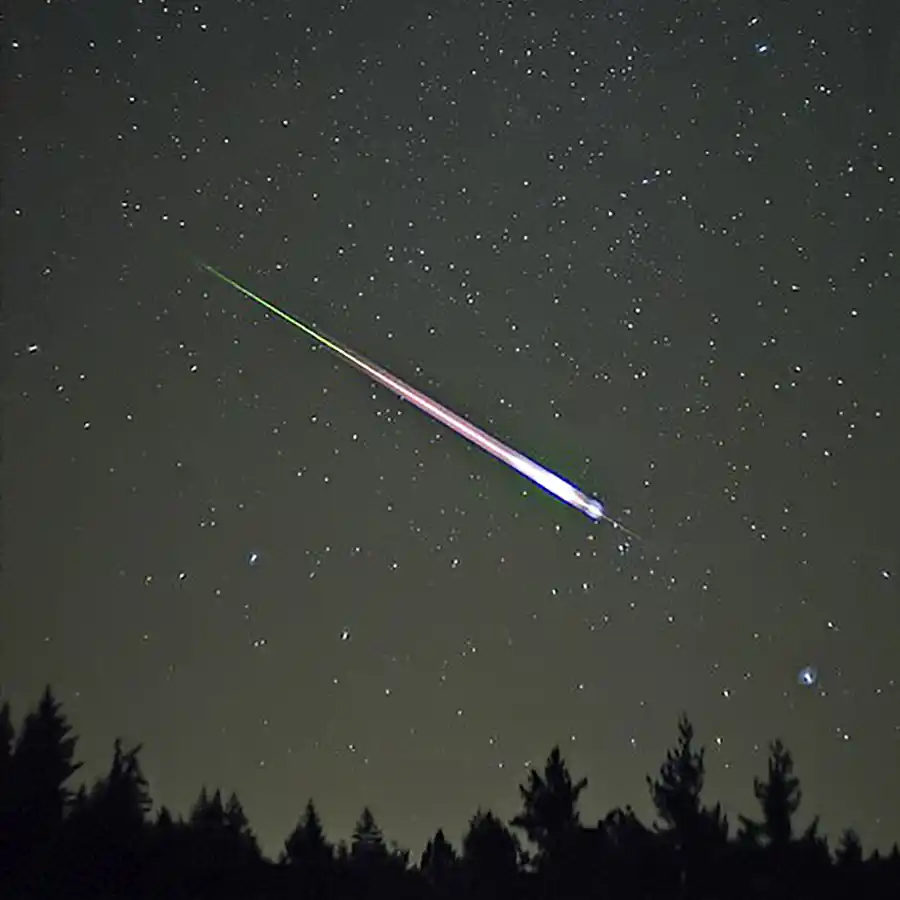
Leonid Meteor Shower (credit: Navicore)

Watch the Leonids Roar in at John Sevier’s House

November 8, 2023

Leonid Meteor Shower (credit: Navicore)

Grad Students Coordinate November 18 Viewing at the Marble Spring Historic Site

In a fitting tribute to Governor John Sevier’s pioneer spirit, his home is hosting explorers looking to learn more about the universe where we live.

The Marble Springs State Historic Site is the last home and farm of Tennessee’s first governor and welcomes night sky fans on November 18, when UT Physics graduate students will explain and coordinate viewing of the Leonid Meteor Shower. The event gets underway at 7 PM and lasts until 11 PM. Marble Springs will have firepits out for s’mores and warmth, so bring blankets, telescopes, questions, and your astronomical enthusiasm.

This is the third astronomy presentation at Marble Springs this year: in April the site opened their green space as part of World Astronomy Month and Earth day celebrations. On August 25 they hosted an ice cream social followed by an evening of stargazing. Physics graduate students Michael Benjamin, Adam Cole, Donnie Hoskins, Jordan Jubeck, Ashwin Nagarajan, and Colter Richardson shared their insights and set up telescopes to help amateur astronomers navigate the night sky.

“This most recent event had us providing a night sky talk to a group of about 140 people from around the Knoxville area,” Richardson explained. “We had two telescopes, some binoculars, and then hosted some by-eye viewings. In all cases the physics graduate students were talking with community members and providing mini sky lectures.”

Students will reprise these roles at the November event. Richardson said Marble Springs is a great spot for stargazing because the skies are much darker than around campus but not too far from downtown Knoxville.

The events began when Danielle Sherrell, education and programming coordinator for the Marble Springs site, reached out to her former classmate (and current physics graduate student) Donnie Hoskins about community engagement. He spoke to Richardson and the astronomy outreach program got rolling. The students hope to grow their ranks to host more regularly scheduled events, but for now, be sure to mark your calendar and review event details for November 18! You can also RSVP here.

November 8, 2023  |  Filed Under: Astronomy, Featured News, News

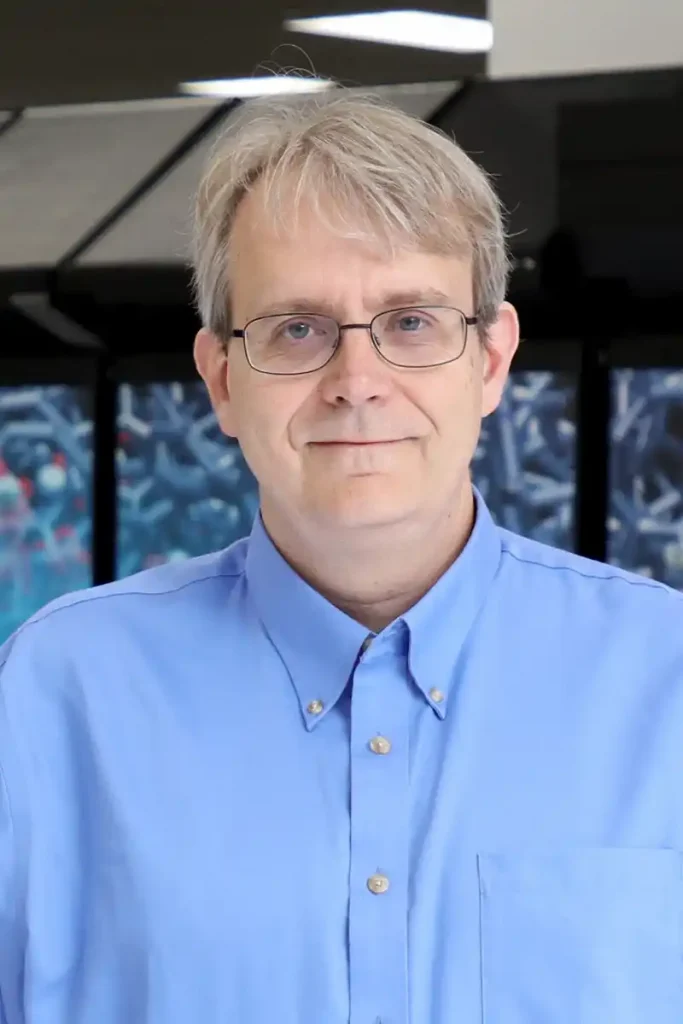
A photo of Raph Hix

Raph Hix Elected APS Fellow

October 19, 2023

A photo of Raph Hix
Hix

Star-Stuff, Indeed

We are made of star-stuff, Carl Sagan said in the Cosmos TV series.

William Raphael (Raph) Hix knew that quote. As a high school kid in Maryland he’d taken advanced physics and chemistry. He’d watched Cosmos and heard Sagan talk about stars and elements. But something changed when he encountered this concept in one of his college astronomy textbooks. It took on a gravitas that has captivated him ever since, leading him to climb inside stars (theoretically) to see how the stuff that makes us—carbon, iron, etc.—came to be.

For his “contributions to understanding explosive thermonuclear burning and nucleosynthesis, particularly in contexts like supernovae,” Hix, a UT-Oak Ridge National Laboratory joint faculty professor, has been elected a Fellow of the American Physical Society. This honor is bestowed on only one half of one percent of the Society’s membership each year. Hix is one of 153 Fellows in the 2023 cohort and the second UT physicist elected in the past two years.

Adrian Del Maestro, UT Physics Professor and Department Head, had high praise for the department’s newest APS Fellow.

“Dr. Hix is exemplary of the unique and visionary researchers that bridge the University of Tennessee and Oak Ridge National Lab as joint faculty,” he said. “He is a driving force behind our astrophysics program and is a sought-after mentor and teacher, involving both graduate and undergraduate students in his cutting-edge research on stellar evolution.”

Late Bloomers

Hix is interested in how the chemical elements are made, or nucleosynthesis. The Big Bang gave us hydrogen, helium, and lithium. Since then, nuclear reactions accompanying the life and death of stars have created most of the other elements. As it turns out, stars are late bloomers.

“Most of the elements get made at the end of a star’s life,” he said.

Stars run on the fusion of hydrogen into helium for most of their lives. Hix explained that as a star begins to run out of fuel, temperatures go up and conditions become more extreme. That’s when the heavier elements, like carbon and iron, are made. Once the fuel is exhausted, an ordinary star (like our Sun) violently expels its outer layers, including elements made late in its life, and becomes a white dwarf. For more massive stars, like Betelgeuse, Rigel and Antares, the exhaustion of fuel leads to a supernova—sending those recently made elements into the cosmos—while the stellar core collapses, leaving a neutron star or a black hole.

With colleagues at ORNL and UT, Hix develops sophisticated models to understand how all this works. He leads ORNL’s Theoretical and Computational Physics group, utilizing some of the national lab’s powerful tools, like Summit and Frontier.

“We use the biggest supercomputer we can to model as much physics as possible within the intricate workings inside a star that we (then) blow up,” he said.

The results become part of a chain of handing off data—ultimately going to scientists who use telescopes to see if the model holds up to observation. Hix explained this is how they prove their models are accurate.

“It’s a way to climb inside a star and see the parts that are ordinarily hidden from view,” he said.

When Everything Was Cool and New

Hix finished undergraduate studies at the University of Maryland at College Park, where he re-discovered Sagan’s quote and graduated with bachelor’s degrees in physics and astronomy as well as math. He earned AM and PhD degrees in astronomy at Harvard University. Following a postdoctoral appointment at the University of Texas, he came to UT in Knoxville. He began as a postdoc, became a research professor, and then in 2004 moved (without moving) to ORNL. In 2010, he rejoined the UT faculty with a joint faculty appointment.

In his case, he explained, being joint faculty means that he’s an ORNL astrophysicist and the university subcontracts half of his time to teach courses (like Honors Introductory Astronomy) and supervise students. Hix said he really enjoys working with undergraduates. He loves seeing how excited they are when they come to the national lab and have an office for the summer. He likes being reminded, he said, “of that time in my career when everything was cool and new and interesting.”

About APS Fellows

The APS Fellowship Program was created to recognize members who may have made advances in physics through original research and publication, or made significant innovative contributions in the application of physics to science and technology. They may also have made significant contributions to the teaching of physics or service and participation in the activities of the Society.

Raph Hix is the 10th APS Fellow on UT’s current faculty.

October 19, 2023  |  Filed Under: Featured News, News, Nuclear

Taylor Sussmane Photo

In My Own Words: Undergraduate Taylor Sussmane

September 14, 2023

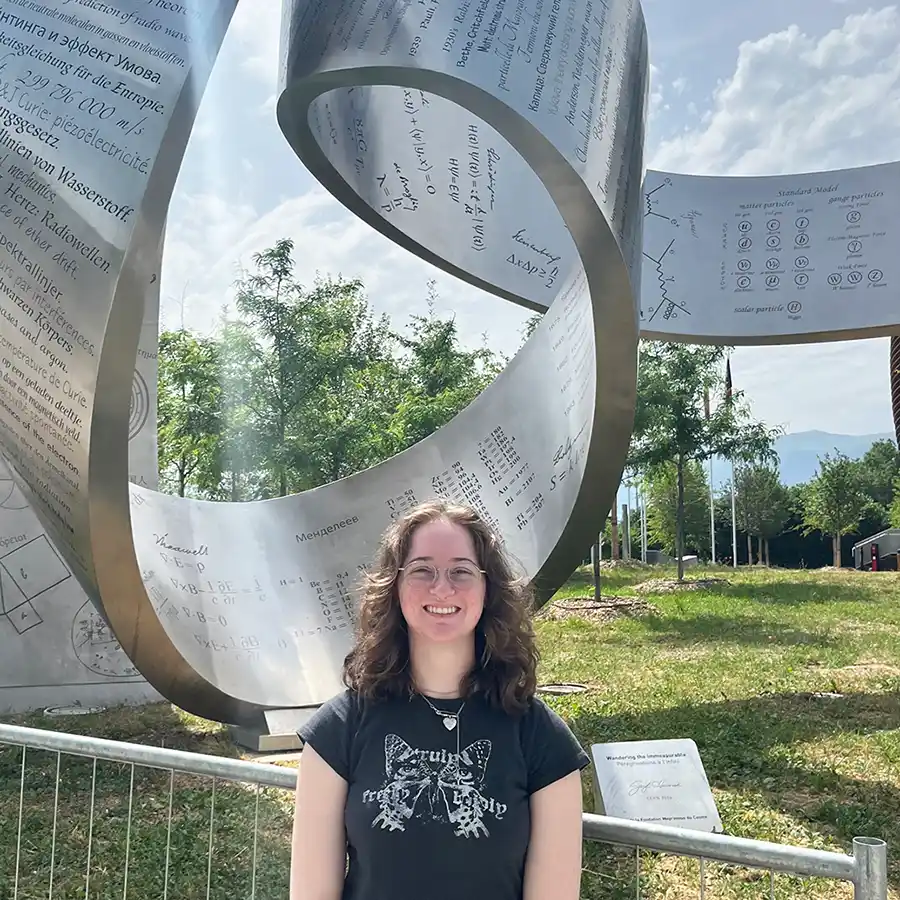
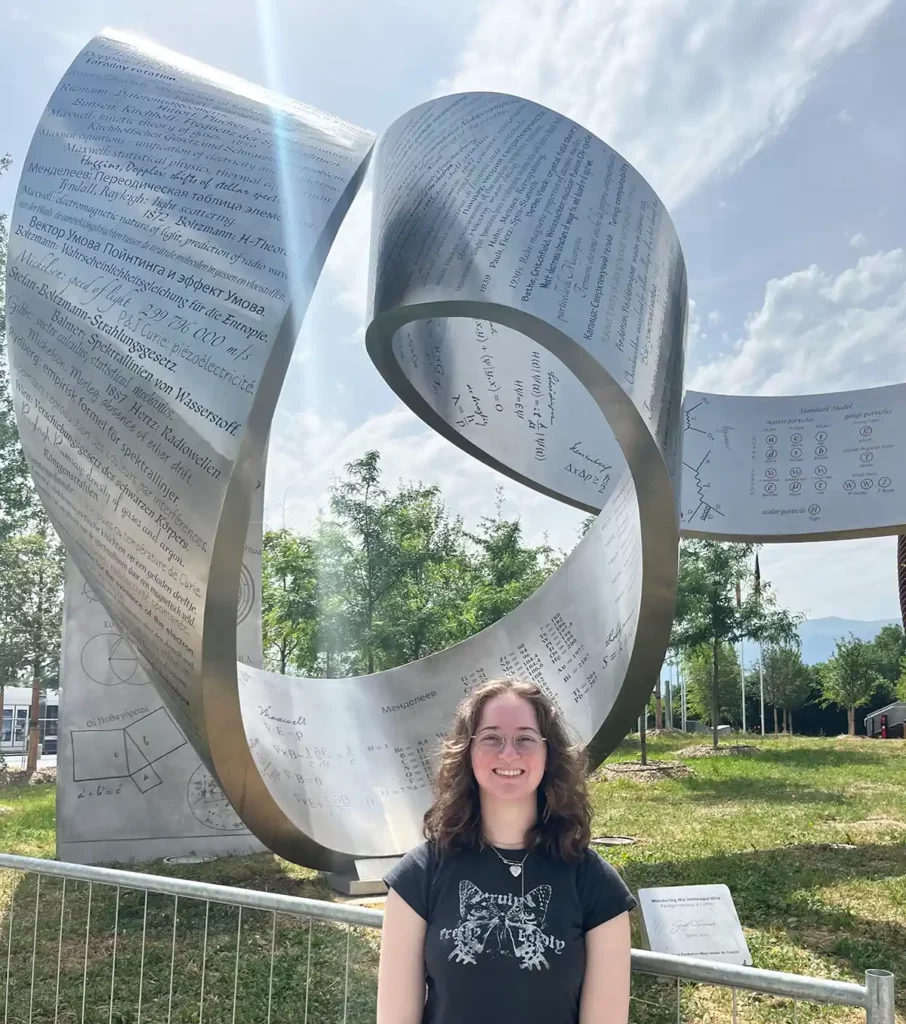
Photo: Taylor in front of "Wandering the Immeasurable," a sculpture designed by Gayle Hermick that welcomes CERN visitors. From the Mesopotamians' cuneiform script to the mathematical formalism behind the discovery of the Higgs boson, the sculpture narrates the story of how knowledge is passed through the generations and illustrates the aesthetic nature of the mathematics behind physics. (Description Credit: ATLAS experiment)
Photo: Taylor in front of “Wandering the Immeasurable,” a sculpture designed by Gayle Hermick that welcomes CERN visitors. From the Mesopotamians’ cuneiform script to the mathematical formalism behind the discovery of the Higgs boson, the sculpture narrates the story of how knowledge is passed through the generations and illustrates the aesthetic nature of the mathematics behind physics. (Description Credit: ATLAS experiment)

Taylor Sussmane, Undergraduate Physics Major

Hometown: Knoxville, Tennessee

Class of 2024

Undergraduate Taylor Sussmane spent the summer in Geneva working at CERN, home to the world’s largest and most complex scientific instruments dedicated to studying fundamental particles. She worked on the ATLAS experiment, which uses the largest detector ever constructed for a particle collider. Taylor was looking at the possibility of measurements that might further explain the Higgs Mechanism and therefore the electroweak theory, which unifies two of the four fundamental forces (the weak force and the electromagnetic force). She won support from the National Science Foundation Research Experiences for Undergraduates (REU) program via the University of Michigan.

Over the summer, I got the opportunity to do research at CERN through the University of Michigan REU program.

I was working on an ATLAS project studying the plausibility for a measurement of longitudinally polarized gauge bosons produced in VBF (Vector Boson Fusion) events. Because the longitudinal polarization state arises from the Higgs Mechanism, studying this state could answer some remaining questions about the Higgs Mechanism. Specifically, we wanted to study the energy dependence of the production cross section, which can tell us about the Goldstone Boson Equivalence Theorem in the domain of single gauge boson production.

In My Own Words Logo

I worked on this project under the advice of Dr. Philip Sommer, a visiting researcher at CERN. During the summer, I also attended the CERN Summer Student Lectures, where I learned about a wide range of topics relating to research done at CERN. Topics included high energy physics, antimatter studies, heavy ion physics, detector physics, and more. I definitely learned a lot while I was there! Overall, it was a fantastic summer of learning valuable career skills, lounging by Lac Léman, and eating too much Swiss chocolate.

September 14, 2023  |  Filed Under: Featured News, News, Particle

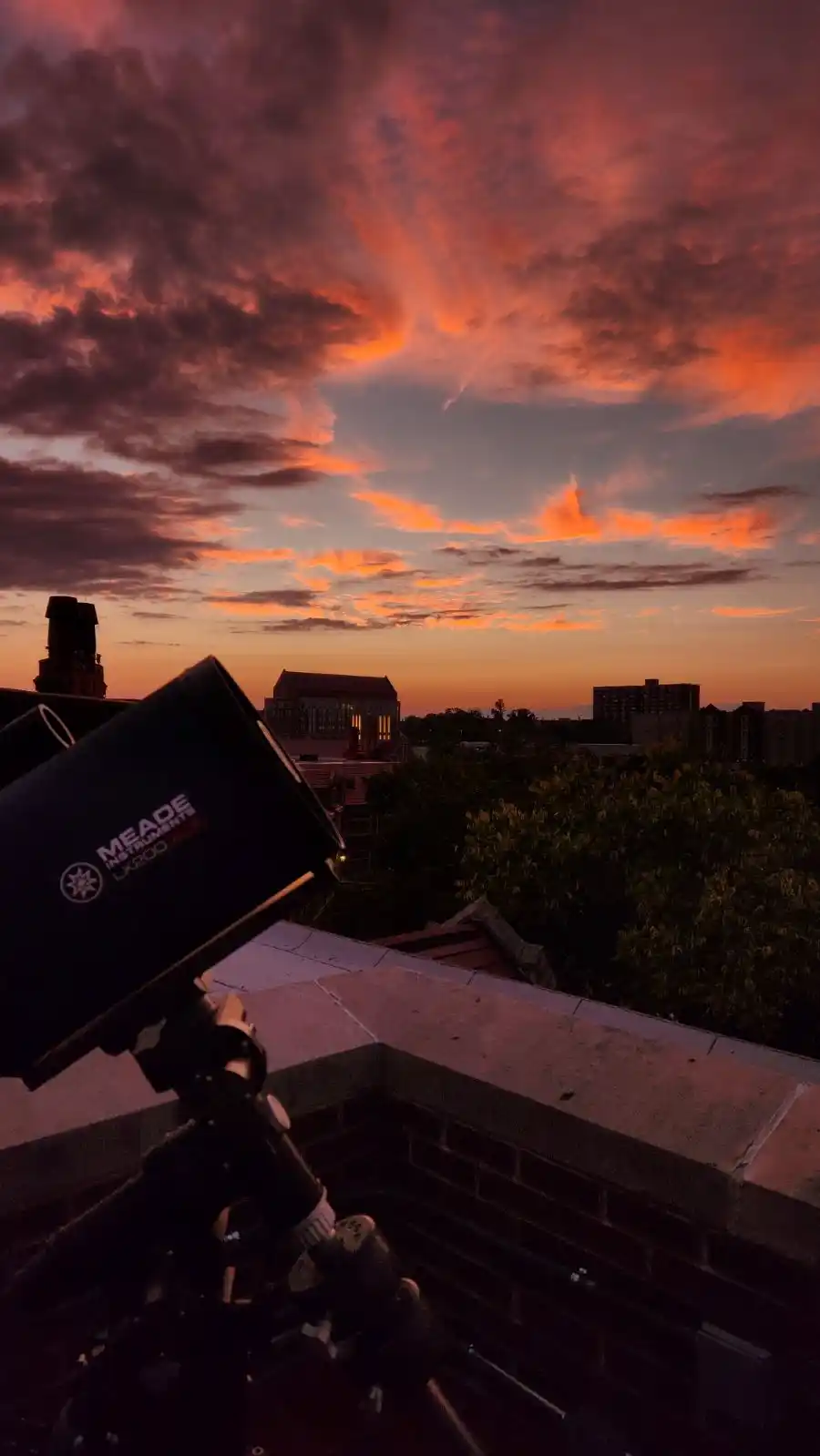
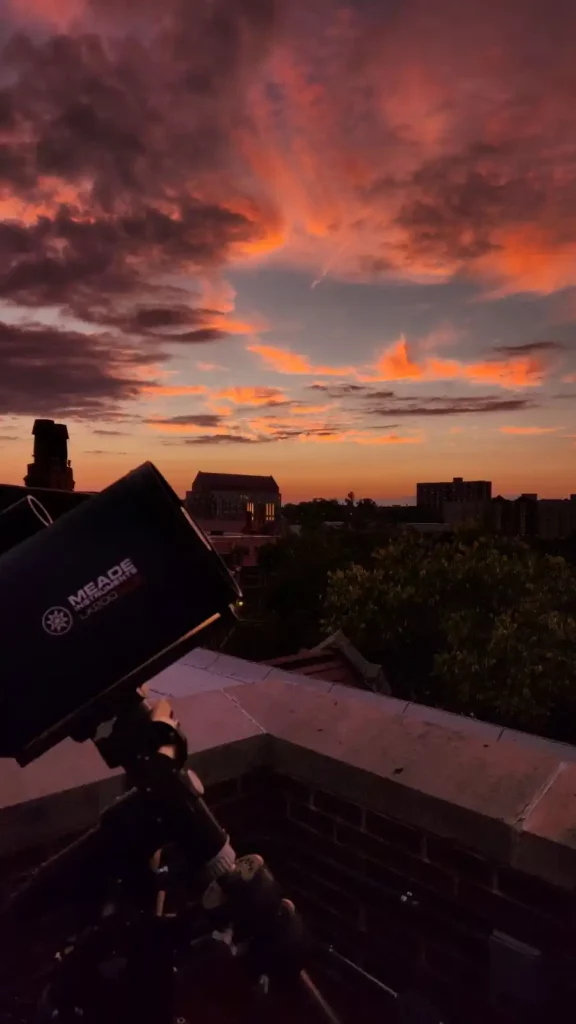
A photo of a telescope on the Nielsen Rooftop with a gorgeous sunset colored sky.

Rooftop Viewing Returns!

August 31, 2023

A photo of a telescope on the Nielsen Rooftop with a gorgeous sunset colored sky.

Time to hit the roof! After some spiffing up we’re ready for the return of Nielsen rooftop public viewing on the first and third Fridays of every month (weather permitting). Join us this Friday, September 1, at 9:30 PM, when we’ll be looking at Saturn, deep-sky objects, and the moon. We are located on the The Hill off Cumberland Avenue between 13th Street and Phillip Fulmer Way. Parking is available in the Volunteer Hall Parking Garage on White Avenue. (Some handicapped parking is available in front of the Nielsen Physics Building.) (Photo courtesy of Paul Lewis.)

August 31, 2023  |  Filed Under: Astronomy, Featured News, News

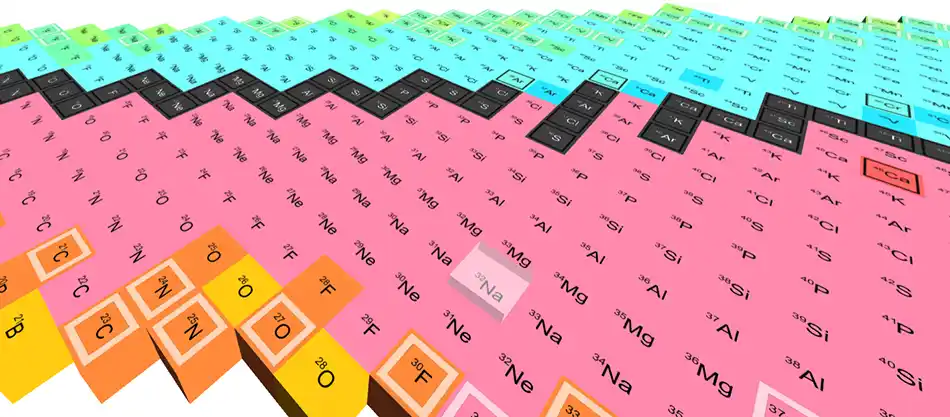
A snapshot of the Chart of the Nuclides with sodium-32 highlighted (Credit: Ed Simpson, Australian National University Research School of Physics.)

Shape-Shifting Nuclei

August 22, 2023

A snapshot of the Chart of the Nuclides with sodium-32 highlighted (Credit: Ed Simpson, Australian National University Research School of Physics.)
A snapshot of the Chart of the Nuclides with sodium-32 highlighted (Credit: Ed Simpson, Australian National University Research School of Physics.)

What determines the shape of a nucleus? UT’s physicists played a key role in recently-reported findings that shed new light on that mystery. Their dedicated work to develop and deploy a sophisticated yet nimble detection system was central to an Oak Ridge National Laboratory-led study of how nuclear shapes evolve. The unexpected results could point to a deeper understanding of how nuclei stay together and how elements form.

Shape Shifters

Nuclei typically appear as spherical or deformed (football-like). Some can shift their shape depending on their energy level— deformed at higher energy (excited state) and spherical at low energy (ground state). The reverse (deformed at low energy; spherical at high energy) has been harder to pin down, especially in regions of the nuclear landscape where little experimental data is available.

In this work, scientists found that a sodium-32 nucleus has an exceptionally long-lived excited state, also known as an isomer. This nucleus sits at the heart of the “island of inversion,” where previous experiments have documented spherical-to-deformed shape reversal. Isomers can help probe nuclear structure, and the one observed in sodium-32 is a rare microsecond isomer in this particular area of the nuclide chart. It can provide a window into the underlying conditions where the spherical-to-deformed transition begins.

The analysis is based on data collected from the very first experiment at the Facility for Rare Isotope Beams (FRIB)—specifically the FRIB Decay Station Initiator (FDSi). This is Professor Robert Grzywacz’s home office, so to speak, as he and his group have invested years in this sensitive, modular detector system, starting with the plans on paper and now actually “catching” the fragments of a rare isotopes created by FRIB’s powerful linear accelerator and measuring their decay.

“We poured an enormous amount of work into this experiment,” he said. “It had to succeed.”

Getting an Early Start

While the observation of the sodium-32 isomer is new, the premise is not. As a graduate student Grzywacz was a lead author on papers outlining a novel method suited to scanning large swaths of the nuclear chart in search of new isomers. His work eventually led him to Tennessee, where in 1998 he became a postdoctoral fellow at UT and in 2003 joined the faculty.

Since then he’s built a talented nuclear physics team of fellow faculty, students, and staff. These latest findings are outlined in Physical Review Letters and UT Physics co-authors include Grzywacz as well as Miguel Madurga (assistant professor); Zhengyu Xu and Kevin Siegl (postdoctoral research associates), Noritaka Kitamura (postdoctoral research associate, now assistant professor at University of Tokyo); Joseph Heideman, Shree Neupane, and Maninder Singh (PhD alumni); Ian Cox and James Christie (graduate students); Harrison Huegen and Amanda Nowicki (undergraduates); and Jason Chan (Electronics Shop Supervisor).

Learn more about the results at Oak Ridge National Laboratory’s website.

With thanks to Dawn Levy of Oak Ridge National Laboratory.

August 22, 2023  |  Filed Under: Featured News, News, Nuclear

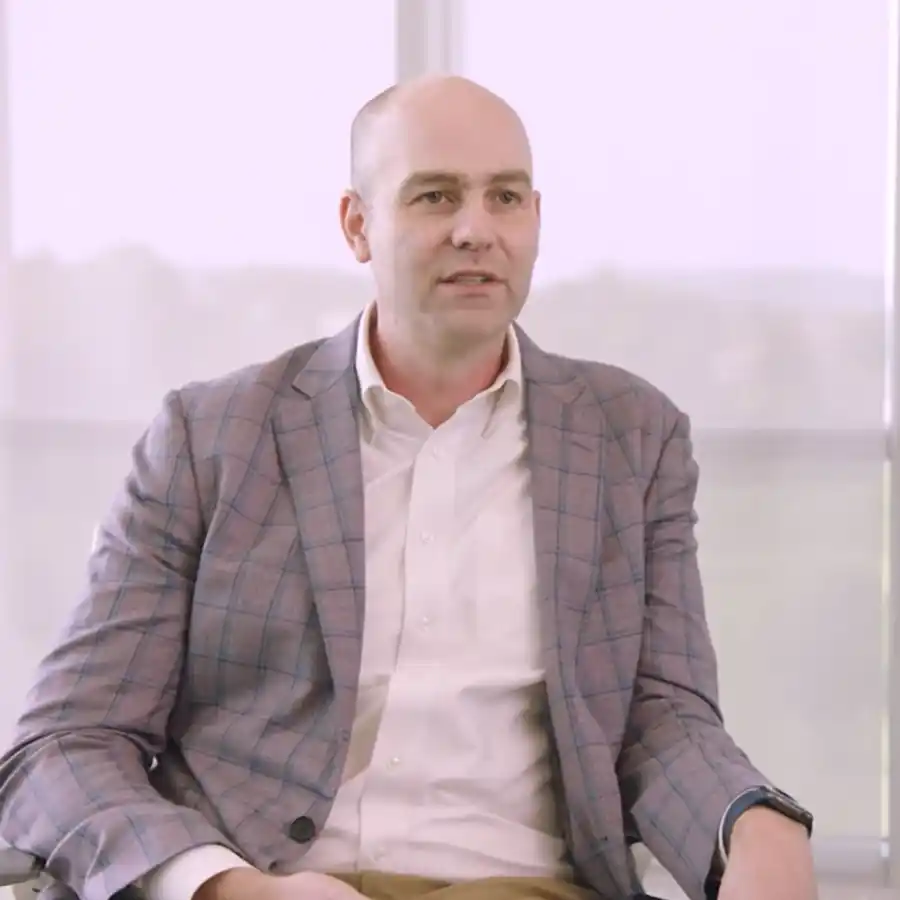
A photo of Del Maestro from the YouTube video announcing new Center for Advanced Materials and Manufacturing

UT Wins NSF Funding for the Center for Advanced Materials and Manufacturing

June 27, 2023

A photo of Alan Tennant
Tennant
Del Maestro

Lightning in a Bottle

Physics faculty will play key roles in a new National Science Foundation Materials Research Science and Engineering Center (NSF MRSEC) set to discover, design, and develop materials that will transform science and industry.

UT won $18 million for the Center for Advanced Materials and Manufacturing (CAMM), one of nine new MRSECS announced June 26. The NSF announcement said the investment “will drive the creation of advanced materials capable of remarkable things—from being tough enough to withstand the heat of a fusion reactor to processing information at the quantum level.”

CAMM has two major initiatives: using artificial intelligence to tame the complexity of quantum materials and building new materials that can operate in extreme conditions.

Physics Professor Alan Tennant will serve as CAMM’s director, while Professor and Department Head Adrian Del Maestro will lead the quantum materials initiative. Del Maestro explained the heart of the work is unlocking the properties of quantum mechanics—the incredibly complex interactions and entanglement between individual electrons or constituents.

UT Announces the new Center for Advanced Materials and Manufacturing

“That can have implications for sustainable energy, for quantum communication, (and for) national security concerns,” he said. “There’s a real need for new types of materials, for example, that can operate in these extreme conditions. Think about things like the center of nuclear reactors. And so advances there could have a really immediate effect on people’s day-to-day life.”

In the past three years the university has built an impressive roster of expertise in quantum materials and artificial intelligence with the Quantum Materials for Future Technologies cluster. With new hires joining faculty already in place, this team includes 13 members from the physics department, many (like Tennant and Del Maestro) with joint appointments in the Tickle College of Engineering.

“CAMM is a model for interdisciplinary research and innovation,” Tennant said. “We are leveraging all the capabilities we have to advance the materials frontier while also developing our nation’s future leaders in these areas. And by working with companies like Lockheed Martin, Volkswagen and Eastman, and launching new high-tech start-ups like SkyNano that will co-locate with us here in Knoxville, we are ensuring that our innovations create economic opportunities for Tennesseans.”

As Del Maestro said, “I think we managed to kind of get this lightning in a bottle. All the pieces fit together. (This) is the right place to do this work.”

June 27, 2023  |  Filed Under: Condensed Matter, Featured News, News

A photo of Kate Jones

A New Divisional Dean and Outstanding Staff: Physics News from Arts & Sciences

June 23, 2023

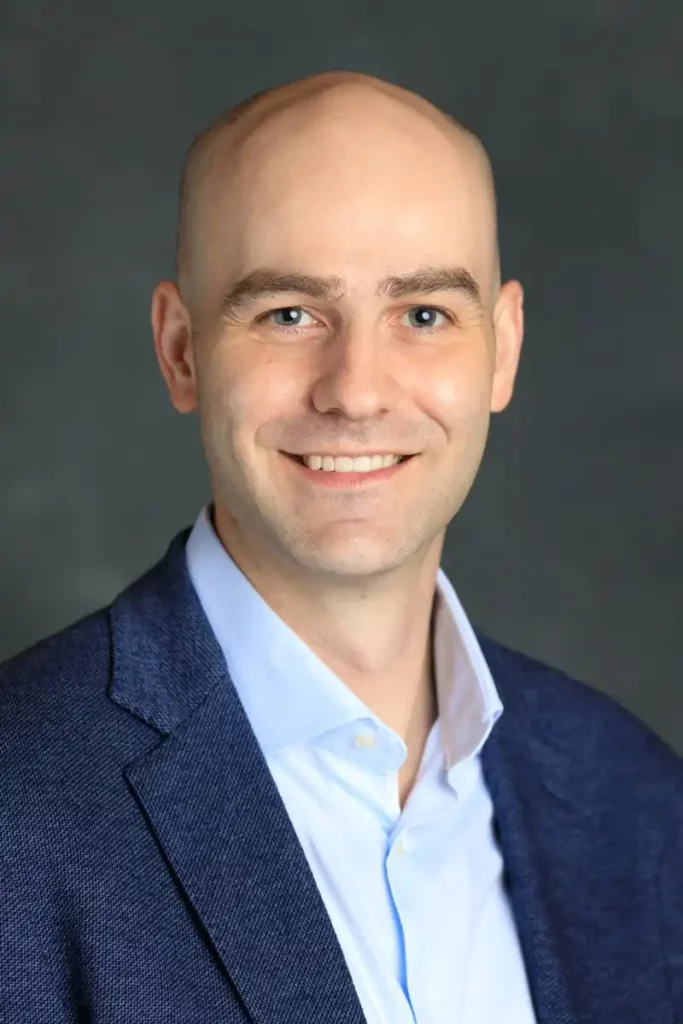
Jones
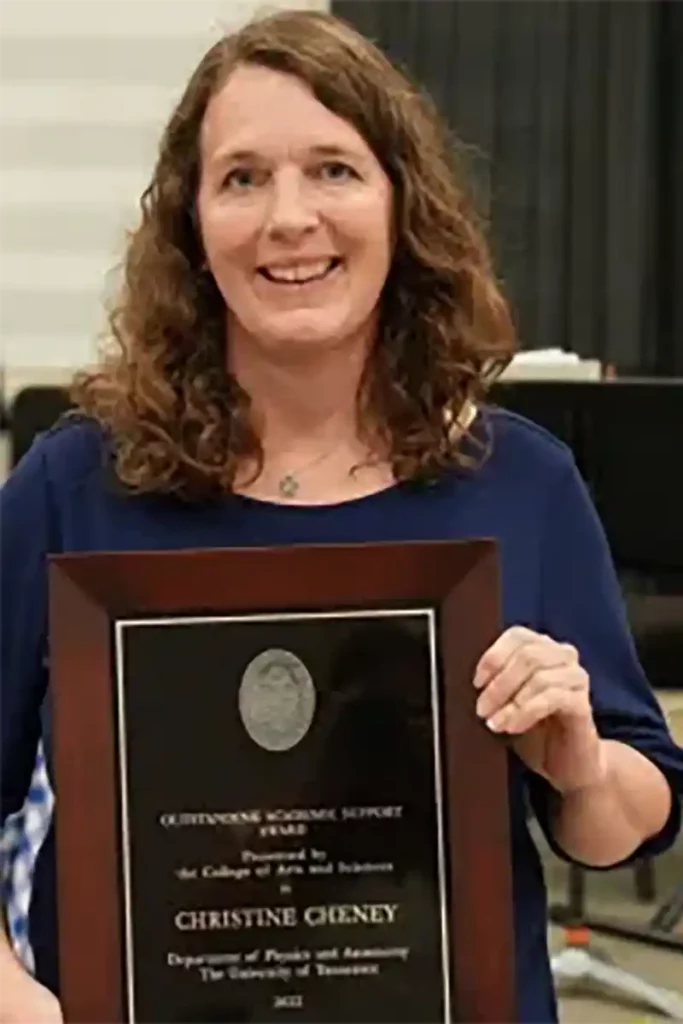
Cheney
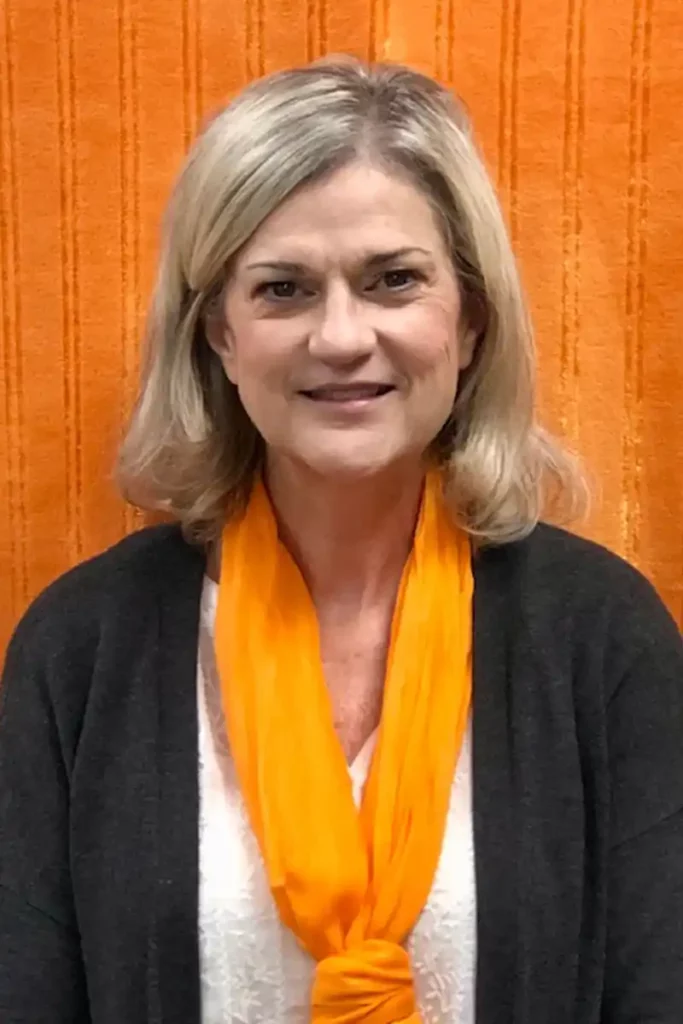
A photo of Showni Medlin Crump
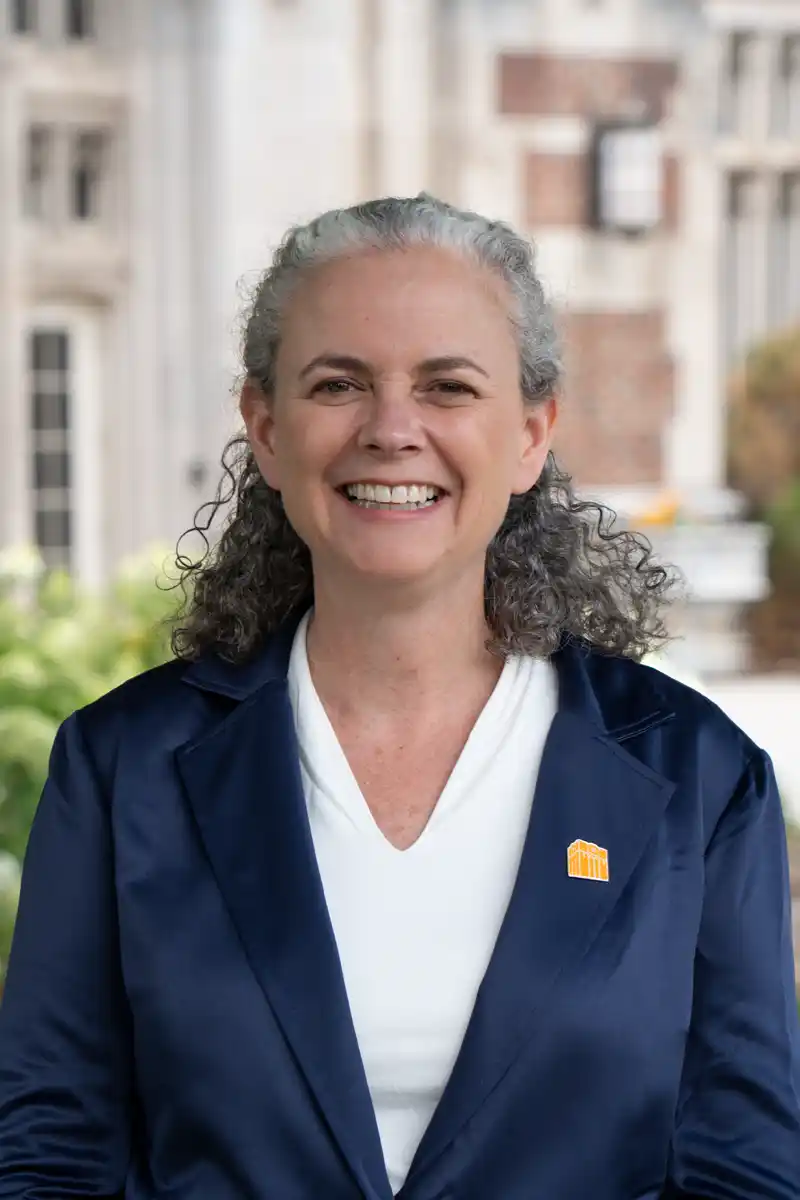
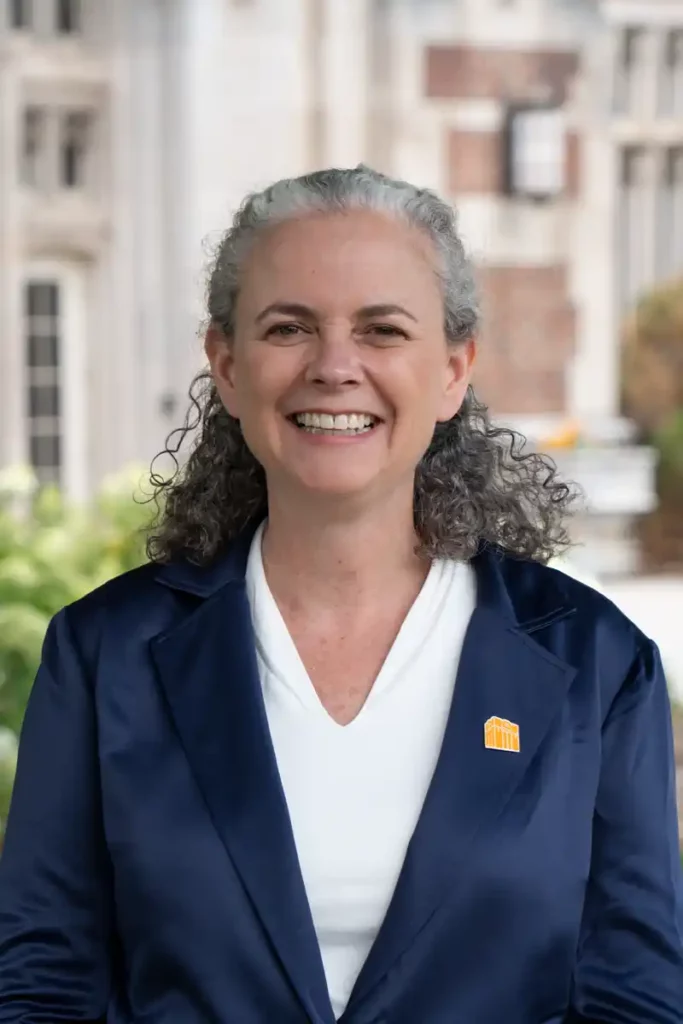
Medlin-Crump

The Department of Physics and Astronomy features prominently in the latest news from the College of Arts & Sciences.

Professor and Associate Department Head Kate Jones will serve as the inaugural divisional dean for natural sciences and mathematics in the UT College of Arts and Sciences.

“I am thrilled to be joining the college leadership,” Jones said. “Transformations can be challenging, and the college is currently undergoing a significant one. My focus will be on ensuring this process is as smooth as possible and listening to the needs of the departments in the natural sciences and mathematics.“

Christine Cheney, director of undergraduate laboratories, and Showni Medlin-Crump, office manager, both won academic support awards at the college’s annual staff appreciation event on June 15. These awards recognize staff members who have exhibited extraordinary academic support during the past academic year.

June 23, 2023  |  Filed Under: Featured News, News

A collage of awards recipients for 2023

Honors Day 2023

May 16, 2023

A collage of awards recipients for 2023

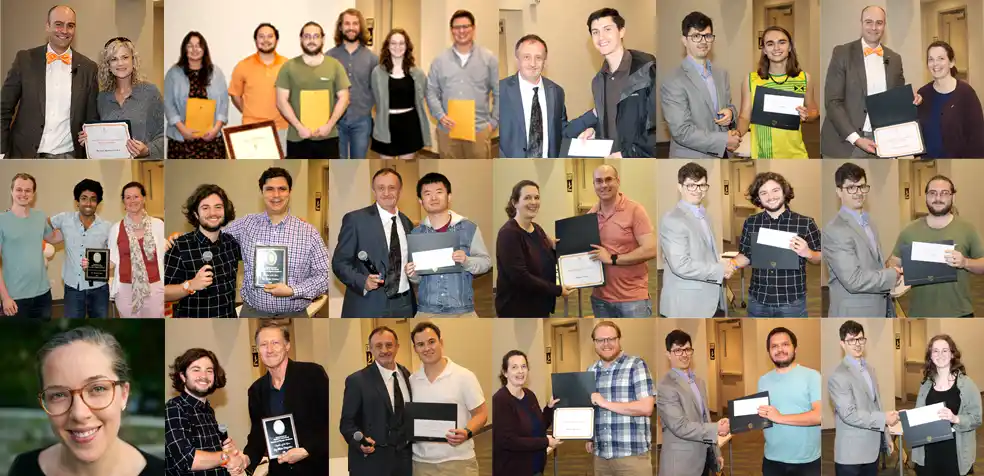
The department gathered on May 8 to celebrate physics students and faculty for outstanding research, academic achievement, leadership, service, teaching, and advising. We also inducted new members into Sigma Pi Sigma, the physics honor society. Professor and Head Adrian Del Maestro presented the staff awards, Assistant Professor Max Lavrentovich presented the undergraduate awards, Undergraduate Laboratory Director Christine Cheney presented the service awards, and Professor Norman Mannella presented the graduate awards. The Society of Physics Students and Graduate Physics Society announced their honorees for outstanding teachers and research advisors, and the festivities concluded with a picnic in front of Ayres Hall. Congratulations to all our 2023 honorees!

Extraordinary Departmental Service Award

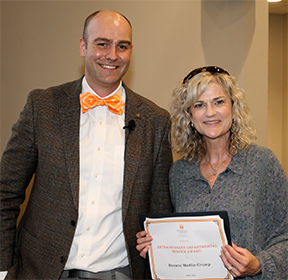
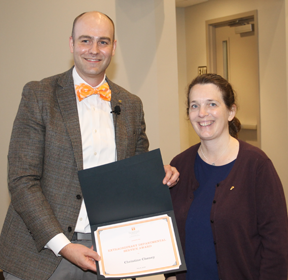
Showni Medlin-Crump and Christine Cheney

This is a new award for 2023 to recognize staff members for their many contributions to the department. The inaugural honorees were Office Manager Showni Medlin-Crump and Director of Undergraduate Laboratories Christine Cheney. Among a host of responsibilities, Showni juggles personnel issues for the entire department (from complicated faculty searches to adding undergraduates to payroll) and makes sure the main office runs smoothly. Christine played a key role in mitigating fallout from “the freeze and flood of 2022” to protect lab space and equipment.

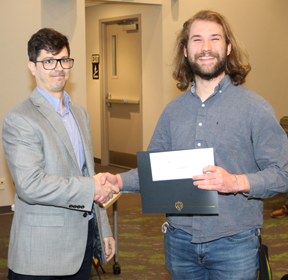
Adrian Del Maestro and Showni Medlin-Crump
Adrian Del Maestro and Christine Cheney

Outstanding First Year Physics Student

Dylan Stewart

Dylan Stewart is a Haslam Scholar and entered the program with academic credentials that placed him immediately into sophomore-level courses. He has consistently been at the top of his class in Physics 251 and 252 and has shown tremendous acumen in quantum physics and applications. He’s also part of the CMS research group.

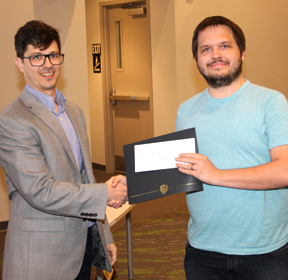
Dylan Stewart with Max Lavrentovich

Robert Talley Award for Outstanding Undergraduate Research

Gage Erwin

As a member of Professor Adrian Del Maestro’s group, Gage Erwin has been working toward realizing an atomically thin superfluid. His nomination reads that he has “excelled in his research role, diving into details, showing real ambition, motivation, and an ability to self-direct towards results.” He comes prepared for group meetings, works to consistently improve his physics understanding and skill set, and looks for connections between his coursework and research experience.

Gage Erwin with Max Lavrentovich

Robert Talley Award for Outstanding Undergraduate Leadership

William Greene and Taylor Sussmane

This year we had multiple great candidates for the Talley Leadership Award and chose two honorees who have devoted their time and energy to our student groups. These organizations give students the opportunity to participate in outreach activities, connect with professional resources, and forge friendships. William Greene has been extremely active in our Society of Physics Students, holding different offices and helping guide the group to another national Outstanding Chapter Award. Similarly, Taylor Sussmane has also been active in SPS and has helped revive our Women in Physics group.

William Greene with Max Lavrentovich
Taylor Sussmane with Max Lavrentovich

James W. McConnell Award for Academic Excellence

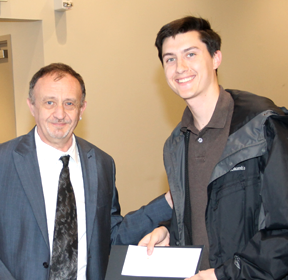
Lucas McBee

Lucas McBee has excelled in the classroom, particularly quantum mechanics, where his professor said his “ability of leveraging (mathematical) skills for understanding the physics is at another level.” He became interested in spin phenomena, linking theory to real observations which shows, as his nomination reads, that “he already thinks like a physicist.” This led to him joining the experimental condensed matter research program to provide theory support, where he applied for and won internal funding for his research. His nomination reads that “his deep understanding of the fundamental principles of physics and his ability to apply that to solve complex problems are extremely impressive.”

Lucas McBee with Max Lavrentovich

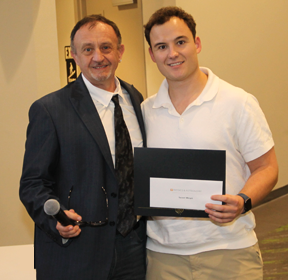
Douglas V. Roseberry Distinguished Upper Classman Major Award

Charles Bell

Charles Bell has worked on several projects across nuclear and particle physics; as well as across theory, phenomenology, and experiment. He’s completed an REU at Cornell University and his current research efforts are the basis for a paper to be submitted this summer. He has also served on the Community Connections Committee and has picked up tutorial center assignments where he’s needed. His nomination reads that “in all of his roles in the department, he holds himself with professionalism, curiosity, and grace. He is a model undergraduate student.”

Charles Bell with Max Lavrentovich

James E. Parks Award

Hannah Garrett

Hannah Garrett (Class of 2022) came to the rescue when the department was short-staffed this semester. Her nomination reads that “she always has a smile on her face no matter what is asked of her. She has done a great job as an astronomy, introductory physics, and optics TA. She has kept everything organized while being well prepared for teaching. She really cares about student learning.”

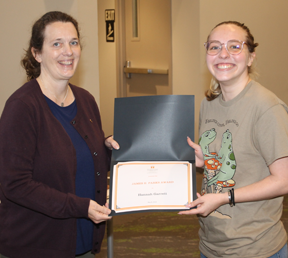
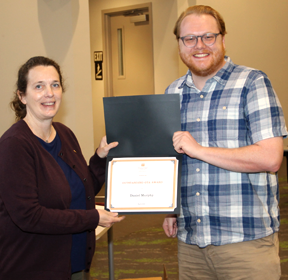
Hannah Garrett with Christine Cheney

Outstanding Graduate Teaching Assistant Award

Daniel Murphy

Daniel Murphy’s nomination describes him as an outstanding astronomy GTA. From his first semester with the astronomy team, he has garnered the respect of his students. He is a natural teacher, and many students have benefited from that. He provides wonderful introduction to the labs, listens to and interacts with his students, and goes out of his way to make the entire astronomy lab curriculum better. He also participated in UT’s Facilitating Undergraduate Evidence-Based Learning (FUEL) professional development seminar, where he said he learned to translate his passion for astronomy into engaging classes that encourage students to participate with him in the act of learning.

Daniel Murphy with Christine Cheney

Outstanding Tutor Award

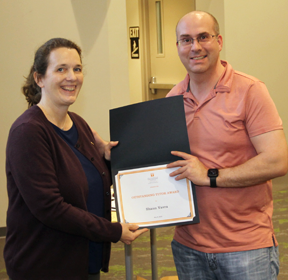
Shaun Vavra

The Outstanding Tutor Award is chosen by students enrolled in our courses and labs. Shaun Vavra has shown amazing dedication and time spent with students. He spends many hours (many more than required) Zooming with students and meeting with them in-person to make sure that they understand the material. He received the James E. Parks Award last year and continues to go above and beyond inside and outside of the classroom.

Shaun Vavra with Christine Cheney

Paul Stelson Fellowship for Professional Promise

Ian Cox

Ian Cox’s current research program focuses on experimental research with exotic nuclei, specifically at the RIKEN facility in Japan. His nomination explains that he has played a vital role in developing instrumentation and has also been involved in every step of the preparation of the FRIB Decay Station Initiator. At FRIB, “he quickly earned the trust of collaborators, who were impressed with his professionalism and level-headed presence.” He traveled to four FRIB experiments in 2022 to help with the setup and performing measurements. His research advisor writes that “his graduate research is outstanding and very independent, and he is a role model for my other graduate students. His individual contribution to our research is vital, but he is also a wonderful citizen who is willing to share his knowledge and train his junior colleagues and undergraduates.”
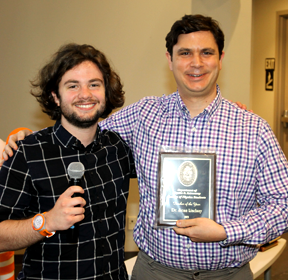
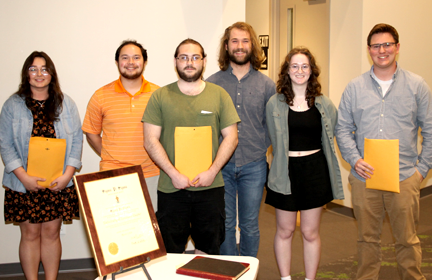
Ian Cox with Norman Mannella

Paul Stelson Fellowship for Outstanding Beginning Research

Tanner Mengel

Tanner Mengel actually chose a project against his advisor’s advice. He was intrigued by a paper proposing that a deep neural network can be used to subtract background from reconstructed jets in heavy ion collisions. He adopted a background generator developed by a previous student and implemented a clever computational trick that sped up the computation time by a couple of orders of magnitude. He demonstrated that they could actually use machine learning to really understand where the improvement in the deep neural network comes from. He came up with the research questions and drove the work.

Tanner Mengel with Norman Mannella

Fowler Marion Outstanding Graduate Student Award

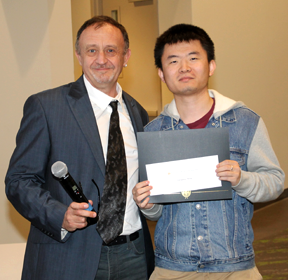
Chengkun Xing

Chengkun Xing’s dissertation project exploits an advance in heterostructure synthesis to convert the exotic excitations in geometrically frustrated quantum magnets into electronic responses. He pursued his work, even through the pandemic, to master and bridge two growth techniques. He developed a multistep procedure on his own with meticulous work and overcame technical barriers to successfully synthesize the BIO/DTO heterostructure. His created a blueprint for the metallization of frustrated quantum magnets and was first author on a Nature Communications paper chosen as an editor’s highlight. His nomination reads that he has acquired a unique skill set and deep knowledge to create novel materials and tackle physics problems in ways beyond others’ imagination. His toolbox makes him stand out from his peers as a “unicorn” in the quantum materials research field.

Chengkun Xing with Norman Mannella

SPS Teacher of the Year Awards

Elbio Dagotto and Sean Lindsay

The Society of Physics is an undergraduate student organization and has been selecting a Teacher (or in this case, Teachers) of the Year since 2001. This year they chose Distinguished Professor Elbio Dagotto (a record-setting third award for Professor Dagotto!) and Senior Lecturer/Astronomy Coordinator Sean Lindsay. Professor Dagotto was also awarded the university’s Alexander Prize for 2023.

William Greene (SPS Pres.) and Elbio Dagotto
William Greene (SPS Pres.) and Sean Lindsay

GPS Teacher of the Year Awards

Steven Johnston

Not to be outdone, the Graduate Physics Society also chose to award a Teacher of the Year honor and they selected Associate Professor Steven Johnston.

Steven Johnston
Steven Johnston

SPS Research Advisor of the Year Award

 Tova Holmes

Last year the Society of Physics Students gave the inaugural award for Research Advisor of the Year. This year they chose Assistant Professor Tova Holmes for the honor.

Tova Holmes
Tova Holmes

GPS Research Advisor of the Year Award

Nadia Fomin

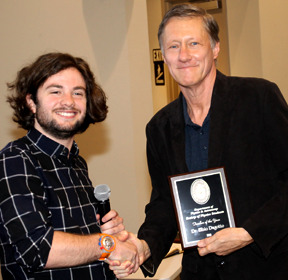
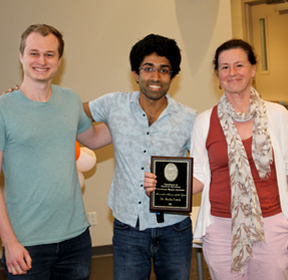
The Graduate Physics Society chose to honor an oustanding research advisor as well, bestowing the honor on Associate Professor Nadia Fomin. (She won the first SPS Research Advisor of the Year honor in 2022.)

Jordan O'Kronley, Abhyuday Sharda, Nadia Fomin
Jordan O’Kronley, Abhyuday Sharda, Nadia Fomin

Sigma Pi Sigma Induction

Nadia Fomin

As the National Physics Honor Society, Sigma Pi Sigma exists to honor outstanding scholarship in physics, encourage interest in physics among students at all levels, promote an attitude of service, and provide a fellowship of persons who have excelled in physics. Election is a lifelong membership and includes a once-year complimentary membership in the Society of Physics Students. Sigma Pi Sigma is an organization of the American Institute of Physics, and a member of the Association of College Honor Societies. It was founded in 1921, and there are now more than 90,000 historical members.

UT’s 2023 Sigma Pi Sigma inductees are (pictured at right): Scarlett Wilson, Preston Waldrop, Gage Erwin, Lucas McBee, Taylor Sussmane, and Fredrick Melhorn.

Scarlett Wilson, Preston Waldrop, Gage Erwin, Lucas McBee, Taylor Sussmane, and Fredrick Melhorn

May 16, 2023  |  Filed Under: Featured News, News

  • 1
  • 2
  • 3
  • 4
  • Next Page »

Physics & Astronomy

College of Arts and Sciences

401 Nielsen Physics Building
1408 Circle Drive
Knoxville TN 37996-1200
Phone: 865-974-3342
Email: physics@utk.edu

Facebook Icon    X Icon

The University of Tennessee, Knoxville
Knoxville, Tennessee 37996
865-974-1000

The flagship campus of the University of Tennessee System and partner in the Tennessee Transfer Pathway.

ADA Privacy Safety Title IX