
• Request Info
  • Visit
  • Apply
  • Give
  • Request Info
  • Visit
  • Apply
  • Give

Search

  • A-Z Index
  • Map

Physics & Astronomy

  • About
    • Honors
    • Administration
    • Faculty Resources
  • Research
    • Research Partners & Facilities
    • Condensed Matter
    • Particle / HEP
    • Biophysics / Soft Matter
    • Nuclear / Astrophysics
    • Quantum Information
  • People
    • Faculty
    • Staff
    • Joint Research & Adjunct Faculty
    • Post Docs
    • Graduate Students
  • Undergraduate
    • Why Physics
    • What Our Grads Do
    • Career Resources
    • Degree Programs
    • Research
    • Scholarships
    • Student Organizations
  • Graduate
    • Join Our Program
    • FAQs
    • Fellowships & Assistantships
    • Bains Fellowship
    • Where Our Grads Go
    • Research
    • Resources
  • News & Events
    • Newsletters
    • News
    • Colloquia Series
    • Events
    • In the Media
  • Outreach
    • Astronomy Outreach
    • Cool Things in the Sky this Month
    • Physics Outreach & High School Lecture Series
  • Alumni
    • Distinguished Alumni Award
    • Giving Opportunities
    • Share Your News
A banner showing a model of an atom and elementary particles

News

Author: physweb
Photo of Dima Bolmatov

Where Are Your Memories Stored?

May 10, 2023

Bolmatov

Dima Bolmatov explains in The Conversation

You may easily remember your kindergarten teacher, your brother’s birthday, or how to do long division. But how? Why do these things get filed away in a place you can quickly access while other information gets lost? Research Assistant Professor Dima Bolmatov helps explain the biophysics of memory for The Conversation in Memories May be Stored in the Membranes of your Neurons.

The article takes findings reported in the Proceedings of the National Academy of Sciences and reframes the science for a general audience. The original research concerns the physics of the brain’s infrastructure and how it influences learning and memory. Understanding how our brains encode information for retrieval has implications for both medicine (Alzheimer’s and dementia research) and computing (developing the neural networks that drive machine learning).

Bolmatov joined the physics department in 2020 and works with the Shull-Wollan Center (SWC) at Oak Ridge National Laboratory. The center connects him with the requisite tools (e.g., X-ray and neutron scattering) to study biological systems at the molecular level. His research links biophysics and soft condensed matter and he collaborates with Assistant Professor Max Lavrentovich and Professor Alan Tennant as well as colleagues in biology, psychology, and materials science.

May 10, 2023  |  Filed Under: Featured News, News, Soft Matter

An image of Lawrence Lee

Challenging the Standard Model: Lawrence Lee Wins NSF CAREER Award

April 28, 2023

An image of Lawrence Lee
Lee

Lawrence Lee Wins NSF CAREER Award

Assistant Professor Lawrence Lee has won $1 million from the National Science Foundation through the Early Career Development (CAREER) Program, an initiative offering the foundation’s most prestigious awards in support of young faculty members.

Lee’s work pushes past what we know about the elementary particles that make up all matter (asteroids and baseballs and carbon atoms) to see what else is there. He’s keen to share what he learns with science fans and non-science fans alike, be that on the dance floor (really) or through exhibitions designed by art students. Research and outreach are two halves of an important whole framing Lee’s proposal: growing a strong talent pool in science, technology, engineering, and math (STEM). With appreciation for what’s already been done and enthusiasm to see what comes next, his NSF-sponsored work aims to inspire a new generation of physicists and science-supporting citizens.

Why Isn’t the Standard Model Enough?

Lee joined the physics department in 2021 as a particle physicist looking to break out of scientific confinements, both theoretical and practical. His curiosity compels him to travel beyond the rather tidy borders of the Standard Model to look for new particles, and consequently new physics. To do so he’ll upgrade a wildly successful detection system designed when he was in elementary school.

Lee is part of the Compact Muon Solenoid (CMS) experiment at the Large Hadron Collider (LHC) in Geneva, Switzerland. The LHC can be thought of as a 27-kilometer racetrack where scientists intentionally create subatomic head-on collisions. They accelerate two beams of particles and smash them together at four different spots, each with a particle detector to see what results from the impact. CMS is one of those detectors. Particles quickly emerge after the crash, allowing the detector to identify them and measure their momenta and energy. Lee sees potential for the detector to look outside the framework of known particles to find new ones.

“We usually assume that the particles leaving signals in our detector are those from the Standard Model,” he said. “Many theory models for physics beyond the Standard Model predict the existence of heavy new particles that can travel into the detector, and have unexpectedly large interactions.”

But why not just stick with this model that’s done so much to sort out particles and forces and help us understand how magnets work and what powers our Sun? What’s left to know? Plenty, it turns out.

“The Standard Model is a nice little story that has led to some of the most successful predictions in science, ever,” Lee said. “But it can’t be the whole picture. It’s wild for us to believe that our little model from 50 years ago, that describes today’s lab conditions on Earth, is all there is in the universe.”

Obvious omissions he pointed to are “the gravity we know and love or huge amounts of dark matter that seem to be there when we look at the sky.

“Science is about finding answers,” he said. “The Standard Model leaves us with so many questions, so we’re going to keep digging.”

The (In)compatibility Test

New particles, then, can help us expand the sliver of the universe we’ve begun to understand. But how to detect them?

“My group is working on using low-level detector information to distinguish these new heavy particles from Standard Model particles,” Lee said. “We can carefully sift through the data that we have today and that we’ll collect in the next few years to try and find something incompatible with the Standard Model.”

A key to making this work is upgrading the CMS detector, which underwent the first phase of construction in 1998 and took its first measurements in 2009. The CMS experiment has had starring roles in physics breakthroughs including discovery of the Higgs boson. New science, however, will require a bit of freshening up. A revamped CMS will go hand-in-hand with the LHC’s forthcoming High-Luminosity project, as higher luminosity translates into more data for detectors to gather. This means there will be many more particle “footprints” to follow.

“We’re upgrading the CMS detector in ways that will give it new capabilities, particularly in the initial filtering of collision events,” Lee explained. “We’re going to provide much more information about charged particles to this filtering stage (the ‘trigger’) such that we can continue to probe these anomalous tracks with new tools.”

Appreciate the Past; Plan for the Future

Of note in Lee’s proposal is a plan for upgrading the CMS detector so it can collect data for years to come without considerable reworking.

“We are always subject to the decisions of the past, especially for these long time-scale projects,” he explained. “The overall structure of CMS was designed decades ago. My program has been all about trying to use the system we have creatively to get additional physics sensitivity for signatures that the experiment was not designed for.”

This, he said, takes a lot of work, a lot of deep understanding, and a lot of creativity.

“For the future,” he continued, “we have various opportunities to try and create an upgraded detector that is as inclusive as possible for potential new physics signatures. We’re not going to get it perfect, but we can push to not over-optimize for a particular signature and preclude out-of-the-box thinking.”

For Lee, a central theme of good research is accepting that over centuries of modern science all claims of complete knowledge ultimately collapse.

“There are always surprises around the corner when we continue to explore the unknown,” he said. “The Standard Model has held up strong so far, so we need to start challenging it in more specific and less orthodox ways, and this is my research program. Eventually the (model) will fail, and when that happens, we’ll be there to help tear it down and figure out what replaces it.”

Preaching Beyond the Choir (& the Congregation)

Lee is well aware that not everyone shares his enthusiasm for subatomic particles or massive detectors. He’s not at all insulted by that. When he’s talking to colleagues, he knows he’s preaching to the choir. And he knows that science outreach programs are often aimed at people who are at least interested enough to show up for a Saturday morning lecture. He calls that “preaching to the congregation.” As with his research, Lee’s NSF-sponsored outreach goes beyond the confines of what’s been done.

The first of two components is ColliderScope, a mix of repurposed lab equipment and funk where Lee creates audio waveforms to paint musical pictures. At music festivals all over the world he’s gotten people to the dance floor who had no idea they were rocking out to particle physics. (He won the College of Arts and Sciences Outreach Teaching Award for the project.) He plans to expand his schedule and offer more shows, focusing on a U.S. audience. He’s also adding an experimental cloud chamber element, so while the music gets people moving, they’ll also learn about the cosmic rays moving through them.

“(Cosmic rays) are a beautiful playground of particle physics, relativity, astronomy, cosmology, etc.,” Lee explained. “And they’re not only in a lab. It’s incredibly democratic in that every one of us has a huge number of cosmic rays passing through our bodies at all times. What better way to connect the public to our particle physics research than to show them that particle physics is all around (and through!) us.”

Lee will expand on this notion to develop CosmoVision. He and Professor David Matthews from UT’s School of Interior Architecture will create a senior-level design course where UT students use cloud chambers to build a transportable educational exhibit.

“The over-arching goal of the CosmoVision project is to connect the normally invisible cosmic rays to something that you can experience with your own senses such that the public can really ‘feel’ and intuit,” Lee said.

He and Matthews are actually neighbors who’ve collaborated in the past to build a school outreach exhibit on the physics of sound. This encore project will give design students an opportunity to brainstorm what the CosmoVision experience will be and see that vision through to a finished product to engage general audiences and school groups.

“Integrating STEM education into the artistic design process is the most serious realization of the STEAM (science, technology, engineering, arts and mathematics) ideal that I can imagine,” Lee said. “I can’t wait to see what we can come up with together as a team.”

Developing New Scientists—and Their Cheering Section

Lee hopes this outreach plan will recruit future scientists and also share a fun side of physics with people who’ll never set foot in a lab.

“I’m interested in having a robust pipeline of STEM-education directly within my group,” he said. “I want significant training to happen from the undergraduate level all the way through the academic ranks, including with myself.”

His expectation of all scientists—including those he mentors—is that they engage with everyone, even if that means taking the show on the road.

“I want everyone to seriously participate in outreach and educational activities — yes, to grade school students, but also to the government, the general public that loves science, and most importantly the general public that does not particularly love science,” he said.

“Most taxpayers — most of the people who are funding our work — don’t seek out a physics lecture in their free time,” he continued. “A major goal of my programs is to connect with a different slice of the population, focusing on experiences, culture, and art that anybody can connect with, to make new enthusiastic supporters of basic research today.”

Lee’s award officially begins June 1 and includes five years of NSF support. This makes eight NSF CAREER Awards for UT Physics since 2012:

  • Larry Lee (2023)
  • Steve Johnston and Jian Liu (2019)
  • Lucas Platter and Andrew W. Steiner (2016)
  • Haidong Zhou (2014)
  • Jaan Mannik (2013)
  • Norman Mannella (2012)

Learn more about the CMS Experiment Group at UT.

April 28, 2023  |  Filed Under: Featured News, News, Particle

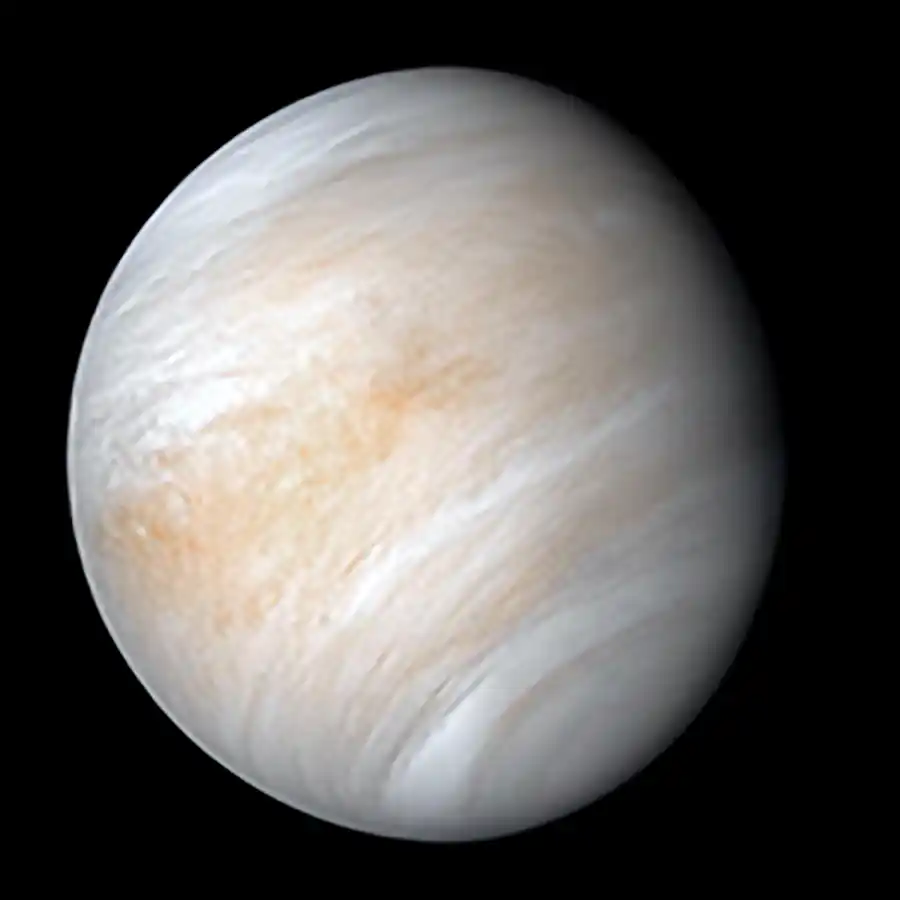
A photo of Venus (NASA/JPL-Caltech)

Your Ticket to the Universe

March 30, 2023

A photo of Venus (NASA/JPL-Caltech)
Venus (NASA/JPL-Caltech)

There’s been lots of buzz about the recent planetary parade, but you don’t need the planets to align to satisfy your cosmic curiosity—UT Physics and Astronomy is always your ticket to the universe.

Venus, Mars, Mercury, Jupiter, and Uranus lining up in the western sky generated lots of interest and there’s still more to see, with fantastic opportunities right here on campus.

Paul Lewis directs astronomy outreach for the department and said though the planetary parade is over, Venus and Mars are still observable in East Tennessee.

“It’s impossible not to see Venus, as it’s the brightest of all the planets and is about 30 degrees above the Western horizon at sunset,” he said. “Mars is high in the sky at sunset but is more than one and a half times farther from us than the sun, so it is pretty faint. It still has a reddish tint to it, so you should be able to catch it just to the right of the leftmost foot of the Gemini twins, who are facing us.”

Also in the neighborhood is the Messier 35 (M35) open cluster of stars. Lewis said amateur astronomers should be able to see this collection with a pair of binoculars. A sweep farther to the right of M35 offers a view of three more open clusters: M36, M37, and M38.

“Mars has a lot of company, it would seem,” he said.

Lewis recommends downloading a free planetarium program called Stellarium to make finding these objects easier and to learn something about the night sky at the same time.

“We use Stellarium in our astronomy labs and it runs our planetarium,” he explained.

There’s no need to navigate the sky entirely on your own, however. The department is eager to share expertise and resources with the public.

A photo of Paul Lewis
Lewis

Lewis organizes public astronomical observations on the roof of the Alvin H. Nielsen Physics Building on the first and third Fridays every month, weather permitting. There’s also a 32-seat planetarium for visits from local school groups, scouts, home schoolers, church groups or any group looking for an hour or so under the stars, indoors, rain or shine.

There are also special viewing opportunities when there are cool events—or sometimes hot ones—in the sky.

“We are planning to start conducting solar observations on weekends in the near future,” Lewis said. “The sun has been, for the last few months, spectacularly active. Sunspots galore have danced across the face of the sun, popping off solar flares and spewing beautiful prominences all around the edge of the solar disc. We use special Hydrogen-alpha telescopes to see these beautiful features. We can also observe sunspots with white-light filters. You will not be disappointed. Solar observing is truly thrilling.”

Anyone can share the wonders of the night (or day) sky, especially here in Tennessee.

“If nothing else, we encourage you to get out on your own or join us for views of the night skies over Knoxville,” Lewis said. “There is always something to see. And remember, if you don’t look up, you won’t see a thing.”

Come See Us!

  • To schedule a planetarium visit, please contact Paul Lewis at 865-974-9601.
  • Hit the Roof!
    • The department hosts observations from the roof of the Alvin H. Nielsen Physics and Astronomy Building on the first and third Fridays of every month, weather permitting. We are located on the “the Hill” off Cumberland Avenue between 13th Street and Phillip Fulmer Way.
    • Parking is available in the Volunteer Hall Parking Garage on White Avenue.
    • Some handicapped parking is available in front of the physics building.
    • Observing begins at 9:00 PM.
    • Don’t forget to check the weather!

March 30, 2023  |  Filed Under: Astronomy, Featured News, News

A photo of Weitering and Lee

The Art of Science

March 20, 2023

An image of Hanno Weitering
Weitering
An image of Lawrence Lee
Lee

Hanno Weitering and Larry Lee Honored at CAS Awards Banquet

Professor Hanno Weitering and Assistant Professor Larry Lee are physicists, but sometimes that means being a designer, architect, musician, or painter. This creative blend of art and science was appropriately rewarded at the annual College of Arts and Sciences awards banquet. Weitering was recognized for his Distinguished Research Career at UT while Lee was honored with the Outreach Teaching Award.

Serendipity and Strategy

Weitering has been at UT since 1993. Part of the condensed matter physics group, he’s an experimentalist who’s never been afraid to venture into new directions. For years he swore he’d never get involved in superconductivity research. Then he moved to an office next door to Professor Jim Thompson (now retired) and began collaborating on that very topic: a career highlight he chalks up to serendipity.

Weitering is interested in the often-unpredictable electronic properties of low dimensional materials systems. The smaller a system, the more subtle its physics becomes. He explained that many physicists like to find and study exotic electronic properties of materials that he sees as way too complex to truly comprehend. Instead, he prefers to look at theoretical models for those materials that are intuitively “easy” to understand, yet necessarily oversimplify aspects related to a material’s chemistry, which can be extremely complex and difficult to control.

“My approach is to create simple materials systems that would be a much closer experimental realization of some of the most promising theoretical models and then see (if) it all makes sense,” he said.

This involves some nanoscale architecture. Working with Associate Professor Steve Johnston, he found that silicon—the heart of the electronics industry—can host a novel form of superconductivity. Arriving at that result required him to create a sample comprising a third of a layer of tin atoms on a layer of silicon atoms. This wasn’t something he just happened upon, however.

“This was all by design,” Weitering said, part of a scientific approach that’s “a mix of serendipity and strategy.

“I never really jumped on hot topics,” he continued. “Instead I consider, ‘What is my expertise? What is my background? Where do I think I can make a really interesting and lasting contribution?'”

This mindset has resulted in a successful research career rounded out by dedicated classroom teaching and 10 years of service as department head, as well as 10 years as deputy director of what’s now the Institute for Advanced Materials and Manufacturing.

His hard work has not escaped notice. In addition to this honor from the College, in 2022 Weitering was elected a Fellow of the American Association for the Advancement of Science and appointed a UT Chancellor’s Professor.

While appreciative of the honors, he said his creativity is driven by curiosity, not potential accolades.

“You have people that I feel are giants, and they build cathedrals,” he said. “I just would like a nice mosaic somewhere on the floor that I’ll be remembered by.”

Setting Physics to Music

While Weitering crafts artwork for theoretical cathedral floors, Lee is literally bringing people to the dance floor.

Giving vintage tech equipment a second life, he engineers audio waveforms to show images from experimental particle physics—painting musical pictures through his ColliderScope project. He’s played festivals both in the United State and Europe, delighting crowds by transforming old oscilloscopes into the heartbeat of techno music and cool imagery.

Lee joined the faculty in 2021 and is both a musician in his own right as well as a particle physicist. When he’s creating riffs for ColliderScope he has to give equal weight to each role.

“It’s both all the way,” he said. “When you’re making these complicated sounds there’s an interplay between the shape of the sound and the timbral quality of the sound. If I know I want a particular visual to happen, I have to design it in way that will produce a sound that I want.”

In other words: he wants good physics and good music.

“It has to be true to science but also musically engaging,” Lee explained. “When you draw these shapes, they end up sounding complex and often naturally harsh. You then have the artistic choice to change the way it looks and therefore sounds, or compose around those harsh sounds.”

While he didn’t invent this method of drawing pictures with music, once he saw it he knew immediately it would be a perfect fit for particle physics outreach.

“It ties in with the electronics that we use and we build for our day-to-day lives,” he said.

Lee has an affinity for bringing physics out of the lab and offering it to the public in ways they can understand, appreciate, and enjoy. Last summer he and Assistant Professor Tova Holmes organized a free public viewing of Particle Fever to celebrate the 10-year anniversary of the Higgs Boson discovery. He hopes to put on a ColliderScope show in Knoxville when he can work out the timing with his research and teaching schedule and find the right venue.

With these latest awards, the Department of Physics and Astronomy has won 11 College Convocation Honors since 2016 for outstanding research, teaching, advising, and outreach.

March 20, 2023  |  Filed Under: Condensed Matter, Featured News, News, Particle

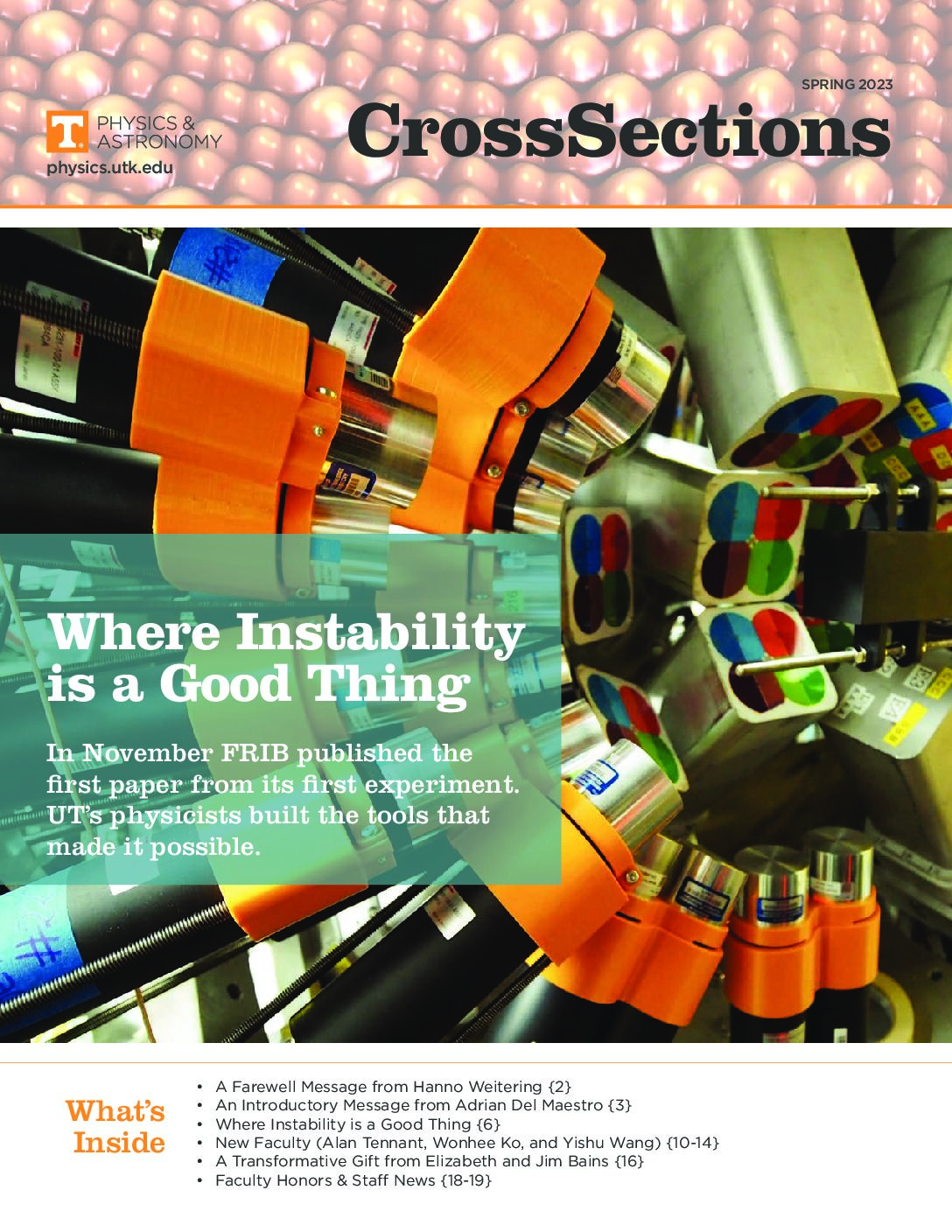
CrossSections, Spring 2023

March 12, 2023

xsections-spring-2023Download

March 12, 2023  |  Filed Under: Newsletter

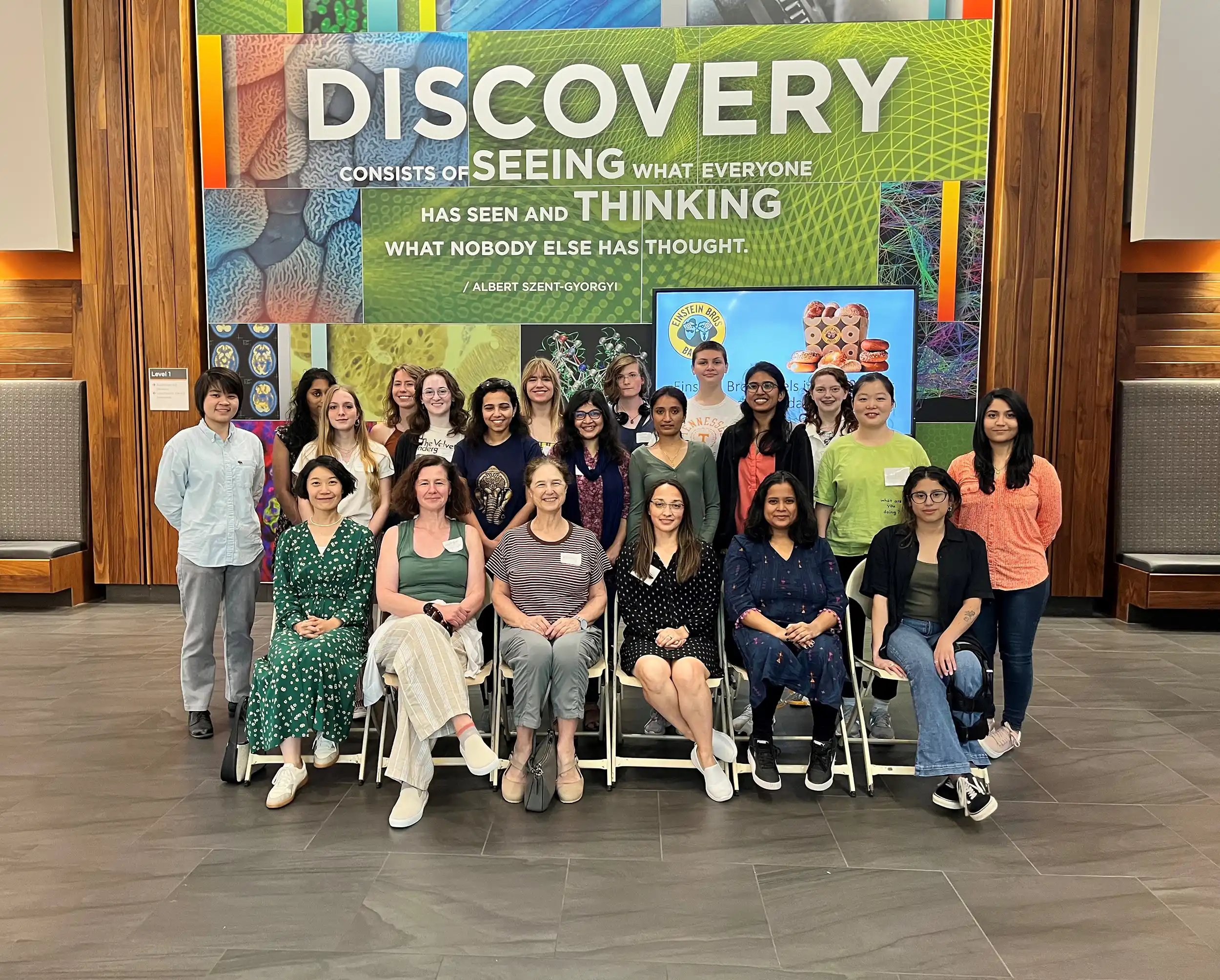
A photo of a gathering of women for the Spring Women in Physics lunch

Spring Women in Physics Lunch

March 11, 2023

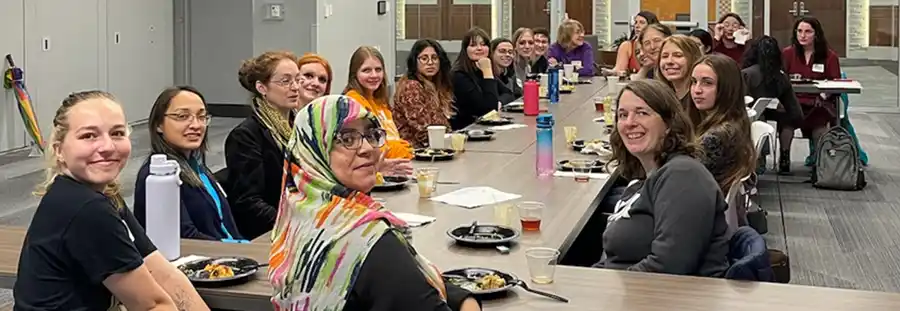
A photo of a gathering of women for the Spring Women in Physics lunch
Courtesy of Professor Adriana Moreo

The Spring 2023 edition of the Women in Physics Lunch was held May 10. We had a large group which included undergraduates, graduate students, post-docs, and faculty. We enjoyed good conversation and great food sponsored by the Department of Physics and Astronomy. If you are a Woman in Physics, we hope to see you at our next lunch that will take place on December 7, 2023.

March 11, 2023  |  Filed Under: Featured News, News

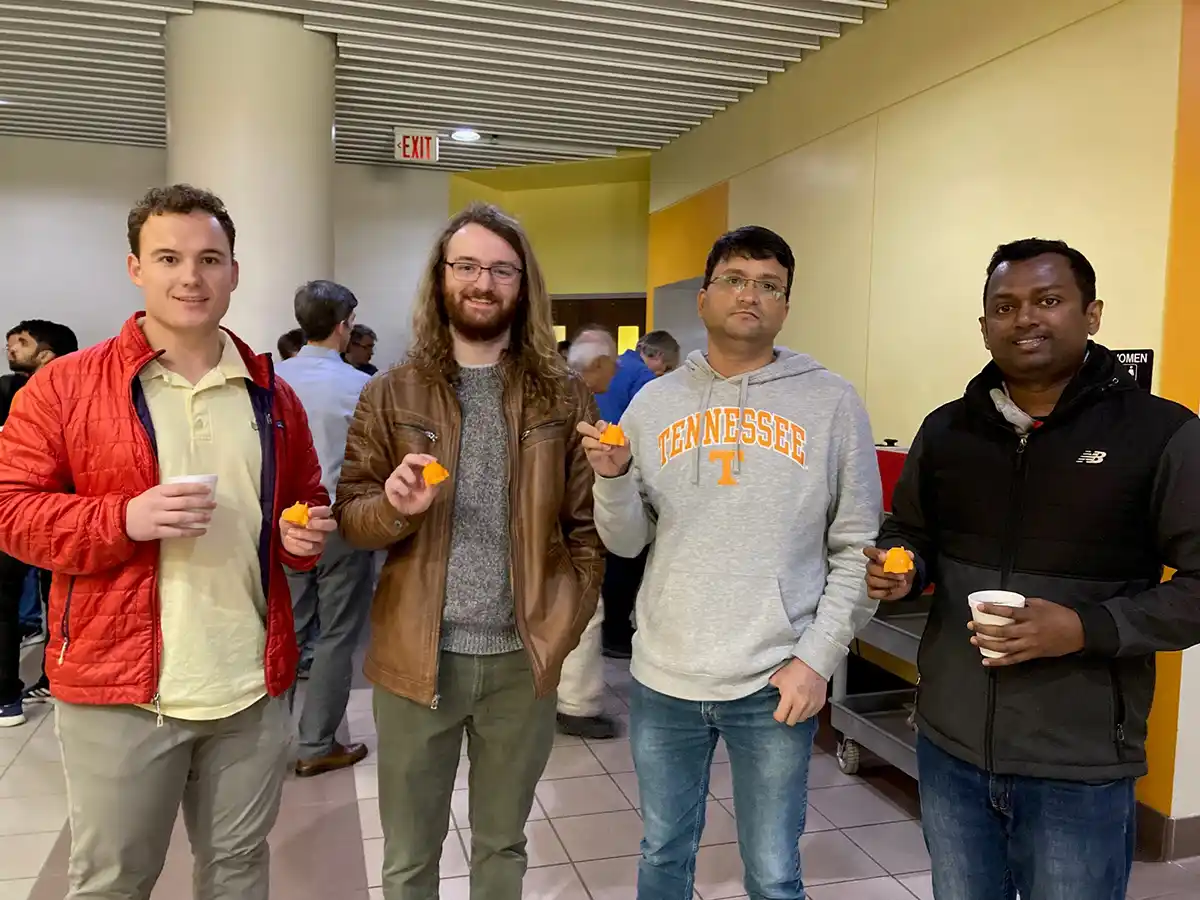
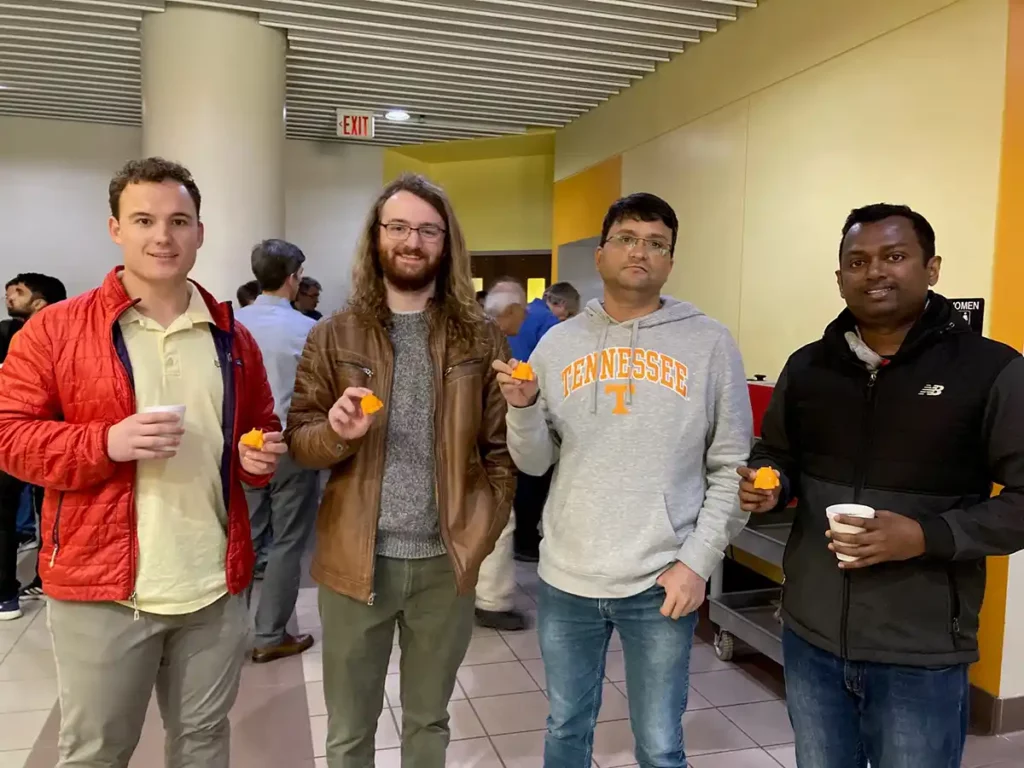
YETI 2 Competitors Tanner Mengel, Johnny Lawless, Sanket Sharma, and Nimmitha Karunarathna.

The YETI Returns

February 14, 2023

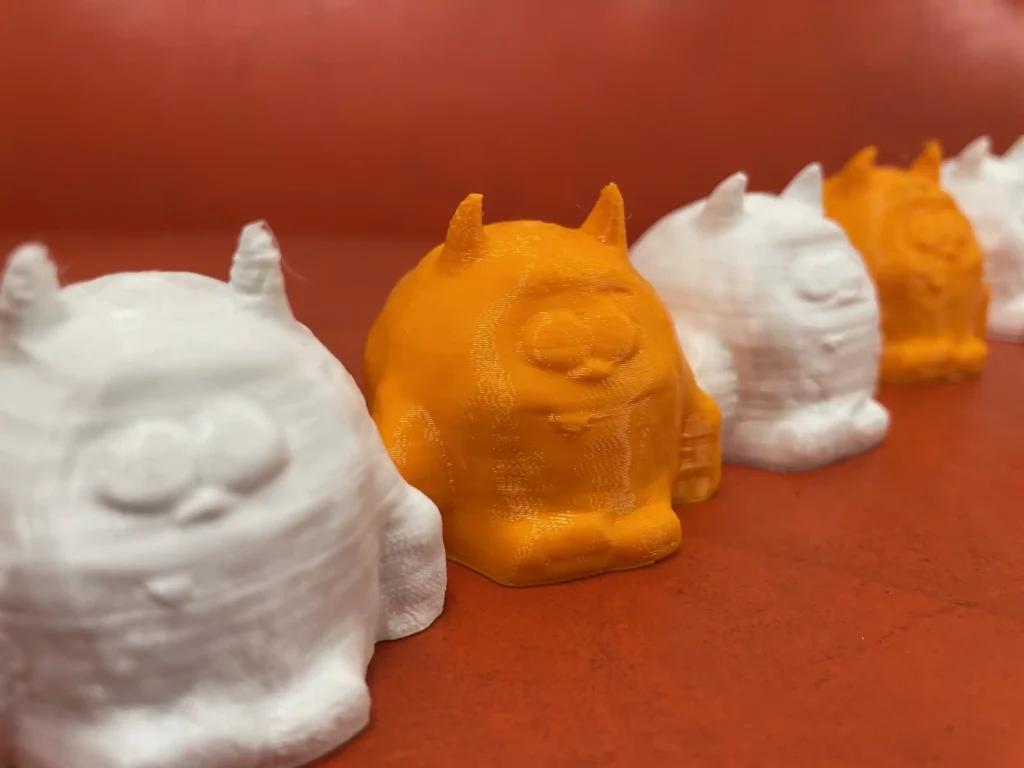
White and Orange printed YETI figurines

You could be forgiven if you didn’t think a data-based challenge would involve regional cow mooing accents and 48 pints of ice cream. But the unexpected is part of the fun with the physics department’s now-annual YETI (Year End Tournament of Imagination) event. Players analyze data to solve puzzles, unlocking more clues to reveal fun facts. This year 19 intrepid physics students competed, with nine (a new record!) making it across the metaphorical finish line.

YETI 2 Competitors Tanner Mengel, Johnny Lawless, Sanket Sharma, and Nimmitha Karunarathna.

As with the inaugural event, YETI 2 was organized by Assistant Professors Tova Holmes and Larry Lee. Launched in mid-January, the tournament began with each participant receiving a personalized dataset. They plotted the data to reveal a bar code. That code allowed them to encode and upload a fun fact on a GitHub site. The next step was deciphering as many of the other submissions as possible. The rules allowed challenges to be completed with any language, any tools, and by any (legal) means. That included simply asking other participants for answers, but as Lee pointed out those who tried social engineering failed to convince their fellow students to divulge any hints.

While all finishers took home the signature and much-coveted YETI figurine (this year in orange), the winners are listed below. (Thanks to Associate Professor Nadia Fomin for funding the prizes.)

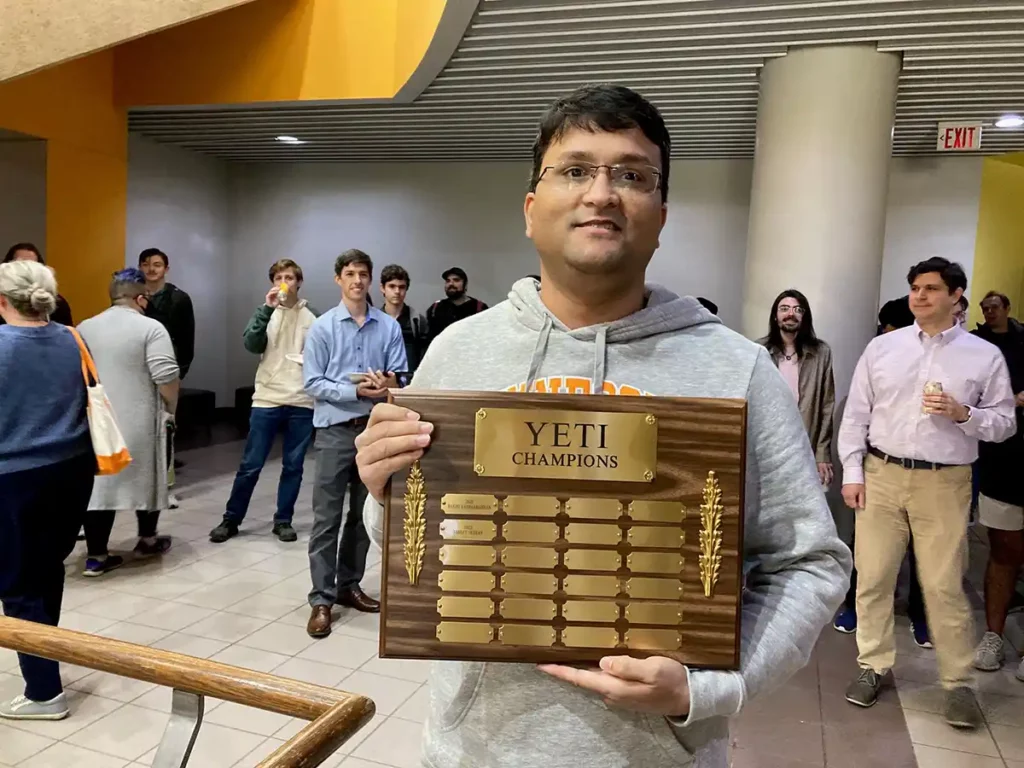
YETI winner Sanket Sharma
Overall Winner & YETI2 Champion, Sanket Sharma

Most Fun Fact—General Category
Winner: Harini Radhakrishnan
Fun Fact: The average U.S. resident consumes 48 pints of ice cream a year.
Prize: $40

Most Fun Fact—Nerdy Edition
Winner: Johnny Lawless
Fun Fact: RollerCoaster Tycoon code was almost entirely written in Assembly.
Prize: $40

First Runner-Up
Tanner Mengel
Fun Fact: Cows from different regions of the world develop unique moo accents.
Decoding Score: Decoded six other messages.
Prize: $60

Overall Winner & YETI2 Champion
Sanket Sharma
Fun Fact: AMD’s Navi 31 RDNA3 processers have 58 billion transistors.
Decoding Score: Decoded five other messages, starting on Day 1.
Prize: $100, bragging rights for a year, and his name on the YETI plaque

February 14, 2023  |  Filed Under: Featured News, News

Nature Physics Magazine Cover for the issue that featured the article referenced in this post

Stealing Electrons and Reversing Time

January 30, 2023

An image of Hanno Weitering
Weitering
A photo of Steve Johnston
Johnston

Evidence for a chiral superconductor could bring quantum computing closer to the mainstream

UT’s physicists led the scientific team that found silicon—a mainstay of the soon-to-be trillion-dollar electronics industry—can host a novel form of superconductivity that could bring rapidly emerging quantum technologies closer to industrial scale production. The findings are reported in Nature Physics and involve electron theft, time reversal, and a little electronic ambidexterity.

Couples on the Superconducting Dance Floor

Superconductors conduct electric current without resistance or energy dissipation. Their uses range from powerful electromagnets for particle accelerators and medical MRI devices to ultrasensitive magnetic sensors to quantum computers. Superconductivity is a spectacular display of quantum mechanics in action on a macroscopic scale. And it all comes down to the electrons.

Electrons are negatively charged and repel each other in a vacuum. However, in a solid-state medium—the realm of metals and semiconductors—there are roughly 1023 (= 100 billion x one trillion) other electrons and positive ions that complicate the picture enormously. In a superconductor, conduction electrons overcome their mutual repulsion and become attracted to each other through interactions with the other particles. This interaction causes them to pair up like dancers at a ball, forming composite particles, or “Cooper pairs” (so named for Nobel laureate Leon Cooper).

Typically, the “glue” causing this pairing comes from the atom vibrations in a metal, but only if the electrons don’t repel each other too strongly. The process is somewhat like two people (the electrons) on a soft mattress (the medium) that roll toward one another when the mattress is compressed in the center. The laws of quantum mechanics dictate that Cooper pairs (unlike single electrons) can all condense into a single coherent quantum state, where they move in lock step. The condensate exhibits a rigidity as a result, allowing current to flow without interruption or dissipation. In other words: to superconduct. This mechanism leads to conventional (s-wave) superconductors such as aluminum, tin, or lead.

When the repulsion between electrons is strong, however, they pair up in higher angular momentum states so that they can’t get too close, resulting in, e.g., a d-wave superconductor. This is the case with materials made from copper and oxygen (cuprates) and it plays a starring role in the Nature Physics research and its future potential.

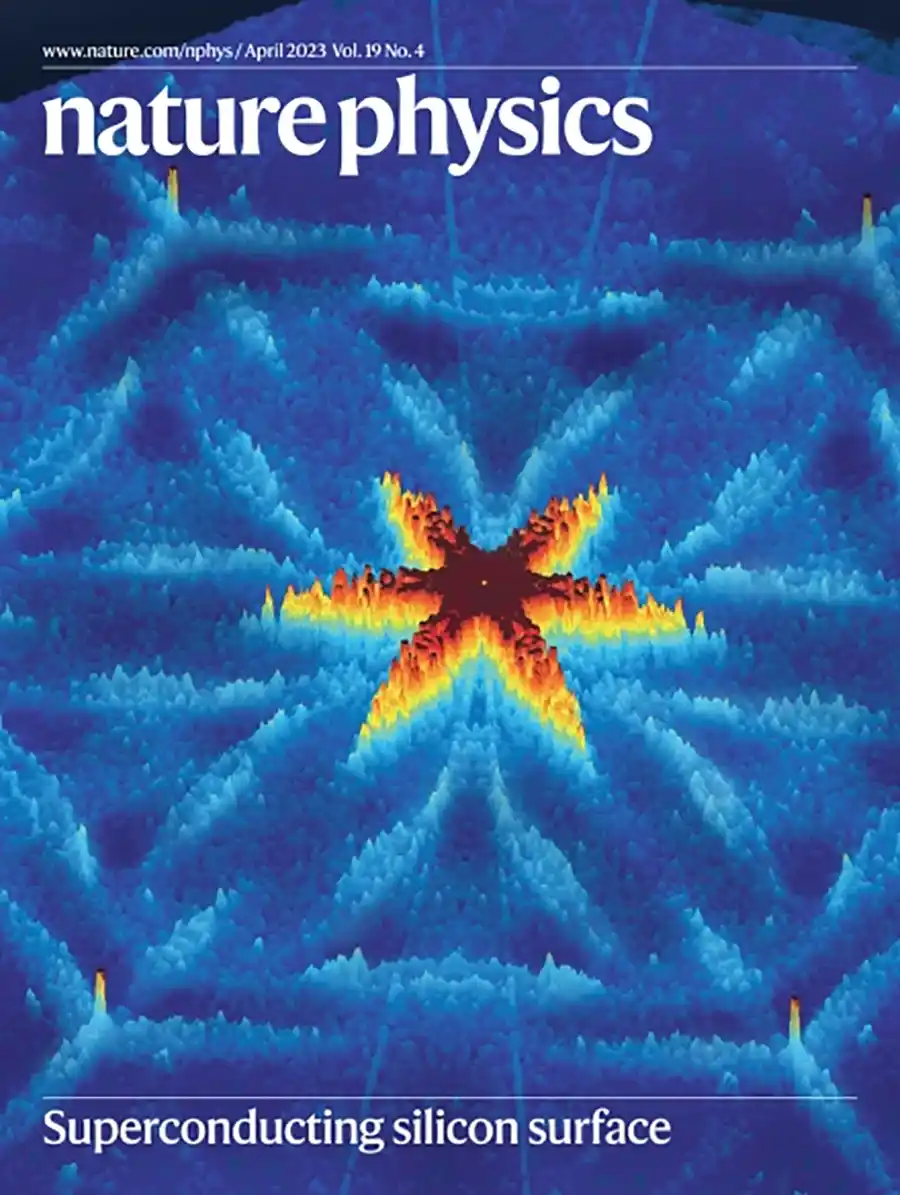
Nature Physics Magazine Cover for the issue that featured the article referenced in this post
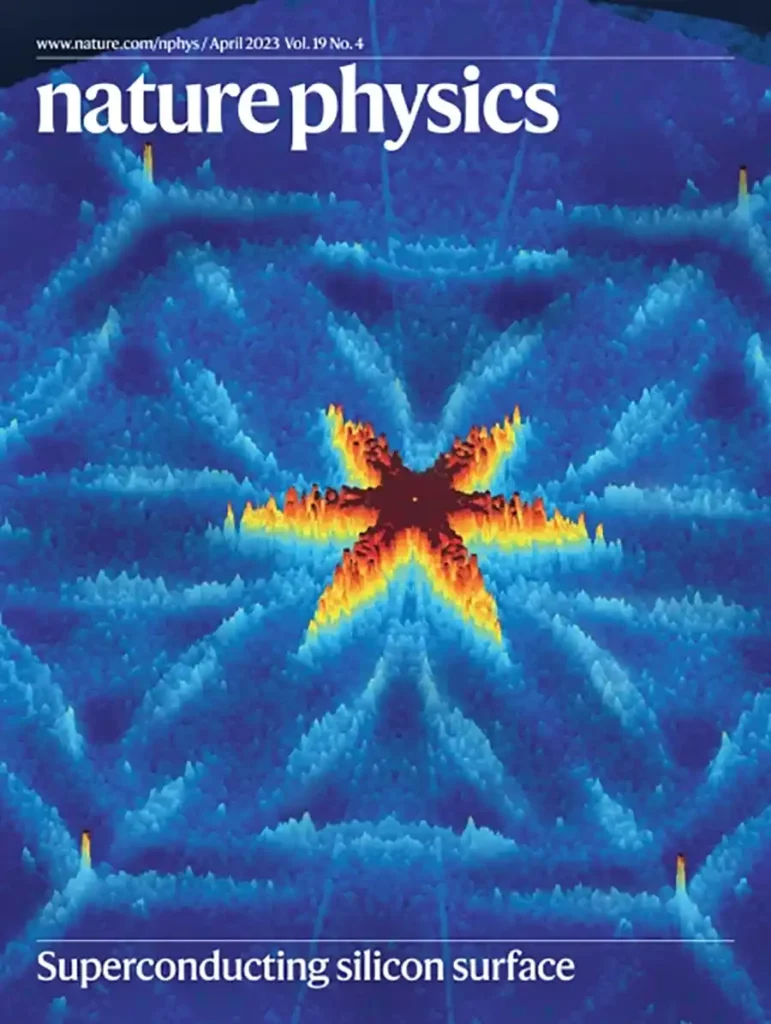
Featured on the April 23 (Vol. 19, No 4) cover of Nature Physics: A 3D rendition of images from the paper.

This is a quasi-particle interference spectrum of a monatomic superconducting tin layer on a silicon substrate. The bright star at the center originates from quasi-particle scattering processes in which time-reversal symmetry is broken. The latter indicates that the superconductivity is topological in nature.

Stealing Electrons

In this work, Professor Hanno Weitering and Associate Professor Steve Johnston and their colleagues in the U.S., Spain, and China replicated cuprate-like physics by growing one-third of a monolayer of tin atoms on a substrate (base layer) of silicon. Think of it as nine silicon atoms in a single layer, with three tin atoms—placed farther apart—stacked in another layer on top. The system is engineered such that the repulsion between the tin electrons is so strong they can’t move and won’t superconduct.

Weitering, Johnston, et al., found a clever workaround by implanting boron atoms in the silicon layer’s diamond-like crystal structure. The boron atoms proceeded to steal electrons from the tin layer (typically about 10 percent) in a process similar to techniques perfected by the semiconductor industry. This gave the remaining tin electrons the freedom to move about. The tin layer thus becomes metallic and even superconducting at a critical temperature exceeding that of nearly all elemental superconductors. Importantly, the phenomenon also scales with the number of boron atoms or stolen electrons, behavior reminiscent of the cuprate superconductors.

Reversing Time and Quantum Computing Applications

While electron theft-based superconductivity is interesting in its own right, the research team found even more intriguing physics suggesting this tin-silicon material hosts chiral superconductivity. This highly exotic state of matter is heavily pursued, in part because of its potential for quantum computing.

In chiral systems, clockwise and counterclockwise rotations are the same and yet different—like how left and right hands are mirror images of each other that can’t be superimposed. In quantum mechanics, the properties of single or paired electrons are encoded in a mathematical wavefunction that can be left-handed, right-handed, or “topologically trivial.” The superconducting wavefunction in the tin layer turns out to be clockwise in parts of the sample and counterclockwise in other parts. If one were to rewind the clock, the clockwise wavefunction would become counterclockwise and vice-versa, but these two wavefunctions are still different, just like the left hand and right hand are different. Or as the physicist would say, time-reversal symmetry is broken.

Time-reversal symmetry breaking is a hallmark of chiral superconductivity. Another is that the system has two one-dimensional conduction channels that run like railroad tracks along the perimeter of the sample material. These channels host exotic particle-like entities (named for Ettore Majorana) where under certain conditions the particle and its antiparticle become indistinguishable. Majorana particles are topologically protected, impervious to what’s going on in the environment around them. They’ve been envisioned as building blocks of future quantum computers, a rapidly emerging technology that could help solve problems too complex for classical computers. The use of Majorana particles implies a safeguard against decoherence, a critical requirement for quantum computation to succeed.

Taken together, the Nature Physics results suggest the possibility of integrating exotic properties with an easily scalable silicon-based materials platform. As such, this would bring futuristic quantum technologies closer to industrial scale production.

January 30, 2023  |  Filed Under: Condensed Matter, Featured News, News

A photo of Jian Liu

Symmetry Breaking in Quantum Systems

December 21, 2022

A photo of Jian Liu
Liu
A photo of Haidong Zhou
Zhou
A photo of Junyi Yang
Yang
A photo of Dongliang Gong
Gong
A photo of Shashi Pandey
Pandey
Lin Hao
Hao
An image of Han Zhang
Zhang

What nature doesn’t readily provide, Associate Professor Jian Liu’s group will create or compel. By designing or controlling a material’s geometry they can tune how its electrons behave. Fundamental research like this is the foundation of everyday electronics we know well. It reveals how phenomena like magnetism, insulation, and superconductivity arise, opening the door to new and exotic properties that drive future discoveries. Graduate students and postdocs play key roles in Liu’s group and have found creative ways to use or alter an atom’s architecture to control electronic behavior.

Breaking Some (But Not All) Rules

How do scientists tune electrons? It starts with the materials they study. Liu and his colleagues focus on samples that have a crystalline structure, and that involves symmetry.

As Richard Feynman explained in his famous lectures, “everyone likes objects or patterns that are in some way symmetrical. It is an interesting fact that nature often exhibits certain kinds of symmetry in the objects we find in the world around us. … The crystals found in rocks exhibit many different kinds of symmetry, the study of which tells us some important things about the structure of solids.”

Researchers have been interested in solid state physics for decades. Simply put, it’s the science of solid materials, where atoms are in close quarters. This proximity gives rise to intriguing interactions, especially where electrons are concerned. That knowledge gave us devices like transistors and semiconductors. Solid state physics is part of what’s now more commonly known as condensed matter physics, which includes materials with the lattice-like, repetitive patterns Liu studies. To get to new and interesting physics, his group has found ways to break that symmetry in quantum materials.

“Condensed matters are complicated due to the large number of constituents, especially when quantum effects are significant,” Liu explained. “While electrons often spontaneously break a certain symmetry, they have to follow the symmetries afforded by the crystal structures. If we can design or control the lattice symmetry as we want, we can tune electron behavior the way we want and even force them to spontaneously break another symmetry that they don’t want to break originally.”

In recent papers his group has outlined a successful strategy to do this, including materials that already exist in nature and “toy model” materials they created on their own.

Top-Down Design and Bottom-Up Synthesis

One of Liu’s interests is the interplay of topology and electron correlation in materials. Topology has to do with systems that don’t change even when you bend, twist, or deform them. Electron correlation is how much an electron’s movement is determined by other electrons in the same system. Topology has been a more recent revolution in understanding quantum materials, but electron correlation isn’t well understood in quantum materials despite being known for a long time. Further, what scientists understand about topology assumes the electrons don’t interact with each other.

To implement topology to correlated electrons in a controllable way, Liu and his colleagues created their own materials from strontium, iridium, calcium, titanium, and oxygen.

“One can pick the desired elements and put them into a structure with the designed symmetries,” he said. “We call this top-down design and bottom-up synthesis.”

In this case, he said they devised a “toy-model material that has the ingredients of both topology and correlation (to) find out what the electrons would actually do.”

That’s how they found new physics in the middle ground: the intermediate coupling of electrons. In their fabricated materials, electrons form an insulator (as expected when correlation is strong) and at the same time exhibit a spontaneous Hall effect (as expected if the electron wave function has topological properties). They occur simultaneously because the correlation is not too strong, but just strong enough, so that electrons can break the designed symmetry by ordering their spins magnetically. The unusual phenomena open a new view on electronic topology and correlation interplay in a largely unexplored regime.

Liu’s group had similar success designing a hybrid structure using most of the same elements. By stacking two sheets of atoms, they brought electron spins close to each other but without direct contact or bonding. He explained they “figure out a way to compromise” and create distinct rotational symmetries.

Same Ends, Different Means

How electrons spin is key to additional symmetry-breaking research the Liu group published with Associate Professor Haidong Zhou.

“The idea is quite simple,” Liu said. “While spins can point to any direction, they have to spontaneously pick a direction when they form a magnetic order. The process depends on the internal symmetry of the material.”

Liu gives this analogy: imagine arranging furniture in a rectangular-shaped office. People typically place a desk against one of the walls even though they don’t have to. Now imagine strain is put on the four walls, making the room oblique. That changes the symmetry, and one may not like having the furniture against the walls anymore. Similarly, researchers can deform a material’s structure so that parallel atomic planes slide past each other, forcing spins to make a new choice.

“There is no obvious choice like before,” Liu said, “so it turns out they spontaneously come up with a new solution where their directions are modulated in space.”

This symmetry breaking hadn’t been seen before in the material they used, which comprised strontium, iridium, and oxygen. The findings are significant, Liu explained, not only because the strain-induced interaction hadn’t been previously observed, but also because two magnetic interactions are competing “just because they want the spins to point along different axes.”

Continuous strain tuning and controllable new phases could be widely applicable to two dimensional materials—those consisting of isolated single layers of atoms—that promise to play an increasingly important role in future technologies.

The Inevitable Experience of Failure, and Why it’s Good

Young scientists in Liu’s group were first or co-authors on all papers stemming from this research. They include Junyi Yang (PhD, 2022; now a postdoc at Argonne National Laboratory), Dongliang Gong (postdoc), Shashi Paney (graduate student), and Lin Hao and Han Zhang (both former UT postdocs).

Liu believes giving students leadership roles is important for the field to advance.

“The students are the future,” he said. “By leading a project, they have to face all the challenges, tackle them, and inevitably experience failure of the experiment during which they actually learn a lot more. This process makes the final success of the experiment much more rewarding. That’s how they become the next generation of physicists.”

December 21, 2022  |  Filed Under: Condensed Matter, Featured News, News

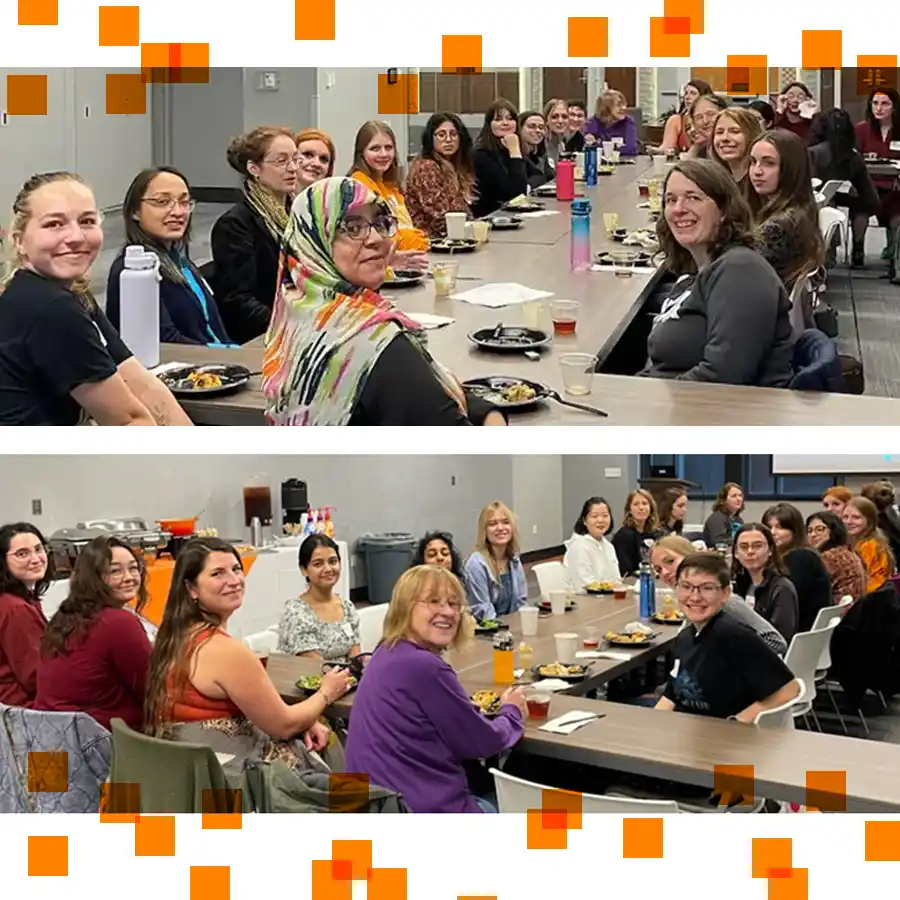
Women dining: a collage photo from the Women in Physics luncheon

Women in Physics Lunch: Fall Edition

December 9, 2022

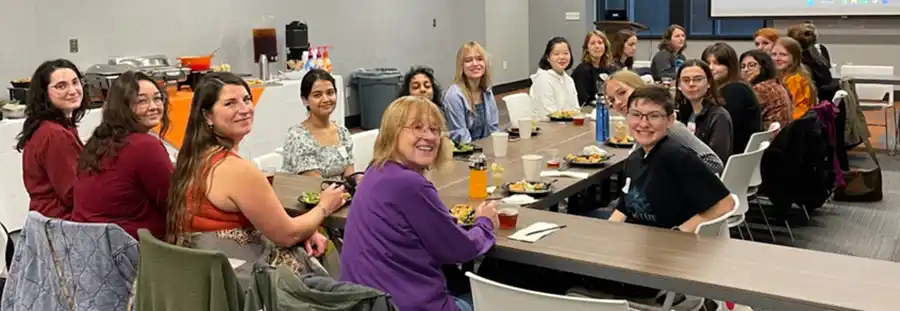
The Fall edition of the Women in Physics Lunch, sponsored by the Department of Physics and Astronomy, was held on December 8, 2022. Thirty female students, post-docs, and faculty shared great food and stimulating conversation. Save the date for our next lunch, which is going to be on Wednesday, May 10, 2023.

Women dining: a photo from the Women in Physics luncheon
Courtesy of Professor Adriana Moreo

December 9, 2022  |  Filed Under: Featured News, News

  • « Previous Page
  • 1
  • 2
  • 3
  • 4
  • Next Page »

Physics & Astronomy

College of Arts and Sciences

401 Nielsen Physics Building
1408 Circle Drive
Knoxville TN 37996-1200
Phone: 865-974-3342
Email: physics@utk.edu

Facebook Icon    X Icon

The University of Tennessee, Knoxville
Knoxville, Tennessee 37996
865-974-1000

The flagship campus of the University of Tennessee System and partner in the Tennessee Transfer Pathway.

ADA Privacy Safety Title IX