• Request Info
  • Visit
  • Apply
  • Give
  • Request Info
  • Visit
  • Apply
  • Give

Search

  • A-Z Index
  • Map

Physics & Astronomy

  • About
    • Honors
    • Administration
    • Faculty Resources
  • Research
    • Research Partners & Facilities
    • Condensed Matter
    • Particle / HEP
    • Biophysics / Soft Matter
    • Nuclear / Astrophysics
    • Quantum Information
  • People
    • Faculty
    • Staff
    • Joint Research & Adjunct Faculty
    • Post Docs
    • Graduate Students
  • Undergraduate
    • Why Physics
    • What Our Grads Do
    • Career Resources
    • Degree Programs
    • Research
    • Scholarships
    • Student Organizations
  • Graduate
    • Join Our Program
    • FAQs
    • Fellowships & Assistantships
    • Bains Fellowship
    • Where Our Grads Go
    • Research
    • Resources
  • News & Events
    • Newsletters
    • News
    • Colloquia Series
    • Events
    • In the Media
  • Outreach
    • Astronomy Outreach
    • Cool Things in the Sky this Month
    • Physics Outreach & High School Lecture Series
  • Alumni
    • Distinguished Alumni Award
    • Giving Opportunities
    • Share Your News
A banner showing a model of an atom and elementary particles

News

Featured News

A photo of UT Physics graduate student Ian Cox.

Knowledge (Gained from) Gaps

July 3, 2024

A persistent shell gap, an impressive instrumental performance, and important student contributions all lead to another PRL for UT’s nuclear physicists

A photo of UT Physics graduate student Ian Cox.
Ian Cox
A photo of Robert Grzywacz
Robert Grzywacz

Ian Cox is proof that you don’t always have to travel far to go a long way. He grew up in Knoxville, graduated from Hardin Valley Academy, and came to UT on a physics scholarship. Now he’s finishing a PhD in nuclear physics with Professor Robert Grzywacz and is first author on a Physical Review Letters publication detailing a new approach to understanding exotic nuclei.  

A Touch of Magic

Researchers from 13 universities and five national laboratories collaborated on this investigation at the Facility for Rare Isotope Beams (FRIB), a premiere research hub at Michigan State University. The nucleus is the heart of every atom, and since 2022 FRIB has produced hundreds of rare isotopes so that scientists can unearth how the most exotic nuclei hold together or decay. FRIB explores this unknown territory by creating extremely imbalanced and short-lived assemblies of protons and neutrons, helping physicists gain a deeper understanding of these quantum mechanical systems. The more complete that picture, the greater the likelihood scientists can predict how nuclei form, what their properties are, and how those properties can be of use. In this case, the starring isotope was chlorine-45. With 17 protons and 28 neutrons, it has a touch of what physicists categorize as magic.

Protons and neutrons in a nucleus are known collectively as nucleons and they’re arranged in shells. When they appear in certain numbers (2, 8, 20, 28, 50, 82, and 126), scientists call them “magic” because they fill complete shells and make the nucleus more stable (although that may be a lifetime of only a few milliseconds). Magic numbers are like sentinels in what’s known as the valley of stability. A proton or neutron count with a magic number (as in chlorine-45) resides at the border, where on one side you have nucleons bound strongly enough to hold the nucleus together and on the other their imbalance causes it to fall apart. This isn’t always straightforward, however. Magic numbers change for nuclei rich with neutrons, and scientists want to know how that alters the shell structure.

In this experiment the scientific team found that the beta decay of chlorine-45 converts one of its 28 neutrons to one of the 18 protons in argon-45. This lies outside the magic threshold of a 20-proton shell, creating a particularly unstable, unbound system. Grzywacz said “the experiment provided a unique method to study how the protons behave in a very neutron-rich nucleus. Understanding the persistence of nuclear shell gaps is crucial to describe the properties and formation of atomic nuclei.”

A Nuclear Symphony

A combined arrangement of innovative tools, talent, and effort made this work successful.

“This was an important experiment because we tried a lot of new things,” Grzywacz said.

His team was particularly pleased to use the full capabilities of the FRIB Decay Station Initiator (FDSi) for the first time. Grzywacz is the spokesperson for the FDSi, a years-long collaboration that designed, built, and implemented a modular combination of beta, neutron, and gamma-ray detectors to measure the decay of the most exotic nuclei produced at FRIB.

The FDSi played a crucial role in determining the complete decay pattern of chlorine-45. Cox identified the isotopes in this experiment as interesting candidates to show what the decay station could do. A key element was the two-focal plane detection system, which allows for simultaneous measurements and ultimately a combined and consistent data analysis that wouldn’t be possible with a single multi-detector system.

This is what Grzywacz called a scientific “symphony,” where “the instruments combined produce a different result than if played separately and individually.”

That metaphor extends to the scientists involved in the experiment.

Cox and Zhengyu Xu (a UT postdoctoral research associate) helped install FDSi at FRIB from the ground up. They’ve supported every FDSi experiment since, and led the analysis on the work published in PRL. Wei Jia Ong of Lawrence Livermore National Laboratory (LLNL) directed the measurement. Her interest was to measure decay of another isotope, calcium-54; this experiment was a prelude to the 2024 measurement.

Navigating multiple instruments and working with a large team were part of the learning experience for Cox.

“Working at FRIB on FDSi, I have learned a great deal about the complex nature of radioactive ion beam facilities and specifically the challenges which come with combining multiple different detector systems for a single experiment,” he said. “The varying types of detectors require a large collaboration of researchers, each with their own expertise to handle the individual detector systems, while also having to work together to ensure a successful experiment.”

Cox explained that frustrations could arise while everyone was trying to optimize their system in a limited amount of time. However, he found that having a sizable collaboration was helpful because in the end, working together, smaller groups could focus on individual detectors. Sharing the responsibility meant the science moved forward more seamlessly. This is the fourth publication based on FDSi findings and the third published in PRL.

To See the World, Stay Close to Home

Cox stayed in Tennessee for his education and ended up travelling far and wide. In addition to FRIB, he’s worked at the Radioactive Isotope Beam Factory at RIKEN in Japan and presented his research at conferences all over the world. He arrived on campus with a William Bugg Physics Scholarship and a spot in the Chancellor’s Honors Program. Over his undergraduate and graduate studies, he won the department’s Robert Talley Award for Outstanding Undergraduate Research, secured a Graduate Advancement and Training Education Fellowship from the UT-Oak Ridge Innovation Institute (UT-ORII), and won the department’s Paul Stelson Fellowship for Professional Promise in recognition of his outstanding research contributions as well as his departmental citizenship.

He plans to finish his PhD this summer and work in either the private sector or at a national laboratory. Whatever comes next, his time at UT has prepared him well, especially with the nuclear research group collaborating at laboratories in different states and countries.

“I have really enjoyed both travelling all over the world, for participating in experiments and presenting results, and the ability to meet many different researchers from all corners of the globe,” Cox said. “I believe this will greatly help me in my career, as I have been able to form many connections and establish myself as a young scientist.”

July 3, 2024  |  Filed Under: Featured News, News, Nuclear

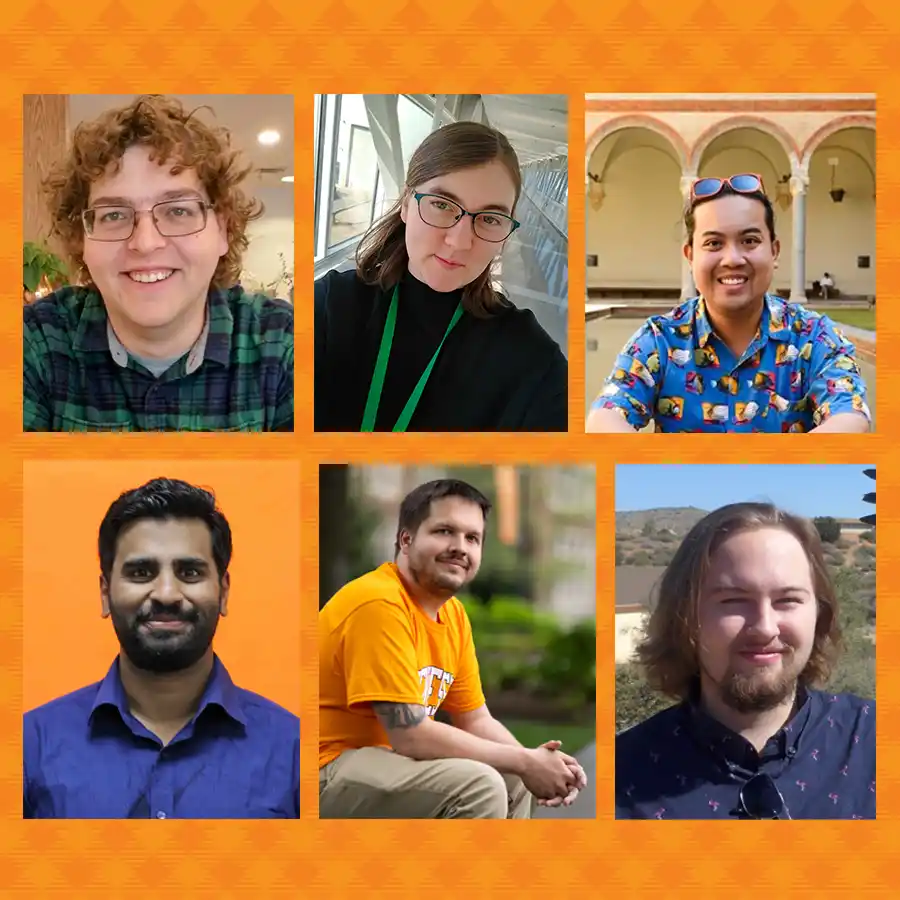
Collage of graduate students who won national and university awards in spring 2024

Four UT Physics Students Win DOE SCGSR Support

June 27, 2024

Collage of graduate students who won national and university awards in spring 2024
James Christie, Love Christie, Andy Tanjaroon Ly, Jinu Thomas, Charles Bell, and Colter Richardson

UT’s campus may be a little quieter during summer, but that doesn’t mean science stops. With help from the US Department of Energy, our graduate students are exploring exotic behavior in materials, measuring why carbon doesn’t fly apart, and testing the limits of the Standard Model of Physics. James Christie, Love Christie, Andy Tanjaroon Ly, and Jinu Thomas are among 86 students who learned this spring their thesis research will be supported by the DOE Office of Science Graduate Student Research (SCGSR) program.

Teaming students with state-of-the-art facilities at national laboratories, the SCGSR effort develops a new generation of scientists to lead innovation and discovery critical to the agency’s mission. While the students’ research projects may differ, the overall goal is the same: to learn more about the how nature works at a fundamental level.

Tanjaroon Ly and Thomas are both working with Professor Steve Johnston to investigate the inner workings of materials.

Tanjaroon Ly will develop computational models to study exotic superconducting states, where electric current moves through a material without losing energy. Working at Oak Ridge National Laboratory (ORNL), he’ll use Monte Carlo simulations to carry out his research. Named for the famed casino, these calculations are a powerful tool using random sampling and probability to generate possible mathematical simulations for new states.

Thomas is working with quantum materials—those whose properties can’t be described by the classical laws of physics. He’s focusing on out-of-equilibrium systems that can drive novel phenomena, using time-resolved resonant inelastic X-ray scattering (tr-RIXS) to explore that behavior. Under Johnston’s supervision, Thomas will work with Dr. Mark Dean at Brookhaven National Laboratory.

While Tanjaroon Ly and Thomas deepen our understanding of materials, James and Love Christie are studying the carbon present in our cells and the model describing the building blocks of the universe.

Working with Assistant Professor Miguel Madurga at ORNL, James Christie is taking a closer look at the Hoyle state, the source of most of the carbon on Earth (including in humans). In this state, excited carbon can de-excite and turn into ground state carbon-12, which makes up nearly 99 percent of the carbon on our planet. His research focusses on measuring how often that transition happens instead of the excited carbon simply flying apart.

Love Christie will also be at ORNL, working with Professor Nadia Fomin on uncertainty studies for the Nab experiment. Using the Spallation Neutron Source’s powerful neutron beam, the experiment will provide precise testing of neutron decay parameters predicted by the Standard Model of Physics, the framework for the particles and forces foundational to our understanding of the universe.

The Road to Rocky Top

What brought these four students to Knoxville is in many ways a combination of UT’s strengths: the chance to be part of a strong research program at a large university that’s also close to home.

Tanjaroon Ly is from St. Petersburg, Florida, and earned his bachelor’s degree in physics and math at the University of Florida.

“I decided to attend UT based on the strength and diversity of the condensed matter research,” he said, noting the proximity of ORNL and the opportunity for collaborations there.

Thomas is originally from Kochi, Kerala, in southern India. He moved to the United States in 2009 and spent most of his time in Illinois, Indiana, and Wisconsin before moving to Knoxville for graduate school. After graduating from the University of Illinois at Urbana-Champaign with a degree in engineering physics, he said “visiting UT gave me the ‘big’ school feel I had as an undergrad. Having been away from physics for four years, the program here felt better suited to help me learn. Plus, it’s beautiful here in East Tennessee.”

For James Christie and Love Christie, who hail from Campbellsville and Richmond Kentucky, respectively, family made the difference. Both graduated from Eastern Kentucky University (James in physics with minors in chemistry and math; Love with a dual degree in physics and math).

Coming to UT meant “I stayed close to home, which is really nice,” James Christie said. “My family’s really important to me, so being close to home is good.”

Love Christie saw twin benefits in UT’s graduate physics program.

“It was the best option for following my passion and staying close to my family simultaneously,” she said.

Success Begets Success

Since 2016, 13 UT physics students have won SCGSR funding to help them untangle scientific questions as they work toward their graduate degrees. These latest awards are among multiple honors the department’s students won this spring, including a prestigious National Science Foundation Graduate Research Fellowship for Charles Bell, who finished an undergraduate degree in May and will begin graduate studies at the University of Michigan this fall. A US Navy veteran, he worked with Assistant Professor Larry Lee in the Compact Muon Solenoid research group, where he helped create a visualization for a possible muon collider detector. The artwork made the cover of Science Magazine.

Graduate Student Colter Richardson also won support through the UT-Oak Ridge Innovation Institute Graduate Advancement, Training and Education (GATE) fellowship program. He’ll work with Professor Anthony Mezzacappa on Bridging Data Analysis and Physical Modeling of Core-Collapse Supernovae. He’s the eighth physics graduate student since 2020 to secure GATE funding.

Learn more about our graduate program in physics.

June 27, 2024  |  Filed Under: Featured News, News, Uncategorized

A photo of Yang Zhang

Yang Zhang Wins Prestigious IUPAP Early Career Scientist Prize

June 20, 2024

A photo of Yang Zhang

Assistant Professor Yang Zhang hadn’t planned to go to Greece this summer, much less prepare an invited lecture. But when he learned he’d been chosen for the 2024 International Union of Pure and Applied Physics (IUPAP) Early Career Scientist Prize in Computational Physics, he was happy to put together some last-minute travel plans.

Watching Galaxies Form

The IUPAP comprises 20 international Commissions representing different subfields of physics. Each Commission recognizes outstanding physicists in the first stages of their careers with the Early Career Scientist Prize. C20, the Commission on Computational Physics, selected Zhang for this year’s award. He was cited “for his significant and innovative achievements in computational study of topological bands and quantum anomalous Hall states in two-dimensional semiconductors.”

As the C20 website explains, computational physics is where a computer becomes the basic tool for exploring natural laws. When experiments are impossible or impractical, computation provides simulated studies with closely-controlled conditions. Where data are overwhelming or unwieldy in terms of volume or intricacy, computational codes and models can work through them more easily.

Zhang has been intrigued by the field’s possibilities since his early studies.

“I first got interested in computational physics during my undergraduate research internship with Dr. Sverre Aarseth” of the University of Cambridge Institute of Astronomy, he said. “Seeing a galaxy form on the computer screen was mesmerizing. I learned to tweak parameters and to optimize the program even at hardware level, gaining a deeper understanding of the physics and computational techniques involved. The blend of physical intuition, mathematical rigor, and computational creativity ignited my passion for the field and set me on the path to further studies and research in computational physics.”

Zhang has taken that passion and applied it quantum materials, helping build UT’s research and teaching expertise in this growing and critical field.

Physics Professor and Department Head Adrian Del Maestro explained that Zhang “is driving innovation in quantum materials research by translating the latest advances in artificial intelligence and applying them to extraordinarily challenging problems in strongly interacting quantum systems.”

He added that with his strong collaboration network, Yang’s research has a truly global impact, while at the same he has a unique gift for developing new algorithmic methods and communicating these discoveries to UT’s undergraduate and graduate students.

Del Maestro works with Zhang through their leadership roles in UT’s Center for Advanced Materials and Manufacturing, a National Science Foundation-supported Materials Research Science and Engineering Center (MRSEC). Both hold joint appointments in the Department of Physics and Astronomy and the Min H. Kao Department of Electrical Engineering and Computer Science.

An Unexpected Honor

Zhang joined UT in 2023 after a postdoctoral appointment at the Massachusetts Institute of Technology following completion of a PhD at the Max Planck Institute Dresden. He has won several awards, including two Overall Winner Awards in the World Supercomputing Contest, the SFB Best Doctoral Thesis Award, the Tschirnhaus Medal from the Leibniz Association, and the Otto-Hahn Medal of the Max Planck Society. Now he adds the prestigious IUPAP Early Career Scientist Prize to that list.

“Receiving this award means a great deal to me,” Zhang said. “It recognizes my hard work and dedication in computational quantum matter and highlights the importance of my method development, as well as my contributions in semiconductor superlattice. This recognition motivates me to continue pushing the boundaries of knowledge in developing methods for large-scale quantum systems and inspires me to mentor future scientists.”

Zhang was surprised to learn he had won the prize, as nominees may have up to eight years of research experience after finishing a doctoral degree and he was about four years past his PhD when he learned he had been nominated.

“This award was an unexpected but deeply appreciated honor,” he explained. “I believe recent breakthroughs in fractional quantum anomalous Hall effects played a significant role in earning this recognition, and I am grateful for the support and acknowledgment of my work in this exciting field.”

Zhang will accept the prize at the 35th IUPAP International Conference on Computational Physics (CCP2024) to be held in Thessaloniki, Greece, July 7-12. As part of his recognition, he’s invited to deliver a lecture. Though his summer agenda hadn’t included the conference, he said he “quickly organized my travel arrangements and prepared for the event.”

About IUPAP

The International Union of Pure and Applied Physics (IUPAP) was established more than a century ago in Brussels with 13 member countries, holding its first General Assembly in 1923 in Paris. That number has grown to 60 member countries, with the Union being the only international physics organization run by the physics community itself. IUPAP’s mission is “to assist in the worldwide development of physics, to foster international cooperation in physics, and to help in the application of physics toward solving problems of concern to humanity.”

June 20, 2024  |  Filed Under: Condensed Matter, Featured News, News, Quantum Materials

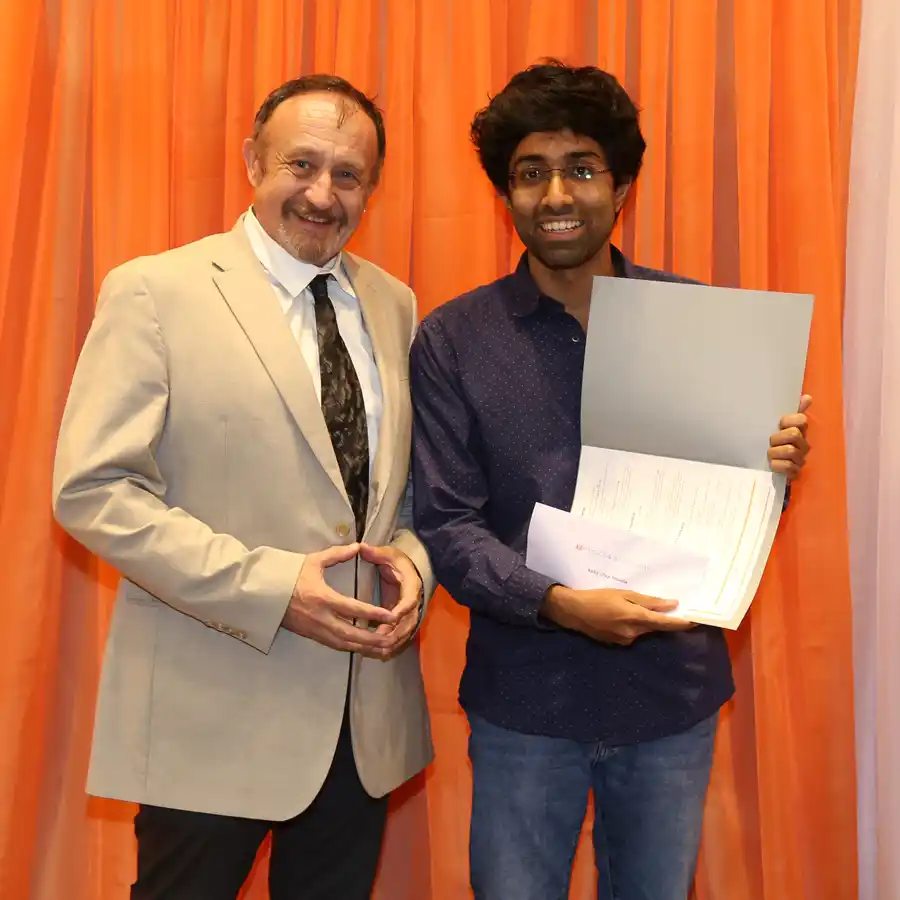
Photo of Norman Mannella and Abhyuday Sharda

Honors Day Awards 2024

May 16, 2024

On May 6 the department hosted our annual Honors Day celebration to recognize outstanding students, faculty, and staff. Professor and Department Head Adrian Del Maestro welcomed guests and shared highlights from the department’s banner year: multiple distinguished awards and fellowships for our faculty and students, 33 graduates for 2023-2024, and milestones like passing the comprehensive exam (a feat 24 students have accomplished in the past year). Physics has a lot to celebrate! Many thanks to Assistant Professor Larry Lee for presenting the undergraduate awards and Professor Norman Mannella for presenting the graduate honors. Read more about our amazing awardees below, and see the photo album at the bottom of the page.

Extraordinary Departmental Service Awards

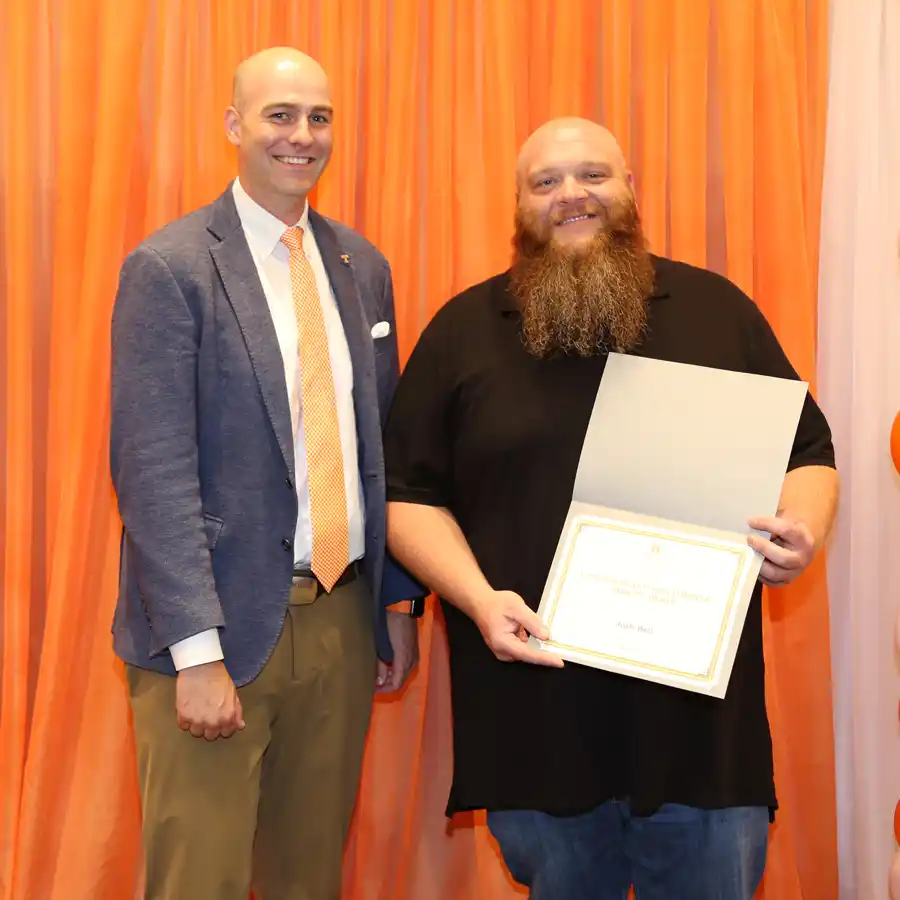
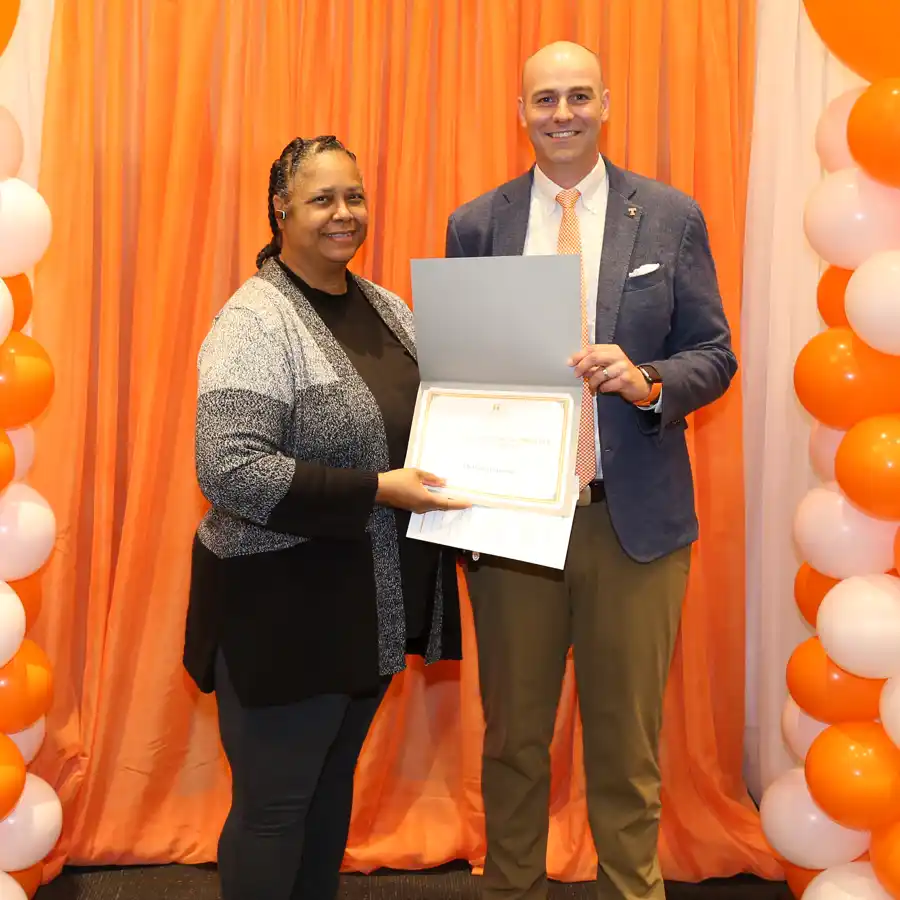
This award goes to staff members who’ve gone above and beyond their job descriptions to keep the department moving in the right direction. This year the department honored Josh Bell (Machine Shop Supervisor) and Debra Johnson (Business Manager). They were cited “for stepping up and taking over leadership of their respective areas (Machine Shop and Business Office), resulting in a seamless transition and continual excellent service in support of the department’s teaching, research, and service mission.”

Outstanding First Year Student Award

This award recognizes exceptional achievement by a student in the first year of physics study. The faculty considers traditional first-year students enrolled as physics majors as well as transfer students who are in their first year at UT.

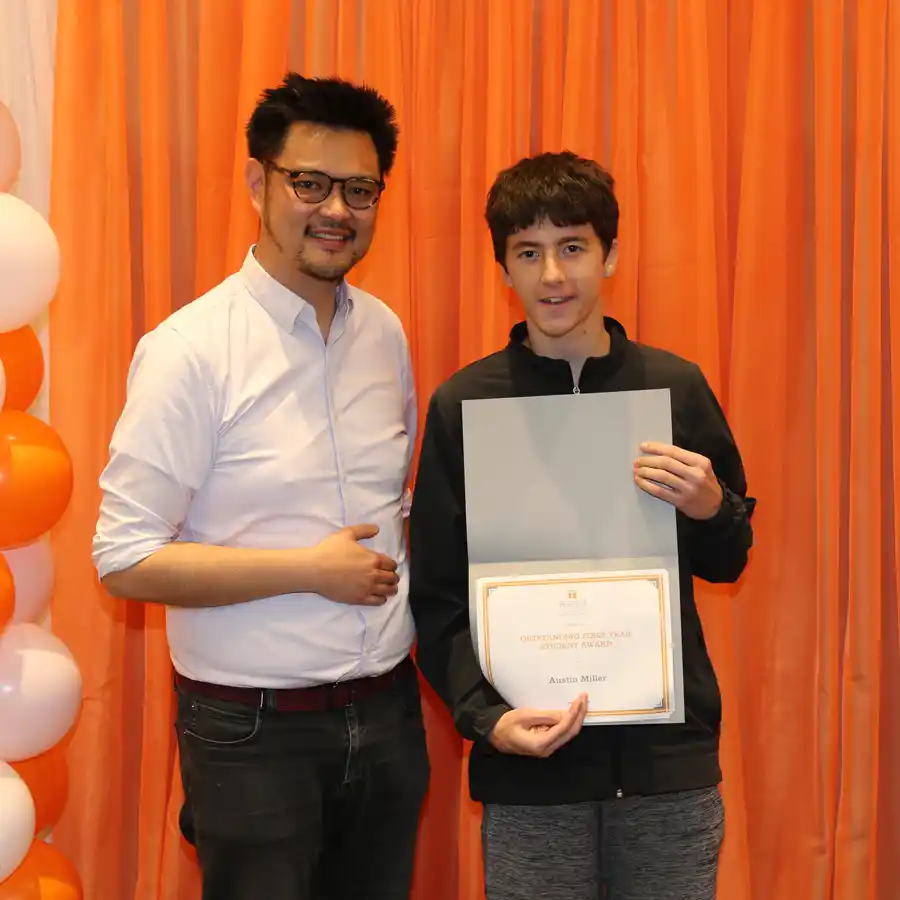
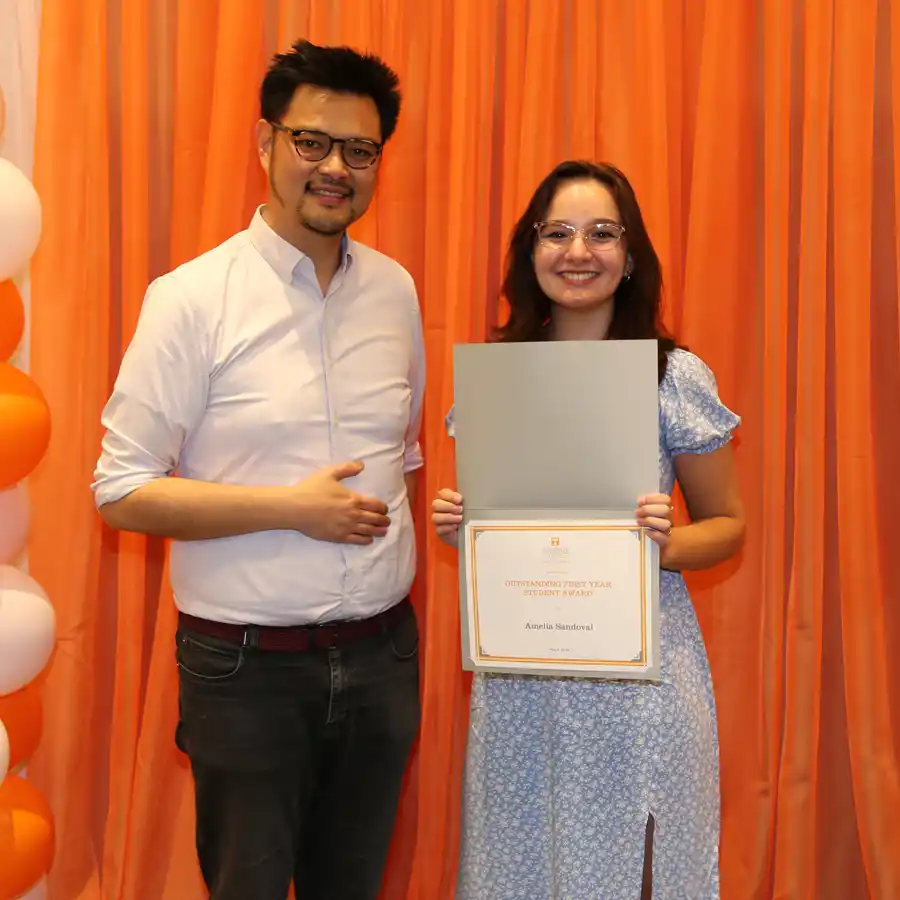
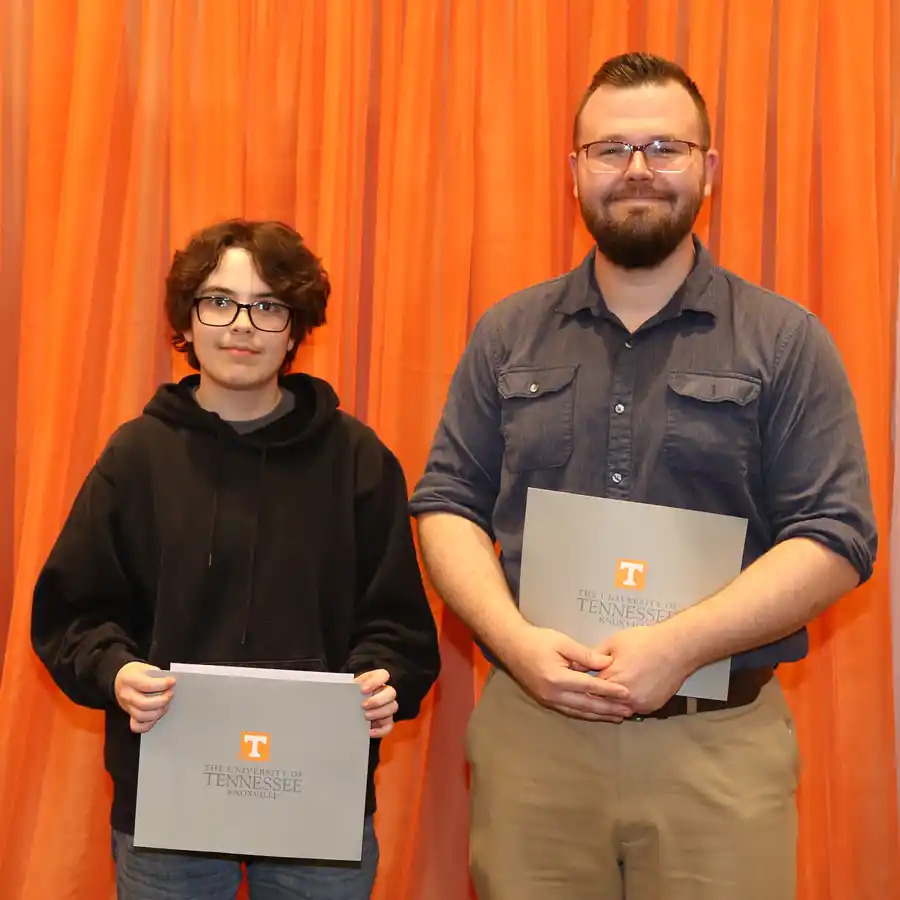
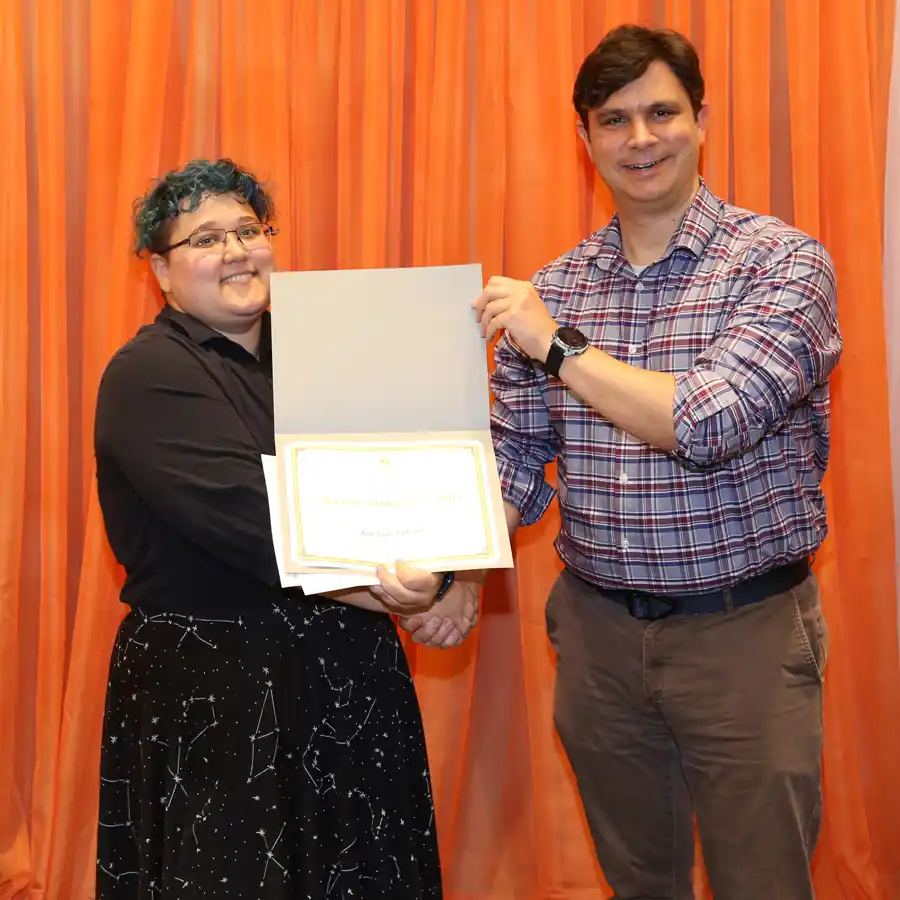
This year we were fortunate to recognize three extraordinary students with this honor: Austin Miller, Amelia Sandoval, and Jordan Ashley.

While they have distinguished themselves academically, they also bring enthusiasm, discipline, and diligence to their coursework. They are off to a great start in physics.

Robert Talley Awards

The Talley Awards are made possible by the late Robert Talley, a UT Physics master’s and PhD graduate and a distinguished alumnus honoree.

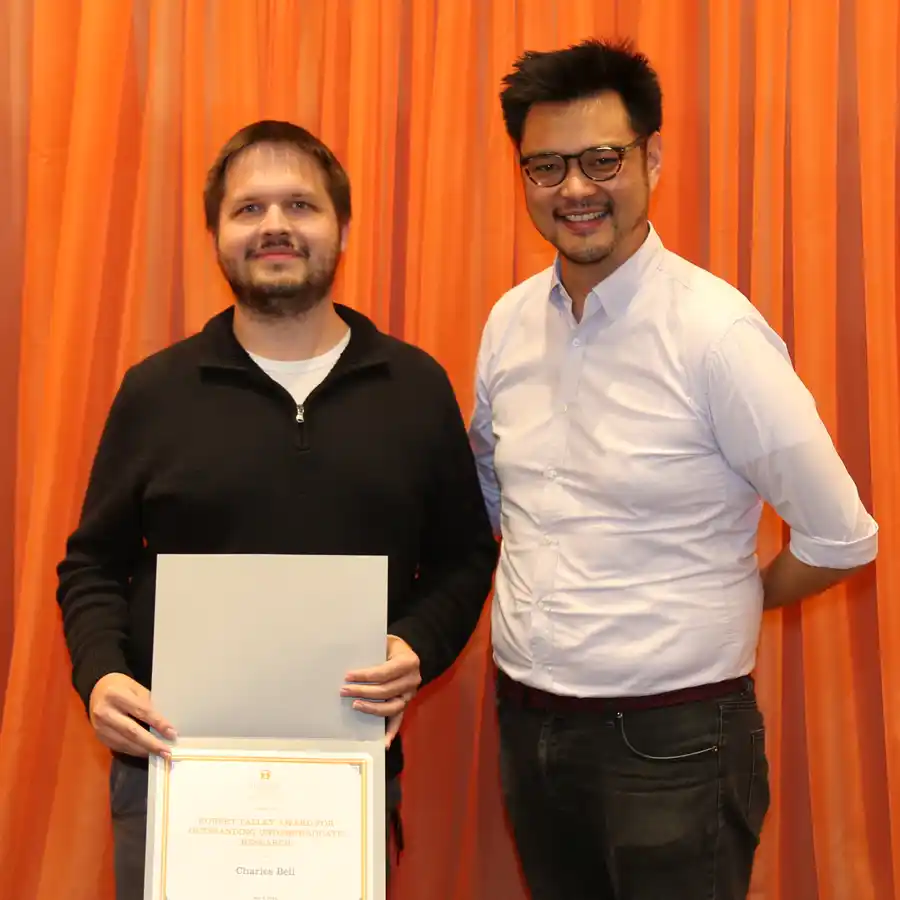
The first award (for Outstanding Undergraduate Research) goes to a student who has demonstrated a talent for solving problems through physics theory and/or experiment. Charles Bell has worked across theory, phenomenology, and experiment. One of his recent successes was helping visualize a particle detector in the game creation system Unreal Engine. He jumped into an incredibly daunting and unfamiliar framework and took the first steps into rendering these detectors in Unreal. The renderings that came out of this work have since been used in a recent issue of Science, including on the cover. This summer he’ll start graduate studies at the University of Michigan, working on the ATLAS Experiment at CERN to continue his particle physics research. He has earned a prestigious NSF graduate fellowship to support his work.

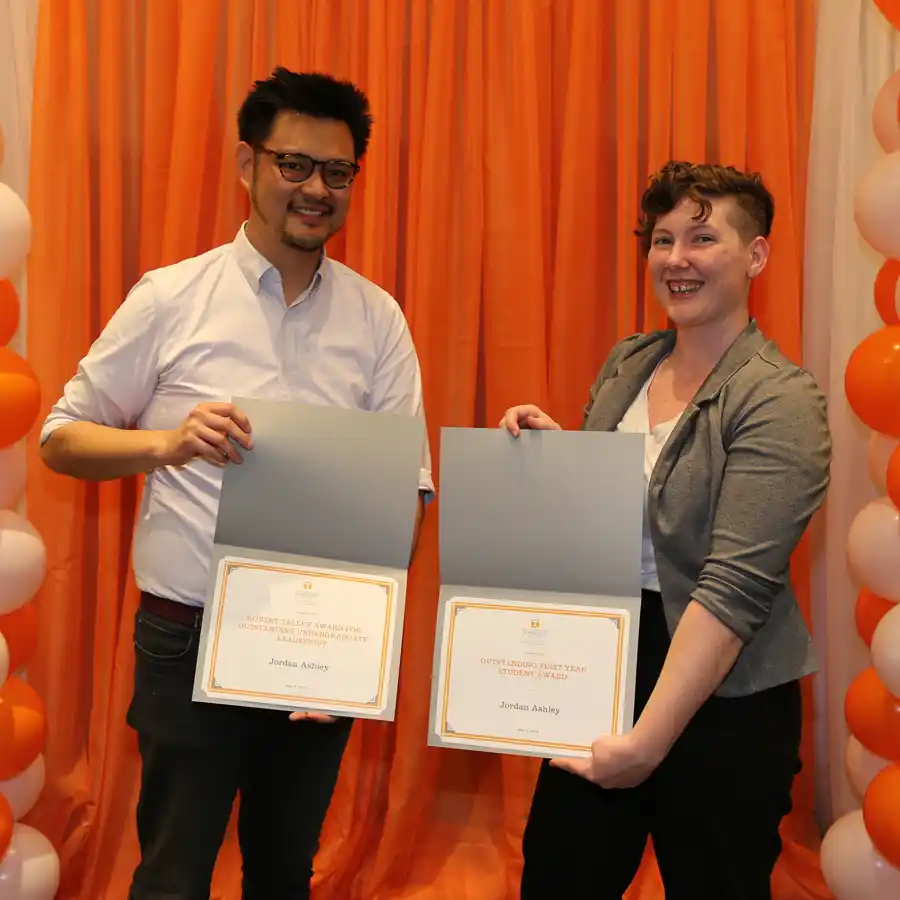
The second Talley Award recognizes Outstanding Undergraduate Leadership and goes to a student who has made significant contributions to the department outside the classroom, adding depth to our programs and encouraging interest in physics. Jordan Ashley spent time in the workforce before pursuing an undergraduate degree and joined the department as a transfer student. She’s been working in the particle physics group to perform a reinterpretation of an ATLAS search for displaced leptons in an R-parity violating supersymmetry context. She has written her own analysis code, helped merge everything into a GitHub project, and established a workflow for shared usage. She’s developed a fully working setup for event generation and compared results to those from the original paper. She’s working on scaling this up for large amounts of input data. Jordan also represented the department on a high energy physics lobbying trip to Washington, DC.

James W. McConnell Award for Academic Excellence

A bequest from UT graduate James W. McConnell established this Physics Excellence Endowment, resulting in $1 million in gifts to the physics department. The McConnell Award recognizes students who have senior standing and who have demonstrated outstanding performance in academic coursework.

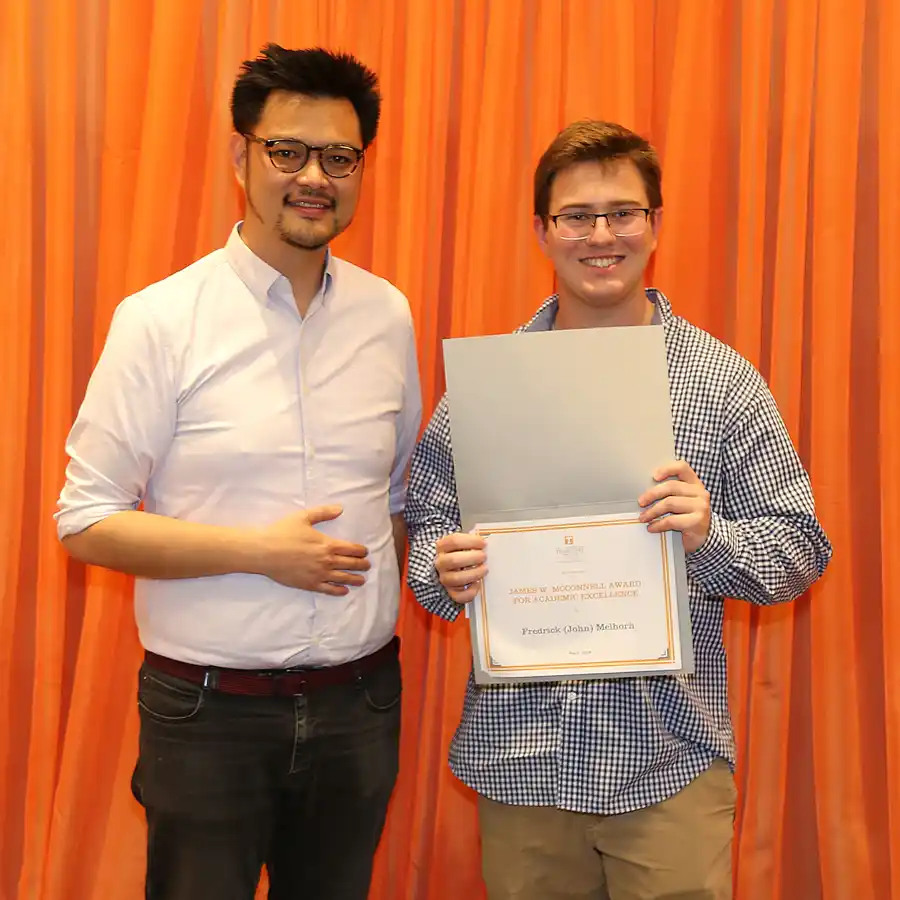
Fredrick (John) Melhorn is a Chancellor’s Honors Scholar who has balanced rigorous coursework with research, including work for his honors thesis. His primary focus is on machine learning applications for direct photon classification in calorimeter clusters, which he tackled with enthusiasm and dedication. He exceeded expectations by delivering a fully functional Convolutional Neural Network model and a streamlined workflow for preprocessing physics data within a week. His proactive approach to learning and problem-solving has been evident throughout the research process, and he has consistently surpassed the goals set for him. He has also excelled in writing-intensive honors classes, building a strong academic record over his undergraduate career.

Douglas V. Roseberry Distinguished Upper Class Major Award

Douglas Roseberry loved physics and extracurricular activities inside and outside the department. He planned to attend graduate school at Princeton when he died unexpectedly in October 1959. In 1960, the department awarded the first Roseberry Award to honor a student with similar gifts and enthusiasm for research, academics, and leadership. The Roseberry Award is the department’s most distinguished undergraduate honor.

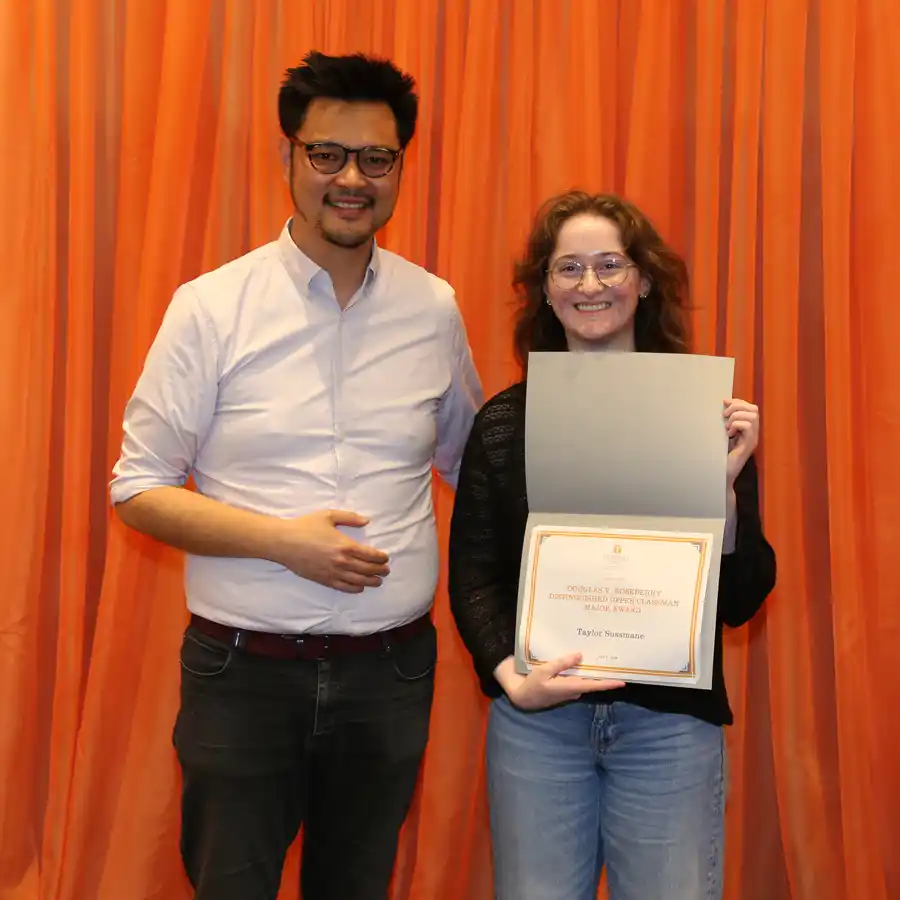
Taylor Sussmane has excelled in academics, research, and community service. She spearheaded the effort to revitalize our department’s Women in Physics group after a long hiatus. This group has sprung back to life with active meetings and membership, with support for women across the department. She worked in heavy ion physics before moving to the Compact Muon Solenoid experiment at CERN, studying possible new particles produced in the collisions of the Large Hadron Collider. With collaborators from UT and the University of Chicago, she led analysis that sets new unique constraints on such new particles, and remains one of the strongest limits to date in a particle region of model space. Next up, she’ll be a proud UT alumna when she continues her studies as a PhD student at the University of Wisconsin, Madison, working in experimental particle physics at the LHC.

Outstanding Graduate Teaching Assistant Awards

This year we recognized three outstanding Graduate Teaching Assistants for their fine work in the undergraduate physics labs.

Nico Braukman taught PHYS 221 and 222 this past year, inspiring student comments including: “Nico was one of the best TAs I have ever had. Very positive, helpful, and insightful. Made the material much more understandable.” And: “Nico was so helpful and kind throughout the semester! No matter how silly or ridiculous my questions were in lab, they were always kindly answered.”

Ryan Elder was a GTA for PHYS 231 this year, earning student evaluations such as: “Ryan was a great TA and his explanations were very helpful. He created a positive and unique lab environment that challenged me to critically think about how I gauge how well I understand the material.” And: “(Ryan) did a great job explaining concepts and clearly knew what was going on. He made a more fun learning environment by being friendly and approachable. Even when I’d be having a bad day, he always showed that he cared and was willing to offer help.”

Amber Stinson is an astronomy GTA whose student evaulations outlined how she is very good at running and teaching lab. One student wrote: “I was never confused during her explanations of labs, and she was always willing to help if I was stuck on any portions of the labs. She was very kind when helping other students.”

Wayne Kincaid Award

Wayne Kincaid was a UT Physics alumnus who later worked as a research associate in the department. He devoted his energy to developing tools that would make learning engaging and accessible for students at all levels. The department established this award to honor his legacy by recognizing a student who shares his love for astronomy and astrophysics education.

Jordan Jubeck is one of two leads for the telescope labs we host for undergraduate students. In presenting the Kincaid Award, Sean Lindsay, senior lecturer and astronomy coordinator, described how she created an Astronomy Telescope Labs website that provides status updates on if the rooftop will be open, gives weather forecasts, and houses an archive of astrophotography taken from our rooftop observing platform. She has also been a tremendous and enthusiastic driver of astronomy education outreach, helping out with events at local schools, community groups, and our own solar (eclipse) and night sky observing events. She also runs much of our planetarium-based outreach programming.

Stelson Fellowships

Paul Stelson finished a PhD at the Massachusetts Institute of Technology when he was 23. He worked for MIT and then joined Oak Ridge National Laboratory as a nuclear physicist, eventually becoming Director of the Physics Division. Dr. Stelson especially enjoyed interacting with young physicists, serving as an adjunct professor in the physics department for nearly 30 years. His family established the Stelson honors in his memory to assist aspiring physicists in completing their education.

Each year we recognize two students at Honors Day with Stelson Fellowships. The first of these is for Professional Promise. Abhyuday Sharda began in our department as a teaching assistant, helping new graduate students adjust to the job by sharing all his notes and lab writeups from previous years. He then moved into research on XEM2 experiments at Jefferson Laboratory. He threw himself into data analysis, assembling needed resources, asking the right questions, and sharing everything he learns with his peers. He knows how to calibrate multiple spectrometer detectors, has done several efficiency studies, and recently obtained EMC results for several isoscalar nuclei. He has developed analysis code, collaborated with experts on detector calibrations and analysis techniques, and built life-long relationships with his peer cohort.

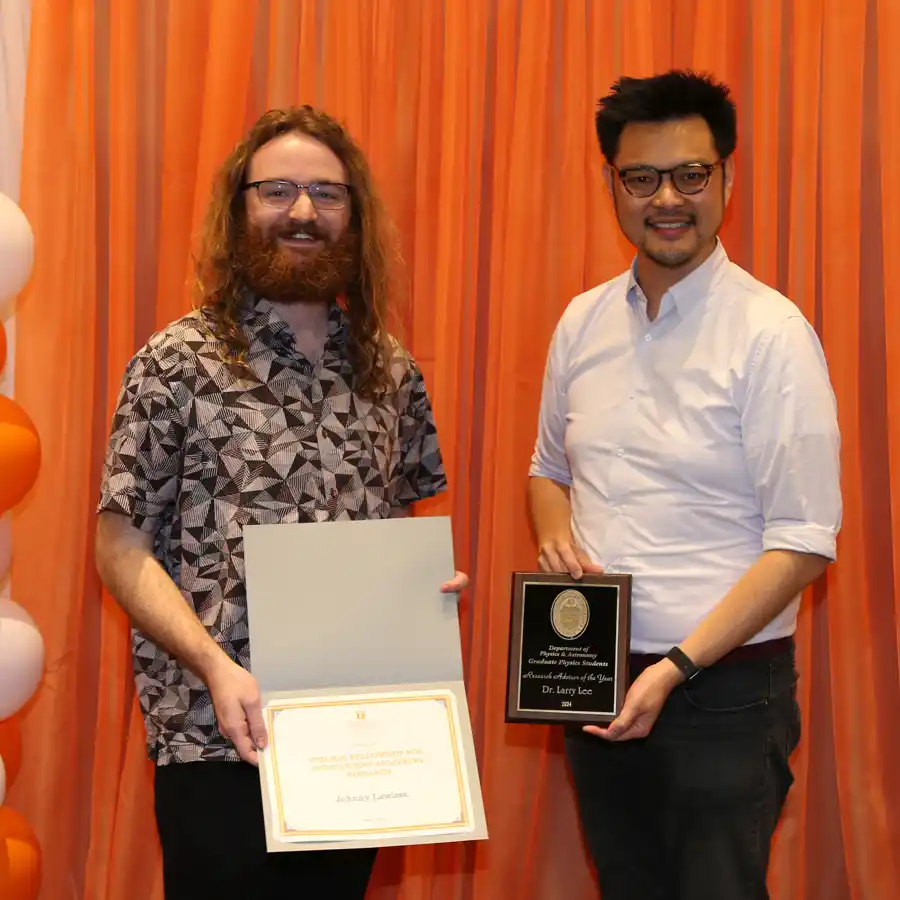
The Stelson Fellowship for Outstanding Beginning Research recognizes a student for outstanding progress early in their research. Johnny Lawless has been tackling problems, learning new skills, and producing results since he first joined the graduate program. He spent a summer at Fermilab working with a team doing test beam characterizations of a Compact Muon Solenoid tracker upgrade component. He quickly became a lead on that project, driving the result with his enthusiasm, curiosity, and hard work. He has since jumped into the world of Large Hadron Collider data analysis and Machine Learning for high dimensional input space problems. On top of his personal research contributions, he goes above and beyond to help train the large number of undergraduates to ensure success across the UT CMS group.

Fowler-Marion Outstanding Graduate Student Award

Joseph Fowler was part of Oak Ridge National Laboratory’s Physics Division and also taught physics courses and conducted research at UT. With his colleague Jerry Marion he co-authored the textbook Fast Neutron Physics. They donated the royalties to the department, where the funds helped establish an award recognizing a graduate student who has excelled in scholarship, research, and departmental citizenship.

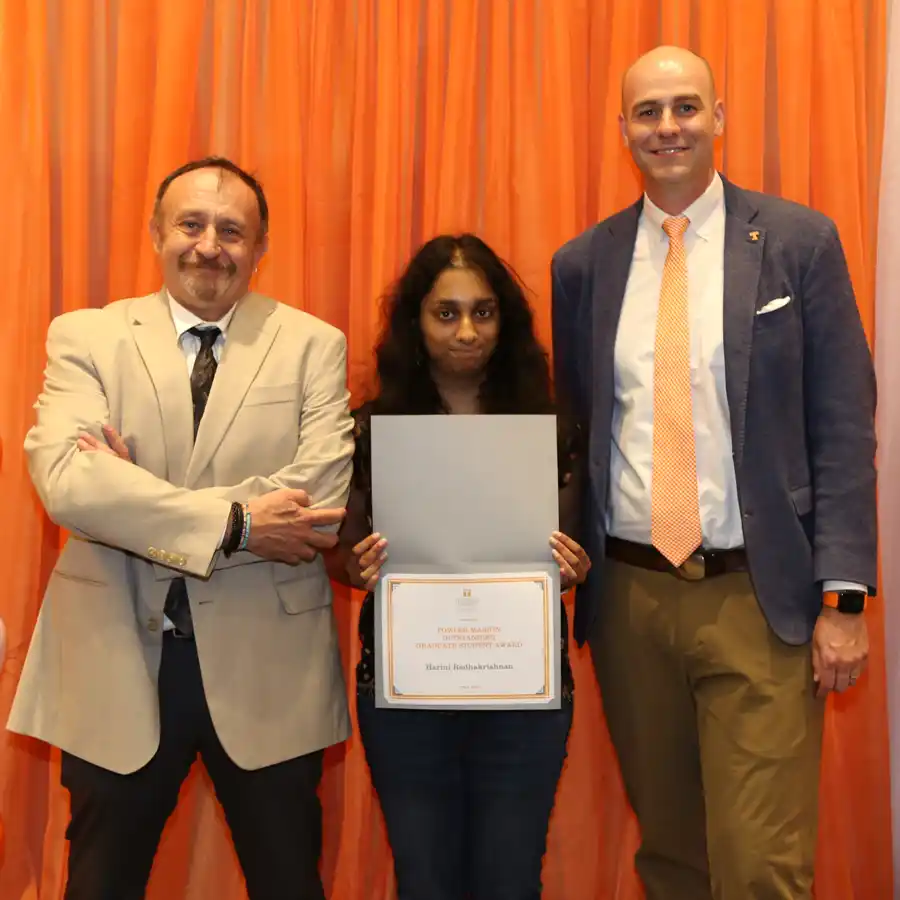
Harini Radhakrishnan has consistently excelled in all these areas. She has three published papers, (one as first author) with another important first author paper in the final manuscript preparation stage. She works to understand entanglement in condensed matter, including a paper that provides new insights into particle entanglement and will yield new tools able to diagnose the generation of exotic quasiparticles in and out of equilibrium. Her research contributes to a better understanding of how quantum statistical mechanics emerges from unitary time evolution in closed quantum systems, with implications for statistical, condensed matter, ultra-cold atom, and quantum information physics. Harini has contributed greatly to the department’s community, serving as president and vice president of the Graduate Physics Society. She also advised high school students as part of UT’s Upward Bound Program and helped create the Individual Development Plan our students now use.

Faculty Honors

Honors Day offers the department an opportunity to recognize exceptional faculty contributions to teaching and research mentorship. The undergraduates select two awardees through the Society of Physics Students and the graduate students do the same through the Graduate Physics Society. This year’s honorees are:

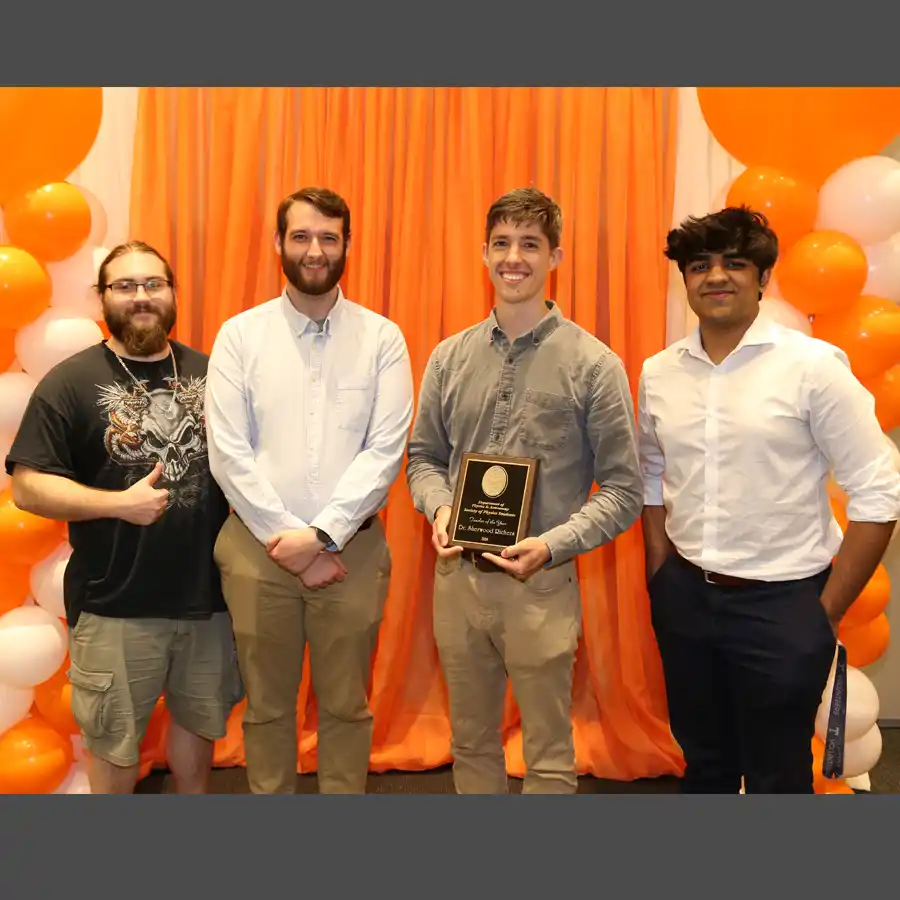
Society of Physics Students Teacher of the Year Award: Assistant Professor Sherwood Richers

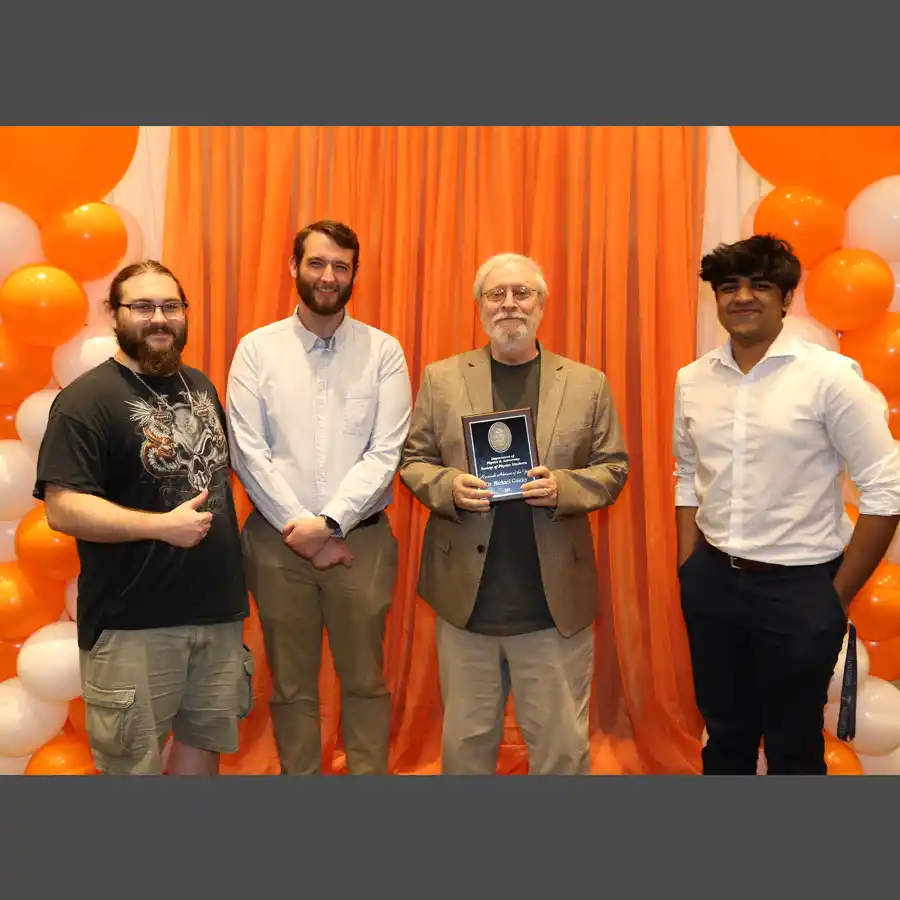
Society of Physics Students Research Advisor of the Year Award: Professor Michael Guidry

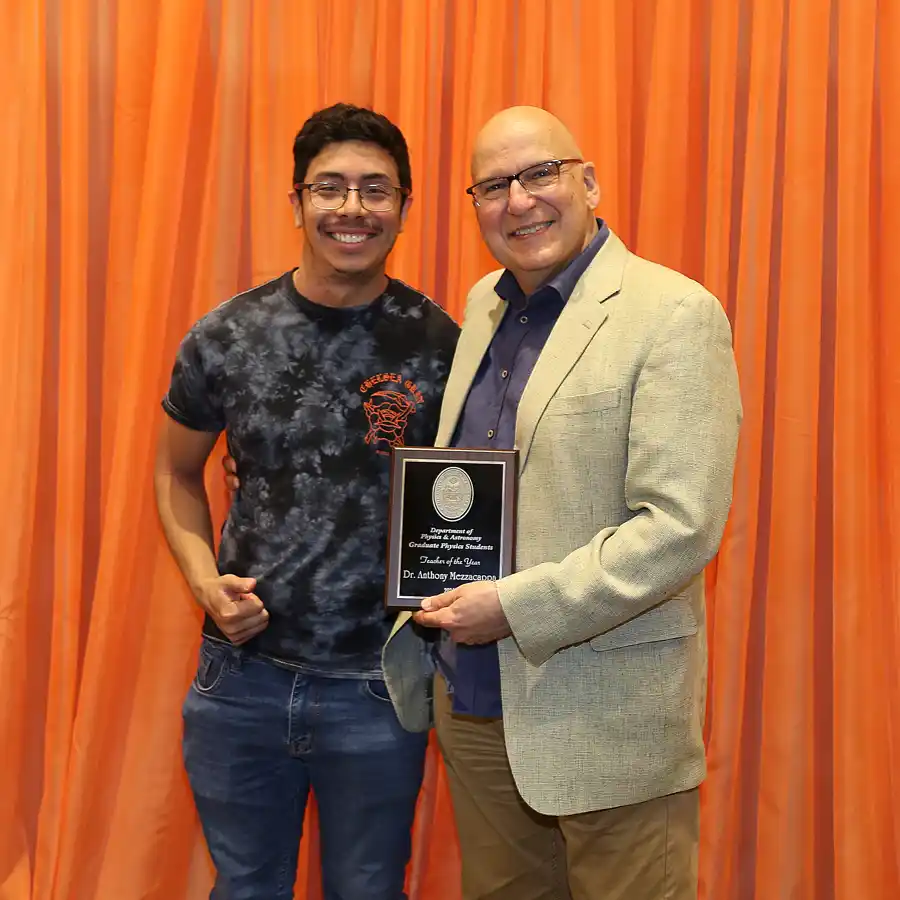
Graduate Physics Society Teacher of the Year Award: Professor Anthony Mezzacappa

Graduate Physics Society Research Advisor of the Year Award: Assistant Professor Larry Lee

Sigma Pi Sigma Inductees

Sigma Pi Sigma is the physics honor society. UT’s chapter began in 1954 with Alvin Nielsen among the inaugural members. The society’s four dimensions are service, encouragement, honor, and fellowship. This year we welcomed the following student’s into our chapter:

Joesph Beller
Raghav Chari
Hugh Jones
Amanda Nowicki
Nolan Robertson
James Rogers
Alexander Sizemore

YETI Awards

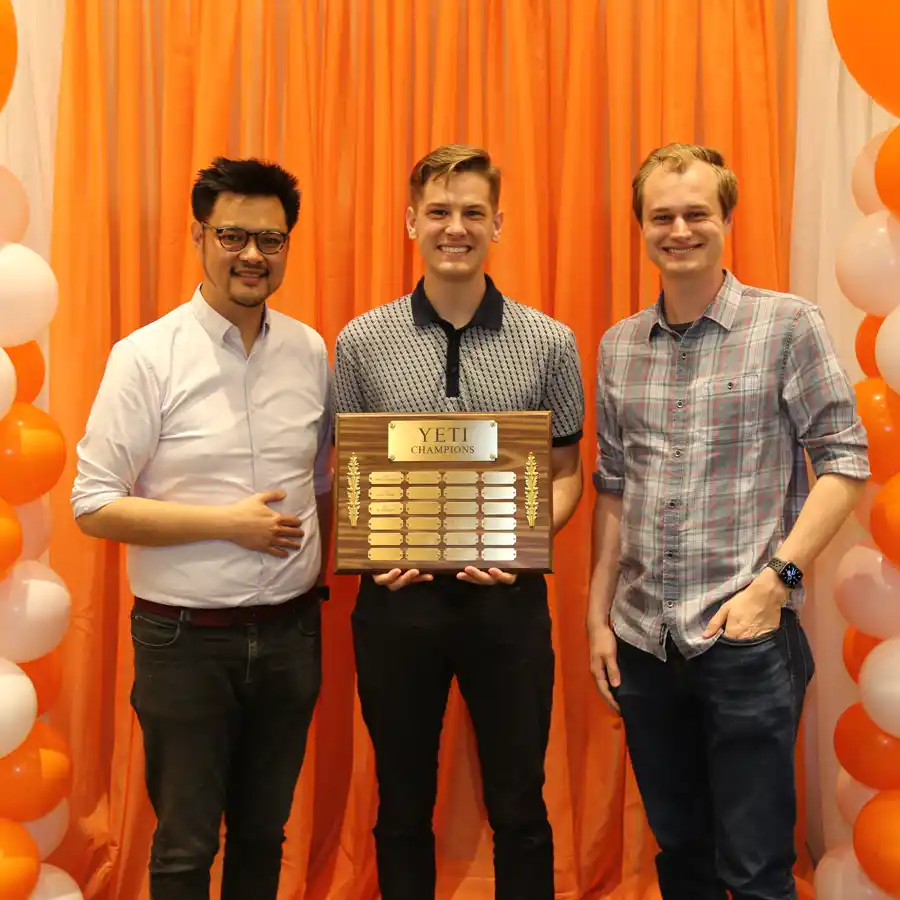
Assistant Professors Tova Holmes and Larry Lee created the Year End Tournament of Imagination (YETI) in 2022 as an engaging challenge where players analyze data to solve puzzles, unlocking more clues to reveal fun facts. This year the department recognized the tournament champions at Honors Day, where we acknowledged the four finishers: Jordan O’Kronley, Sanket Sharma, Micah Hillman, and Rebecca Godri. Claiming the year’s honors by category were:

Very Delightful: Rebecca Godri
Very Interactive: Jordan O’Kronley
Overall winner: Micah Hillman

Photo of Adrian Del Maestro and Josh Bell
Adrian Del Maestro and Josh Bell
Photo of Debra Johnson and Adrian Del Maestro
Debra Johnson and Adrian Del Maestro
Photo of Larry Lee and Austin Miller
Larry Lee and Austin Miller
Photo of Larry Lee and Amelia Sandoval
Larry Lee and Amelia Sandoval
Photo of Larry Lee and Jordan Ashley
Larry Lee and Jordan Ashley
Photo of Charles Bell and Larry Lee
Charles Bell and Larry Lee
Photo of Larry Lee and John Melhorn
Larry Lee and John Melhorn
Photo of Larry Lee and Taylor Sussmane
Larry Lee with Taylor Sussmane
Photo of Nico Braukman and Ryan Elder
Nico Braukman and Ryan Elder
Photo of Jordan Jubeck and Sean Lindsay
Jordan Jubeck and Sean Lindsay
Photo of Norman Mannella and Abhyuday Sharda
Norman Mannella and Abhyuday Sharda
Photo of Johnny Lawless and Larry Lee
Johnny Lawless and Larry Lee
Photo of Norman Mannella, Harini Radhakrishnan, and Adrian Del Maestro
Norman Mannella, Harini Radhakrishnan, and Adrian Del Maestro
Photo of Sherwood Richers with Gage Erwin, Zach Patton, and Raghav Chari
Sherwood Richers with SPS Reps. Gage Erwin, Zach Patton, and Raghav Chari
Photo of Michael Guidry with Gage Erwin, Zach Patton and Raghav Chari
Michael Guidry with SPS Reps. Gage Erwin, Zach Patton, and Raghav Chari
Photo of Ramon Ogaz and Anthony Mezzacappa
Ramon Ogaz and Anthony Mezzacappa
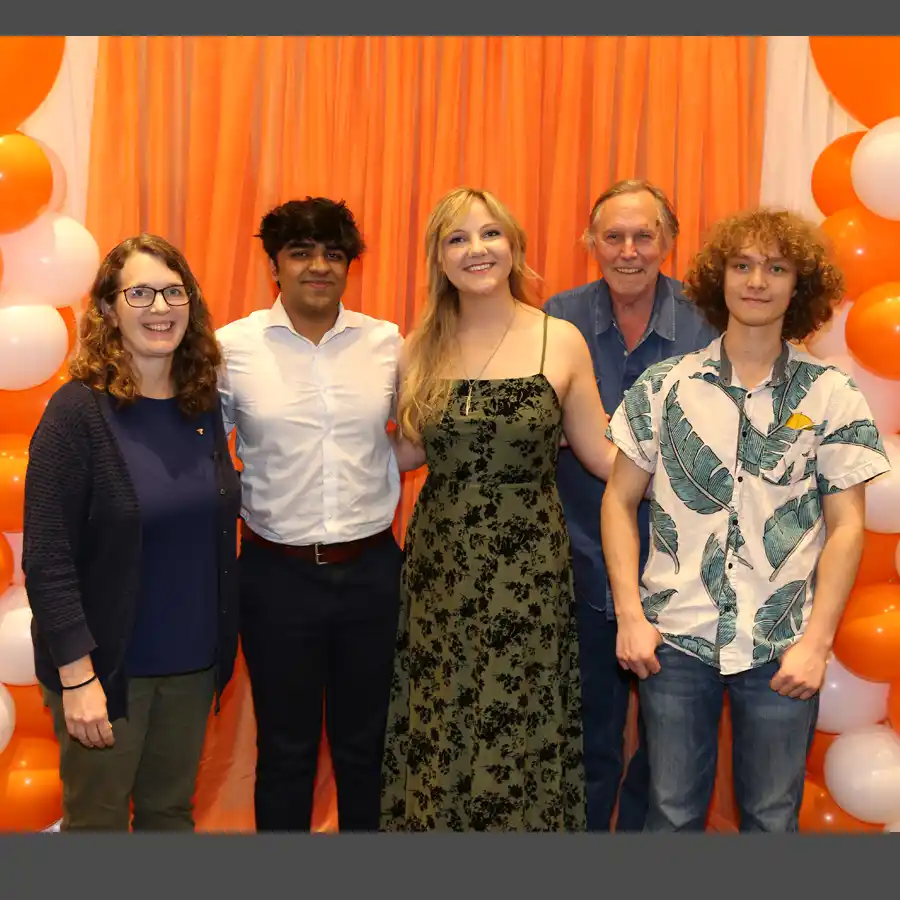
Photo of Sigma Pi Sigma Inductees
Christine Cheney with Raghav Chari,
Amanda Nowicki, Hugh Jones, and James Rogers
Photo of Larry Lee with Micah Hillman and Jordan O'Kronley
Larry Lee with YETI Awardees Micah Hillman and Jordan O’Kronley

May 16, 2024  |  Filed Under: Featured News, News, Uncategorized

Photo of the Spring 2024 Women in Physics Lunch at the University of Tennessee.

Women in Physics Lunch: Spring 2024

May 9, 2024

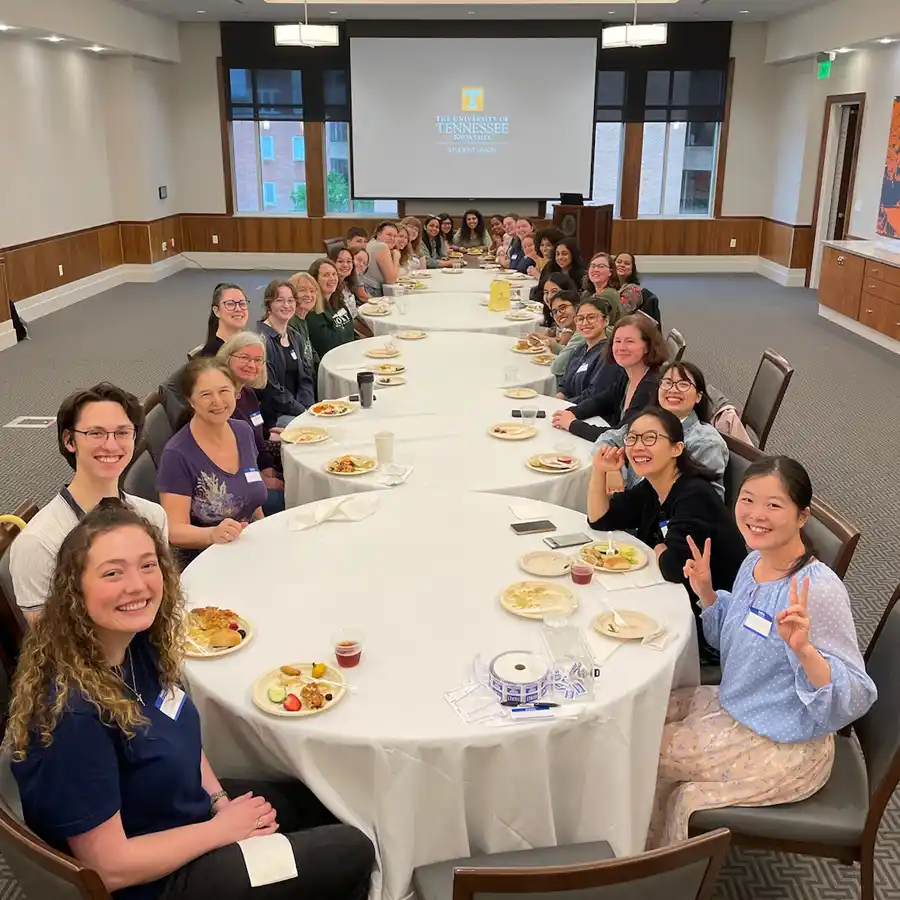
Photo of the Women in Physics Lunch, May 2024, at the University of Tennessee.

The Spring 2024 edition of the Women in Physics Lunch was held on May 8. A large group of 40 undergraduates, graduate students, post-docs, and faculty gathered despite the challenging weather that we had in the morning.

While enjoying excellent food, we had a chance to catch up with each other and celebrate the end of the academic year learning about the future endeavors of the various members of our group that are graduating. We thank the Department of Physics for the support provided, and we are looking forward to our next meeting, the Fall edition, on December 4, 2024. Save the date!

Courtesy of Professor Adriana Moreo

May 9, 2024  |  Filed Under: Featured News, News, Uncategorized

A photo of Anthony Mezzacappa

Anthony Mezzacappa Elected AAAS Fellow

April 19, 2024

A photo of Anthony Mezzacappa
Mezzacappa

Mother Nature keeps moving the goalposts for Anthony Mezzacappa and he wouldn’t have it any other way. His years of dedication to computational and theoretical astrophysics research, even as the landscape shifts, have earned him election as a Fellow of the American Association for the Advancement of Science (AAAS).

The AAAS Council bestows this honor on members whose “efforts on behalf of the advancement of science, or its applications, are scientifically or socially distinguished.”

Mezzacappa is the Newton W. and Wilma C. Thomas Chair in Theoretical and Computational Astrophysics and a College of Arts and Sciences Excellence Professor. He develops sophisticated models of supernovae through roles in UT’s Physics Department (since 1994) and at Oak Ridge National Laboratory (since 1996). It’s the foundation for his AAAS Fellowship, where he was cited “for distinguished contributions to the field of computational and theoretical astrophysics, particularly for developing theoretical frameworks and computational methods to model core collapse supernovae.”

“The AAAS Fellowship is about the advancement of science writ large,” Mezzacappa said. “This Fellowship really is special in that sense. I’ve spent a lot of time doing things for the field and for computational science. It’s really nice to receive a recognition of that.”

From Upstart to Leadership

Early in his career Mezzacappa was the principal investigator for the first large-scale, multi-investigator, multi-institutional computational astrophysics effort in the country to focus on core collapse supernovae. That was the beginning of a long list of professional accomplishments in astrophysics.

“When you first start out, there are more senior people who are leaders in the field and you’re a young upstart,” he said. “I was glad to get the vote of confidence by senior people to lead that effort.”

He said he knew after directing a program of that size there was no going back to smaller initiatives where he’d be the lone PI on a single project. He also noticed that over time, he and his contemporaries evolved from upstarts just beginning in the field to leaders who were guiding it.

“That changes the whole responsibility,” Mezzacappa said. “It changes how you think about yourself and your field. One of your jobs is to usher the science forward, which implicitly means with integrity and scientific accuracy.”

For him, it also means cultivating a network of fellow scientists to dive into the mysteries of astrophysics.

“Over time, you wind up contributing where you can, where your strengths are,” he said. “One of the things I know how to do is build and manage projects and programs. I created the largest core collapse supernova theory group in the world here between (ORNL) and the university.”

That gift for organizing expertise and assets has certainly benefited the research and teaching environment at UT.

“Professor Mezzacappa is the definition of a fearless scientist who chases after the solutions to some of the most challenging and interesting problems underlying how the universe functions,” said Adrian Del Maestro, professor of physics and head of the department­. “The recognition by the AAAS for his dedication to discovery in computational astrophysics is well deserved, and the department (and especially his students and postdocs) are extremely lucky to have Professor Mezzacappa at the University of Tennessee.” 

Moving the Goalposts

When a gigantic star can no longer support its own weight, gravity will eventually cause it to collapse on itself in some of the Universe’s most spectacular fireworks. When Mezzacappa and his colleagues were first developing models for core-collapse supernovae, they began with spherical symmetry, though they knew the physics would eventually lead them to more complex models.

“We always knew that we had a long way to go,” he said.

As they accumulate a deeper knowledge base and their tools (supercomputers) get bigger and faster, Mezzacappa said astrophysicists can now create beautiful three-dimensional supernovae models. As amazing as they are, however, those models still don’t answer all their questions.

“The thing that’s really changed is that Mother Nature is moving the goalposts,” he said.

“When you start out you think it’s a fixed target, because you have limited knowledge,” he went on to explain. “As you learn more and move forward, you realize the problem is even harder than you imagined to begin with. As the models have gotten more sophisticated, we’ve discovered the physics of supernovae is richer, and some of that richness is very challenging to model.”

To Mezzacappa, that’s part of the what makes fundamental science so meaningful.

“As humans, we always want to find the answers,” he explained. “As I’ve grown, one of the things that’s changed is that I kind of enjoy the mystery more now. I think knowing everything would be quite boring.”

Back to the Beginning, and the Future

Mezzacappa was in high school when he first learned about Einstein’s theories and decided what he wanted to study for the rest of his life.

“Relativity is what pulled me into physics from the get-go,” he said.

Decades later, his work keeps him close to the spark that ignited his imagination. He explained that core-collapse supernovae are one of the primary sources of gravitational waves and the only known source from which they’ve yet to be detected.

“We are in a position now, because we are a leading group and we have some of the leading models, to make predictions for what the gravitational waves for the supernovae look like,” he said. “I feel like I’m really contributing—not just to astrophysics but to relativity, which is special for me.”

The Most Important Impact

The AAAS Fellowship is one of many honors Mezzacappa has earned over a distinguished career. In the past year he’s been named a College of Arts and Science Excellence Professor, won the College’s Senior Award for Excellence in Research & Creative Achievement, and been recognized with the university’s Alexander Prize. He was elected a Fellow of the American Physical Society in 2004 and a UT-Battelle Corporate Fellow in 2005 in recognition of his supernova research and his broader role in the development of computational science in the United States.

“They all mean a lot,” Mezzacappa said of his honors, but “your most important impact is the impact you have for others, not for yourself.”

Professor Mezzacappa becomes the fourth member of the current physics faculty elected to AAAS Fellowship, joining Professors Elbio Dagotto, Adriana Moreo, and Hanno Weitering.

April 19, 2024  |  Filed Under: Featured News, News, Nuclear

A photo of Daniel Willingham

Teaching Students to Teach Themselves 

April 16, 2024

A photo of Daniel Willingham
Daniel T. Willingham

Special Lecture by Professor Daniel T. Willingham, University of Virginia

Abstract: When children start school, it is completely up to the teacher to see to it that students learn. But as they grow older, they become increasingly responsible for their own learning. They must learn how to read complicated texts independently, and not just for comprehension, but to remember the contents. They must learn to avoid distraction, commit content to memory, take notes, judge when they have studied enough, avoid procrastination, and more. Studies show that most college students use very inefficient strategies for most of these tasks. In this talk I will summarize research from the last twenty years on a subset of these tasks, focusing on practical applications that can be communicated to students so that they can regulate their learning more efficiently.

  • When: Friday, April 26, 2024
  • Where: 307 Science and Engineering Research Facility (SERF)
  • What Time: 3:30-5:00 pm

Dan Willingham earned a PhD from Harvard University in cognitive psychology and is now a professor of psychology at the University of Virginia. His research concerns the application of cognitive psychology to K-16 education. He is the author of several books, including Outsmart Your Brain and Raising Kids Who Read. He is a Fellow of the American Psychological Association and the Association for Psychological Science.

April 16, 2024  |  Filed Under: Featured News, News, Uncategorized

Solar prominences appear as pink features rising from the edges of the eclipsed Sun during a total solar eclipse. Credit: NASA/Aubrey Gemignani

Solar Eclipse April 2024

April 14, 2024

Solar prominences appear as pink features rising from the edges of the eclipsed Sun during a total solar eclipse. Credit: NASA/Aubrey Gemignani
Image Credit: NASA/Aubrey Gemignani
Photo of a Penumbral Eclipse, Credit Paul Lewis
Penumbral Eclipse, Image Credit: Paul Lewis

Sometimes you absolutely want to be in the path of a natural phenomenon, and the 2024 Great North American Solar Eclipse is one of those times.

On April 8, 2024, Mexico, the United States, and Canada will witness a total solar eclipse. While only those along the path of totality will witness the Moon fully covering the Sun, there are plenty of chances to see a partial eclipse, including right here in Knoxville, where we’ll see 85-90 percent coverage.

(If you want to travel to see the full eclipse, NASA has put together the path of totality.)

Paul Lewis, who directs space science outreach for the Department of Physics and Astronomy, said it’s possible to enjoy this fantastic astronomical event even if you stay here in East Tennessee.

“Just go out your front door, but be certain that you have certified solar eclipse glasses,” he said. “For our area there is no totality, so you must keep the glasses on during the eclipse.”

The American Astronomical Society also has tips on how to view the eclipse safely.

Eclipses always come in pairs and this one is no exception. The partial eclipse we will witness on April 8 was preceded by a deep penumbral eclipse of the moon on March 25th, as seen in the photo (bottom left) taken by our very own Paul Lewis.

What’s the Department of Physics and Astronomy Doing?

Weather permitting, we’ll set up solar telescopes on the roof of the Nielsen Physics Building from 1:30 to 4:00 p.m. for those who’d like to watch the eclipse with us. (If you’re coming from off campus, please consult the campus visitor parking information available from UT Parking and Transportation.)

Assistant Professor Sherwood Richers will help host an event at The Muse Knoxville, with activities for kids including an explanation of eclipses (e.g., lights and shadows), presentations in the planetarium, and solar telescopes for on-site viewing. The event begins at 1:30 p.m. and ends at 4:00 p.m., when The Muse closes. The department is providing a limited number of solar glasses for the event and The Muse will also donate a few pairs.

Need Eclipse Glasses?

First of all, make sure that wherever you get your glasses, they’re labeled ISO 12312-2 and have an authentic ISO certification label.

  • The Knoxville News Sentinel has put together a list of where to find eclipse glasses in Knoxville.
  • The American Astronomical Society has compiled a list (including large retail chains) of where to buy glasses, handheld solar viewers and/or sheets or rolls of solar-filter material.
  • American Paper Optics is a Tennessee company offering an array of glasses; you can visit their website for more information.

What Time is the Eclipse Happening in Knoxville?

  • April 8, 2024
  • For us here in Knoxville, the event starts at 1:49 pm.
  • The peak partial eclipse is about 3:07 pm.
  • The event should end at 4:23 pm.

More Eclipse Resources

  • NASA | 2024 Total Solar Eclipse
  • American Astronomical Society | Solar Eclipse Across America (2024)
  • eclipse.org: Knoxville | The 2024 eclipse in Knoxville, Tennessee, USA

April 14, 2024  |  Filed Under: Astronomy, Featured News, News

Cover Image of Science Magazine 29 March 2024, Used with Permission

The Art of Muon Collisions

April 3, 2024

Image of Science Magazine Cover 29 March 2024, Used with Permission
Credit: Reprinted with permission from AAAS; See Terms & Conditions below
Image of Tova Holmes
An image of Lawrence Lee
Charles Bell

Tova Holmes, Larry Lee, and Charles Bell

Assistant Professors Tova Holmes and Larry Lee are particle physicists and in their line of work, to think big, you have to think small. That’s where muons come in, and it’s how they became part of a Science Magazine story—including creating the cover art.

In “The Dream Machine,” journalist Adrian Cho reviews the newly-drawn roadmap for particle physics research in the United States. For the past century, physicists have designed, built, and deployed powerful accelerators that rev up and collide particles, precisely measuring the fragments and tracking the escapees to learn more about the building blocks of matter that make up the universe. With current instruments here and abroad reaching their energy limits, American physicists are looking at three possible types of colliders to replace them. Among them is a muon collider.

Will the Muon Have Its Moment?

Muons are fundamental particles. They’re quite a bit like electrons, but roughly 200 times heavier. Until now protons and electrons have been the particles of choice for collider physics, but with their extra mass muons are good candidates for collisions at energy scales up to 10 times higher than that of the Large Hadron Collider, the current world leader. As an early-career scientist, Holmes explained to Cho that waiting something like another five decades for a next-generation collider means the particle physics research she’s so passionate about would pass her by.

“I will be definitely not still working, possibly not alive,” she said.

That’s why she and Lee have spent nearly four years creating designs for a possible muon collider. Holmes coordinates the US-based research and development program for tracking detectors. (Her work has won her a Department of Energy Early Career Research Award, as well as place among the 2024 Class of Cottrell Scholars.) In her conversation with Cho she referred him to Lee as a source for images that could further describe the muon collider vision and enhance the article. Like Holmes, Lee has a strong belief in the power of imagery to convey scientific concepts, so he gladly accepted the assignment.

Renaissance and Romance

Planning for a muon collider is one thing. Promoting the idea to stakeholders is another. Holmes and Lee saw right away that the imagery accompanying those pitches didn’t always match the excitement for the collider’s promise.

In particle physics, “we have a long history of making what are called event displays,” Lee explained, which are simply visualizations of individual collision events. He said scientists have field-specific tools to create those displays, but the results look technical and aren’t particularly engaging.

“One thing I’ve wanted to do for a long time was bring in modern 3D environment modeling to essentially do the same thing, but in a slicker way,” he said.

With UT’s particle physicists’ involvement in the muon collider—specifically a conceptual design for a detector—he saw a fantastic opportunity.

“Right now, if we’re talking about the detector, we’re just in the design phase,” Holmes explained. “We write down some parameters, we try and visualize it, we simulate it, we shoot fake particles into it in our simulation, (and) we see what we can do to reconstruct it.”;

Lee enlisted Undergraduate Physics Major Charles Bell to help create a visualization of the detector and what the particles inside it might look like. They started with proprietary formats familiar to particle physics and brought in industry standard tools, ultimately incorporating Unreal Engine, a creative suite used for an array of simulation purposes. The resulting images were stunning enough to land on the cover of Science and alongside Cho’s article.

While standard event displays are great for showing off technical details, the new artistic images add another layer of strategic communication.

“Larry was trying to make a version of them that took advantage of all the tools that are out there to make them both useful and beautiful,” Holmes said. “Improving this kind of visual translation is really important for the future of our field because we have to be able to explain the kind of exploration we’re doing through visual media.”

Holmes said the muon collider’s success is dependent on audiences both inside and outside physics. At present only a few hundred scientists the world over are involved in the project.

“There have been past versions of this muon collider effort where the technology was not really close enough to ready for people to take it seriously as the next thing,” she said. “It needs to grow to happen. That means getting more people interested. It also needs the engagement of the field to get support from funding agencies. Being able to communicate clearly the excitement, and make sure that communication gets in people’s laps, matters.”

She’s hopeful Lee’s images will inspire a “renaissance” where researchers look at the technological progress surrounding the muon collider and see its potential in a new light. They both also want the public to become more excited about the science behind, literally, everything.

“In astrophysics it’s very easy to visualize because we take literal photographs of the universe,” Holmes said. “For us (in particle physics), we can’t take literal photographs. We do something similar with our detector reconstruction, but it doesn’t look like a photo.”

Lee said he wants images like those he created for the muon collider project to tie in to the “romantic big picture” of fundamental science and capture human imagination.

“We both feel very strongly that it’s important to make things visually compelling, because once you do, people remember them,” he said, even if they don’t fully understand the science behind the pictures.

“This was something we’ve been talking about in the muon collider effort because you’re asking the public to embrace a big project and if you can’t explain what it’s for, you have a real problem,” Holmes said.

This isn’t her first foray into art where the collider’s concerned: she created a poster that’s hanging in a good many physics departments as well as swag to promote the project.

Holmes and Lee believe that prioritizing compelling science communication isn’t just a feel-good pursuit: it’s a key to helping serious science thrive.

“This work is important,” Lee said. “It’s not purely outreach; it’s not purely just for fun. It really pushes us to the literal front of the journal.”

Terms and Conditions re: reprinted AAAS material: Readers may view, browse, and/or download material for temporary copying purposes only, provided these uses are for noncommercial personal purposes. Except as provided by law, this material may not be further reproduced, distributed, transmitted, modified, adapted, performed, displayed, published, or sold in whole or in part, without prior written permission from the publisher.

April 3, 2024  |  Filed Under: Featured News, News, Particle, Uncategorized

A photo of Steve Johnston

Steve Johnston Named Bains Professor

March 4, 2024

A photo of Steve Johnston
Johnston

Steve Johnston wants to save time. And though he never met them, Elizabeth and Jim Bains are going to help.

Johnston knows that while silicon has long played a dominant role in industry, quantum materials will shape technology’s future. The challenge is that these atomic-scale materials are hardly straightforward. Like any good mystery, they come with intricacies, entanglements, and surprises that require case-by-case study. A theorist working in condensed matter physics, Johnston and his research group are developing a library of codes to simplify those investigations. Now, as the Elizabeth M. Bains and James A. Bains Professor of Physics and Astronomy, he’ll have resources to build that library faster.

Tennessee SmoQy Codes

While Johnston’s appointment as the Bains Professor began February 1, he first joined the physics faculty in 2014 as an assistant professor. He’s been busy ever since. He directs the department’s graduate program and teaches graduate-level courses. He’s won a National Science Foundation CAREER Award, secured funding to design quantum materials, and played a role in UT’s successful proposal for the NSF-funded Center for Advanced Materials and Manufacturing (CAMM). His work with Chancellor’s Professor Hanno Weitering on chiral superconductivity made the cover of Nature Physics.

Now, with a professorship supported by an endowed bequest from Elizabeth and Jim Bains, he’ll have additional funding to work in areas beyond the confined focus of funding agencies.

“What I’m really looking forward to is using (this support) for exploratory work,” Johnston said. “If I’m interested in pursuing some new line of research, this gives me a little bit of flexibility to do that. My group is investing a lot of time and effort in developing some open source software and, at least for this first year, I’m planning on using (funding) to shore up that effort.”

The heart of this effort is the SmoQy Suite, a collection of codes to help map the quantum landscape.

Scientists confront a host of challenges in defining the properties of quantum materials, one of the first steps in figuring out how and where they’ll be useful. The problem is that the quantum world doesn’t abide by the laws and equations that physicists have spent generations refining. Among the trickier issues is the many-body problem. In microscopic systems, how particles interact is much more complex than in macroscopic environments. And the more particles you have (especially electrons), the more unwieldy the situation becomes. So as researchers developed new quantum materials, physicists were spending more and more time calculating their properties.

“We used to do things (where) our codes were written to simulate one-off models,” Johnston said. “Whenever a new material comes out, we figure out what model it actually needs, then we have to re-write that code for that model. It’s very reactive.”

The SmoQy codes are a much more proactive approach.

“You build the tools upfront and that way when new discoveries come along we’re able to jump on them immediately and do more right away,” Johnston explained. “It’s also an attempt to make a version-control record of these things.”

His postdoc, Benjamin Cohen-Stead, is the lead developer on SmoQy. The Bains Professorship will allow Johnston to support him as he continues to develop resources and make them available to other scientists working in quantum materials.

“He invested a lot of time building a very versatile code and a bunch of frameworks that we can now use to build other codes,” Johnston said.

In true It Takes a Volunteer fashion, he added the group “would like to get some of the many-body methods that we’re using to a stage where anyone can download and use them. We’re trying to really highlight this as a good tool for the community. We’ve also begun to go after new funding to further expand these codes.”

If you’re wondering how the name SmoQy came about, there’s a Volunteer connection there too.

“We wanted something that was in line with the Tennessee spirit,” Johnston said.

They chose to feature the Smoky Mountains, but with a q to highlight the quantum many-body problem. Johnston explained that SmoQy is actually a play on another many-body software package called ALPS (Algorithms and Libraries for Physics Simulations).

“All many-body codes appear to have to be named after mountain ranges, so we decided to stick with that,” he said.

(Johnston noted that he’s also gotten quite a few emails from people asking him about Smokey, UT’s beloved mascot.)

Johnston’s group is spearheading the SmoQy effort, but he said eventually he’d like to involve more students and partner with UT’s Min H. Kao Department of Electrical Engineering and Computer Science on code development. He’s already working with Physics Professor and Department Head Adrian Del Maestro (who holds a joint appointment with that department) to add codes to the SmoQy library.

“Professor Johnston has an incredible impact across the teaching, research, and service mission of the department,” Del Maestro said. “As the Elizabeth M. Bains and James A. Bains Professor of Physics and Astronomy, I look forward to his transformative contributions to quantum materials research that will help shape future technologies for Tennesseans and beyond.”

These opportunities to expand the department’s quantum materials portfolio are possible because of a young couple who met five decades ago not far from Johnston’s office in the Nielsen Physics Building.

When Liz Met Jim

When Elizabeth (Liz) Miller enrolled in the master’s program in the mid-1960s her primary interests were atomic and nuclear physics. She changed her life—and many others’—when she decided to pursue ultrasonics instead. That’s where she got serious with fellow graduate student Jim Bains. The couple married and earned PhDs before settling in Texas to pursue their careers. When Liz and Jim passed away (in 2015 and 2020, respectively), they left the physics department its largest-ever gift.

In the fall of 2022 that bequest funded the first Bains Graduate Fellowship, which helped Shruti Agarwal get an early start on research. Now the Bains Professorship will help Johnston accelerate quantum materials research and in turn help the broader materials community.

“I’m very appreciative to the college and the department for giving me this,” he said. “As we’re trying to look at all kinds of new materials, we want our codes to respond to those materials. It’s not just about the problems I care about solving but also the problems that other people care about solving.”

With the new appointment Johnston becomes the third faculty member to hold a named professorship, alongside Cristian Batista (Lincoln Chair Professor) and Anthony Mezzacappa (Newton W. and Wilma C. Thomas Endowed Chair).

March 4, 2024  |  Filed Under: Condensed Matter, Featured News, News

  • « Previous Page
  • 1
  • …
  • 4
  • 5
  • 6
  • 7
  • 8
  • …
  • 10
  • Next Page »

Recent Posts

  • WiP Closes Fall Term with Lunch & Networking
  • Work-Study Provides Early Research Advantages for Physics Undergraduates
  • First Haslam Family Professorships for Physics
  • With ORNL, UT Works Toward a Quantum Future
  • Joint Physics Faculty Elected APS Fellows

Physics & Astronomy

College of Arts and Sciences

401 Nielsen Physics Building
1408 Circle Drive
Knoxville TN 37996-1200
Phone: 865-974-3342
Email: physics@utk.edu

Facebook Icon    X Icon

The University of Tennessee, Knoxville
Knoxville, Tennessee 37996
865-974-1000

The flagship campus of the University of Tennessee System and partner in the Tennessee Transfer Pathway.

ADA Privacy Safety Title IX