• Request Info
  • Visit
  • Apply
  • Give
  • Request Info
  • Visit
  • Apply
  • Give

Search

  • A-Z Index
  • Map

Physics & Astronomy

  • About
    • Honors
    • Administration
    • Faculty Resources
    • Nielsen Spaces
  • Research
    • Research Partners & Facilities
    • Condensed Matter
    • Particle / HEP
    • Biophysics / Soft Matter
    • Nuclear / Astrophysics
    • Quantum Information
  • People
    • Faculty
    • Staff
    • Joint Research & Adjunct Faculty
    • Post Docs
    • Graduate Students
  • Undergraduate
    • Why Physics
    • What Our Grads Do
    • Career Resources
    • Degree Programs
    • Research
    • Scholarships
    • Student Organizations
  • Graduate
    • Join Our Program
    • FAQs
    • Fellowships & Assistantships
    • Bains Fellowship
    • Where Our Grads Go
    • Research
    • Resources
  • News & Events
    • Newsletters
    • News
    • Colloquia Series
    • Events
    • In the Media
  • Outreach
    • Astronomy Outreach
    • Cool Things in the Sky this Month
    • Physics Outreach & High School Lecture Series
  • Alumni
    • Distinguished Alumni Award
    • Giving Opportunities
    • Share Your News
A banner showing a model of an atom and elementary particles

News

Condensed Matter

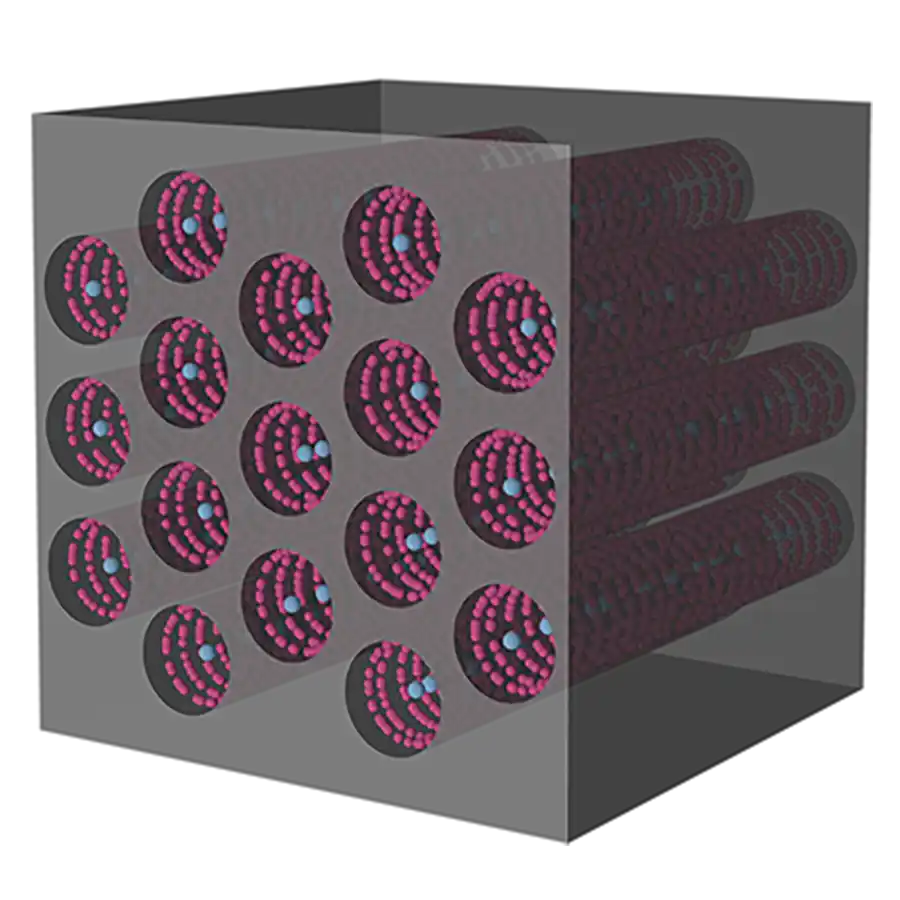
A diagram of helium atoms moving through a 1-D pipe coated with argon.

A Front Row Seat to Quantum Behavior

July 6, 2022

Helium may bring the fun to party balloons but we’re actually more familiar with its serious side. As a liquid it’s crucial to cooling magnets used in magnetic resonance imaging and manufacturing semiconductors. Cooled to a critical temperature it can become a superfluid: flowing with no viscosity and losing no kinetic energy.

For Professor Adrian Del Maestro, helium holds even more exotic charms. Since his postdoctoral days he’s wanted to confine this element to one dimension, where theory predicts it will become a fluctuating phase of matter that’s not exactly a solid, a liquid, or a superfluid. The model itself (a Tomonaga-Luttinger liquid) was first proposed in 1950 and until now has never been seen in a system of strongly-interacting atoms. Del Maestro and his colleagues at Indiana University Bloomington have found a way to squeeze helium down to single-atom thickness and give scientists a front-row seat to observe quantum mechanical behavior.
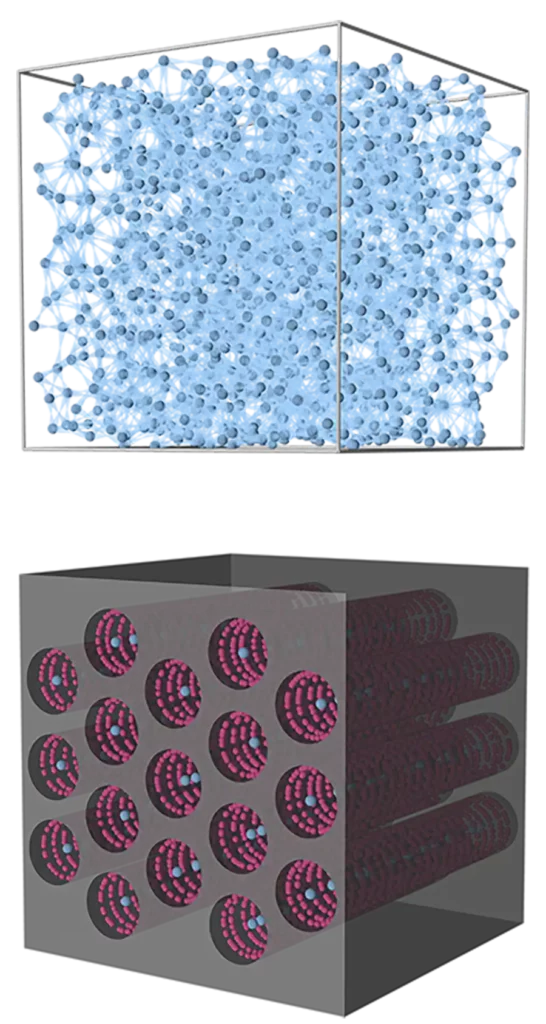
Conceptual image of strongly interacting helium atoms (top)
and helium atoms moving through a 1-D pipe coated with argon.
Conceptual image of strongly interacting helium atoms (top) and helium atoms moving through a 1-D pipe coated with argon.

Building an Atomic Scale Pipe

The promise (and challenge) of quantum science lies in understanding how things work in lower dimensions. Take carbon, for example. In 3-D it’s graphite, the soft stuff that lets a pencil glide across paper. In 2-D it’s graphene, an ultra-light and ultra-strong system.

“A sheet of graphene weighing less than the whisker of a cat could support the cat’s weight,” Del Maestro explained.

Helium has similar differences.

“In 3-D, the same helium atoms that fill balloons can whiz around each other to form a superfluid phase of matter,” he said. “In 1-D, the atoms are forced to interact strongly as they are all made to stand in a line, and they can’t easily exchange places.”

Though its properties make helium an ideal system for getting a glimpse into one-dimensional behavior, confining its atoms to this scale is no trivial task.

“You literally need to make a pipe that is only a few atoms wide,” Del Maestro said. “No normal liquid would ever flow through such a narrow pipe as friction would prevent it.”

Fortunately, in 2015 he met IU’s Paul Sokol at a conference and they merged their theoretical and experimental expertise to build this atomic structure.

“Paul had worked on confining superfluids for years, but just couldn’t get them small enough,” Del Maestro said. “I had done numerical simulations that found the ‘sweet’ spot on the pipe size we needed.”

Del Maestro suggested they paint the inside of a pipe to make it smaller. Sokol came up with the idea to pre-plate it with a rare gas. They took a nanoporous material, whose structure is like a sponge with ordered pores, and coated the inside with a perfect layer of argon to make it angstrom scale (a hundred-millionth of a centimeter). Now they had their 1-D pipe. They filled it with liquid helium, which adsorbed inside the pre-plated nanopores, and then bombarded the helium with neutrons. The resulting excitations told them what phase of matter they had.

“You can think of this as testing whether something is a liquid or solid by asking what happens when you throw something at it,” Del Maestro said. “Does it bounce off, or travel through? The results of the experiments can be modeled with theoretical calculations and simulations to confirm the existence of the Luttinger liquid state of matter.”

The Power of Positive Thinking

Del Maestro explained that helium confined in one dimension holds possibilities that other systems exhibiting 1-D do not.

“It can be adjusted with pressure, all the way from a gas to a solid … and provide the possibility for tuning and optimizing devices exploiting quantum phenomena,” he said.

A one-dimensional pipe filled with liquid helium attached to a device can also sense tiny rotations, pointing to future applications in geo-sensing, gyroscopes, and autonomous navigation in extreme environments where GPS isn’t feasible, such as drones on other planets.

The isotopes helium-3 and helium-4 offer the chance to further test the Luttinger liquid theory that a 1-D liquid of bosons and fermions—particles that make up matter and carry forces—should have similar behavior at low temperatures. Del Maestro and Sokol have opened an avenue for this research with the experimental realization of 1-D helium. The findings, published in Nature Communications, were the result of work from their respective groups, as well as patience, persistence, and positive thinking.

“It’s something I’ve been thinking about for 15 years … and was only possible because of the tight integration of theory and experiment,” Del Maestro said. “I’d ask Paul if something was possible, and he would say ‘No, but I’ll think about it.’ Paul would show me some crazy result and say ‘Do you know what is going on at the atomic level?’ and I would reply with ‘No, but I’ll think about it.’”

Eventually, he said, all the pieces of this 1-D puzzle fit together.
July 6, 2022  |  Filed Under: Condensed Matter, Featured News, News, Quantum Materials

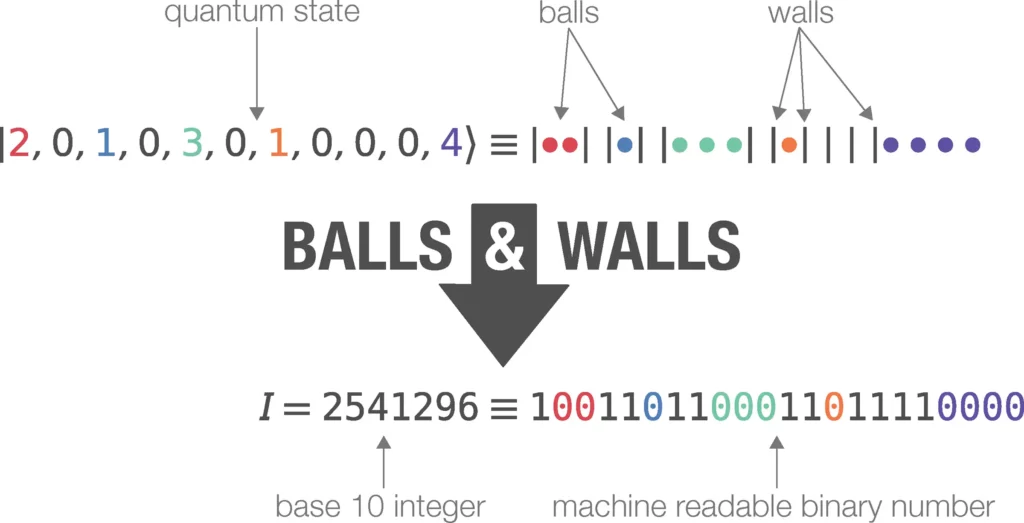
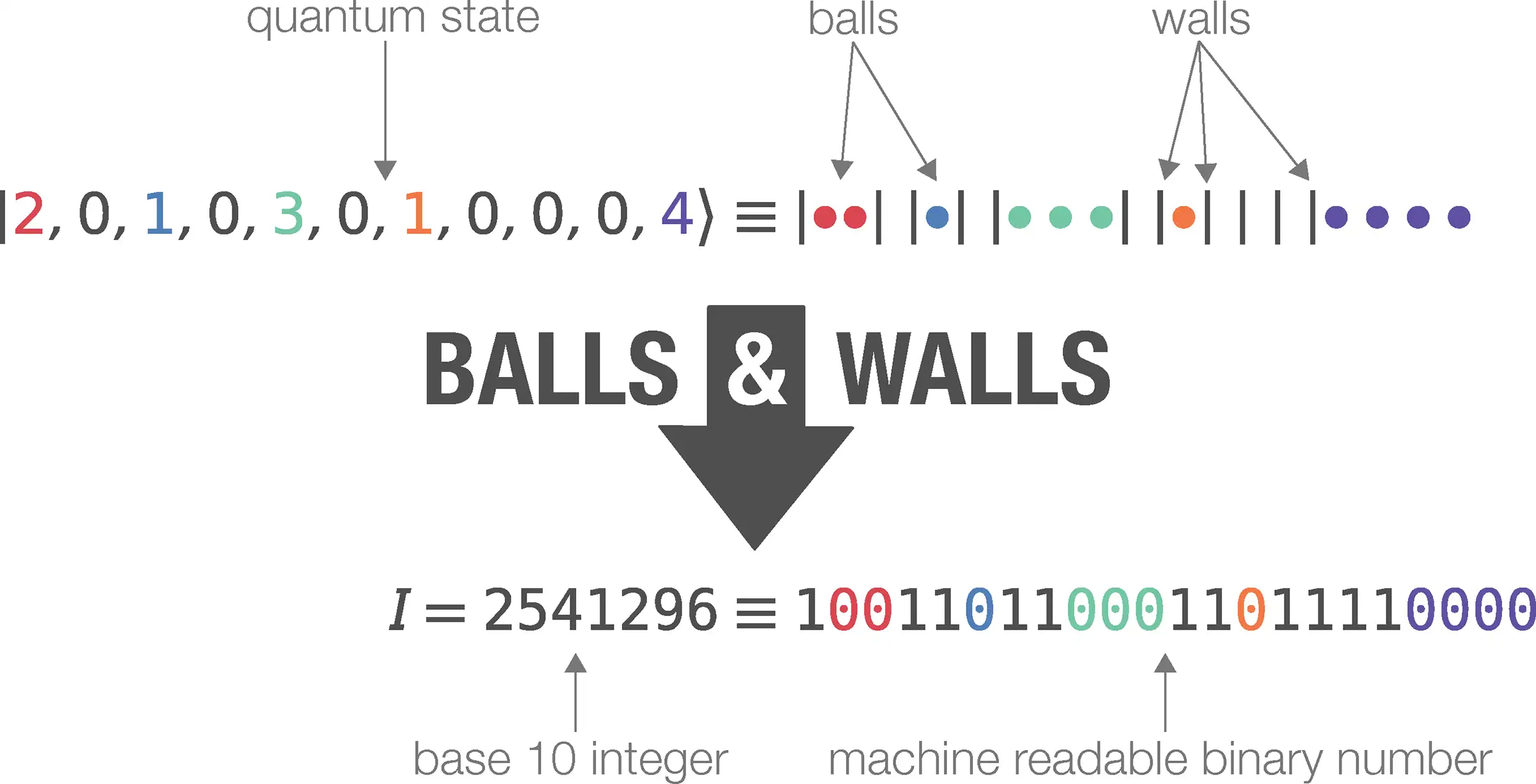
A diagram illustration Adrian Del Maestro's and Hatem Barghathi's counting tool "Balls and Walls."

Building Bridges for the Quantum Era

May 31, 2022

Del Maestro
Photo of Hatem Barghathi
Barghathi

Speed.

Adrian Del Maestro and Hatem Barghathi are talking about speed, and memory, and how many bytes you need to type a single letter. In classical computers those workings are neatly spelled out: things are either on or off. But Del Maestro and Barghathi think in quantum scales, the tiny systems where classical mechanics doesn’t hold up and the multitude of particle configurations is so large, it seems impossible to count and store.

With colleagues from the Tickle College of Engineering, they’ve devised a shorthand to describe these configurations, dramatically speeding up calculations and with them scientists’ ability to predict how quantum systems behave. This kind of innovative thinking sets the stage for quantum materials to take the baton from silicon as new technologies emerge. With investment in the Quantum Materials for Future Technologies cluster, UT is well situated to be a scientific leader in this new era.

The Foundation for a Post-Silicon World

Del Maestro, a professor in both the Department of Physics and Astronomy and the Min H. Kao Department of Electrical Engineering and Computer Science, has been intrigued by quantum science since graduate school. The cluster opportunity brought him to UT from the University of Vermont. Barghathi, a postdoctoral researcher in his group, came along. Counting six new hires and current faculty in physics and engineering, by next year the cluster will have 15 or so active researchers mining the depths of quantum materials. Daunting as they may seem with their rebellion against classical physics and their maddeningly small architecture, leaving that territory unexplored would be both a scientific and economic mistake.

“Fundamental advances in materials led to our current ability to harness technology and that has given us the modern age,” Del Maestro said. “The fact that we have billions of transistors in our pockets in our iPhones is because of that foundational work.

“At the time, people weren’t trying to build iPhones,” he continued. “They were trying to understand the properties of materials. And so what we’re trying to do right now is understand and harness the properties of a new class of quantum materials that can exhibit dizzying non-classical behavior.”

Technology often follows a long path that’s not always obvious. A physicist came up with the principle for a transistor in 1925, engineers developed it in 1947, and in 1961 we had the first silicon chip. Quantum materials could be the next chapter.

“We’re really at the start of that,” Del Maestro said. “The hope is that if we can learn to understand how to first describe, quantify, characterize, and then harness these things we don’t have classical analogs for, then almost by necessity they’ll lead to what we call post-silicon quantum technologies. That’s really the purpose of the cluster. UT was already a leader in this area. We want to move from being a regional leader to being a national or global leader.”

Twenty Times Faster

Leading means solving problems, and quantum materials present plenty. One is that it’s hard to predict what atoms (and their electrons) are going to do in a quantum system. Scientists and engineers know how to control electronic current in an iPhone’s transistors, but that’s classical, not quantum physics.

A diagram illustration Adrian Del Maestro's and Hatem Barghathi's counting tool "Balls and Walls."

“Say you have 10 blue balls,” Del Maestro explained. “Classically, you can always tell the difference between macroscopic objects, like two baseballs or billiard balls. If you look hard enough you can tell them apart. One of the absolutely amazing things about quantum mechanics is that if I give you two electrons or two rubidium atoms, there is no experiment that you can do to distinguish them.”

Those atoms are situated on lattice sites—corners, if you will, of the jungle gym-like structure of quantum materials. Complicating matters is that they’re made up of particles that can be fermions or bosons. Fermions sit one to a seat. Bosons can pile on top of each other, causing another headache, especially when you can’t tell them apart. It’s like putting together a football playbook when all the players in front of you have different abilities but look exactly alike, wear identical jerseys, and in some cases hide behind each other.

“I have these atoms and I ask how many different ways can I distribute them. But the atoms are truly indistinguishable. That’s a very hard problem to solve,” Del Maestro said.

To find the possible configurations in this scenario, he and Barghathi adapted a counting tool called “balls and walls.” At its most basic, it’s a mathematical formula to quickly figure out problems like how many combinations are possible if you want to buy a dozen donuts in four available flavors.

In this research, Del Maestro and Barghathi wanted to find how many different particle combinations were possible on lattice sites. They found the trick was to consider the setup as two objects: one as an object itself and the second as the edges of buckets you’re putting those objects into. Combining the objects and edges using a special mathematical formula gives you the number of slots available for the objects you want to count.

“Balls and walls allows me to use a simple counting argument to enumerate all possible configurations,” Del Maestro said. “Why is it important? If you want to know what the most likely configuration is, you need to know how many times it appears. Configurations are the language in which we solve a problem. We need to know the words in that language before we can write a sentence.”

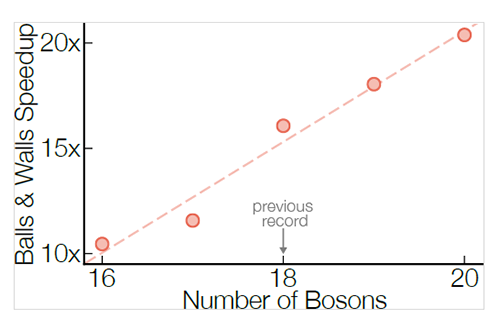
He said the fastest computers in the world have only been able to study 21 fermions on 42 lattice sites, and far fewer bosons. The coding he and Barghathi developed can study 20 bosons on 20 sites: 20 times faster than current methods. Beyond that, it takes much less memory, reducing the needed storage by a factor of the number of sites.

A graph showing the "Balls and Walls" counting tool time scaling.

“Think about how much memory you need for each letter that you store in a computer,” Barghathi said. “It will basically take eight bits. A number is at least going to take the memory of a letter.”

When facing huge numbers of possible configurations, he said, “you need to know how much memory you need to store them and how fast you can deal with them.”

Del Maestro explained that “the number of total configurations you need to store is gigantic, so if you can get a factor of 20 smaller, that’s the difference between being able to solve the problem or not. If something used to take a month, now it can take a day. Modern quantum experiments can start to use these larger system sizes and now we can actually predict what they’re going to measure in the lab.”

Spontaneous Advances

The findings are published in the first paper to come out of two departments from UT’s quantum materials cluster. While Del Maestro and Barghathi brought physics expertise in quantum mechanics, Del Maestro said “to understand this representation at the level of the bits, we needed computer science. This is where our colleagues like Micah Beck, a co-author on the paper, come in.”

The collaboration was a little slow at the beginning, with physicists and engineers speaking different languages about caches and buffers; bosons and symmetries.

“Interdisciplinarity is hard,” Del Maestro said. “It takes time and effort and thoughtfulness to build that bridge.”

The cluster plays a crucial role in that construction.

“Without that, it’s easy to be very fractured, even if we’re all working in quantum materials,” he said.

Del Maestro explained that because the cluster embedded him in engineering and computer science he wasn’t an outsider: he knew who to ask about this problem because he knew Beck was interested in it as well.

“That, I think, is the strength of the cluster,” he said. “It was very much spontaneous. The cluster will enable new types of spontaneous advances. We can’t predict where they’re going to come from because they really come at the interface where different expertise all of a sudden fits together and produces something profoundly new.”

May 31, 2022  |  Filed Under: Condensed Matter, Featured News, News

  • « Previous Page
  • 1
  • 2
  • 3

Recent Posts

  • Cosmic Collaboration: Students Join Forces to Bring the Invisible to Life
  • UT’s Biophysics Group Investigates How Chromosomes Separate
  • WiP Closes Fall Term with Lunch & Networking
  • Work-Study Provides Early Research Advantages for Physics Undergraduates
  • First Haslam Family Professorships for Physics

Physics & Astronomy

College of Arts and Sciences

401 Nielsen Physics Building
1408 Circle Drive
Knoxville TN 37996-1200
Phone: 865-974-3342
Email: physics@utk.edu

Facebook Icon    X Icon

The University of Tennessee, Knoxville
Knoxville, Tennessee 37996
865-974-1000

The flagship campus of the University of Tennessee System and partner in the Tennessee Transfer Pathway.

ADA Privacy Safety Title IX