• Request Info
  • Visit
  • Apply
  • Give
  • Request Info
  • Visit
  • Apply
  • Give

Search

A-Z Index Map

Physics & Astronomy

  • About
    • Honors
    • Administration
    • Faculty Resources
    • Nielsen Spaces
  • Research
    • Research Partners & Facilities
    • Condensed Matter
    • Particle / HEP
    • Biophysics / Soft Matter
    • Nuclear / Astrophysics
    • Quantum Information
  • People
    • Faculty
    • Staff
    • Joint Research & Adjunct Faculty
    • Post Docs
    • Graduate Students
  • Undergraduate
    • Why Physics
    • What Our Grads Do
    • Career Resources
    • Degree Programs
    • Research
    • Scholarships
    • Student Organizations
  • Graduate
    • Join Our Program
    • FAQs
    • Fellowships & Assistantships
    • Bains Fellowship
    • Where Our Grads Go
    • Research
    • Resources
  • News & Events
    • Newsletters
    • News
    • Colloquia Series
    • Events
    • In the Media
  • Outreach
    • Astronomy Outreach
    • Cool Things in the Sky this Month
    • Physics Outreach & High School Lecture Series
  • Alumni
    • Distinguished Alumni Award
    • Giving Opportunities
    • Share Your News
A banner showing a model of an atom and elementary particles

News

Condensed Matter

A photo of Del Maestro from the YouTube video announcing new Center for Advanced Materials and Manufacturing

UT Wins NSF Funding for the Center for Advanced Materials and Manufacturing

June 27, 2023

A photo of Alan Tennant
Tennant
Del Maestro

Lightning in a Bottle

Physics faculty will play key roles in a new National Science Foundation Materials Research Science and Engineering Center (NSF MRSEC) set to discover, design, and develop materials that will transform science and industry.

UT won $18 million for the Center for Advanced Materials and Manufacturing (CAMM), one of nine new MRSECS announced June 26. The NSF announcement said the investment “will drive the creation of advanced materials capable of remarkable things—from being tough enough to withstand the heat of a fusion reactor to processing information at the quantum level.”

CAMM has two major initiatives: using artificial intelligence to tame the complexity of quantum materials and building new materials that can operate in extreme conditions.

Physics Professor Alan Tennant will serve as CAMM’s director, while Professor and Department Head Adrian Del Maestro will lead the quantum materials initiative. Del Maestro explained the heart of the work is unlocking the properties of quantum mechanics—the incredibly complex interactions and entanglement between individual electrons or constituents.

UT Announces the new Center for Advanced Materials and Manufacturing

“That can have implications for sustainable energy, for quantum communication, (and for) national security concerns,” he said. “There’s a real need for new types of materials, for example, that can operate in these extreme conditions. Think about things like the center of nuclear reactors. And so advances there could have a really immediate effect on people’s day-to-day life.”

In the past three years the university has built an impressive roster of expertise in quantum materials and artificial intelligence with the Quantum Materials for Future Technologies cluster. With new hires joining faculty already in place, this team includes 13 members from the physics department, many (like Tennant and Del Maestro) with joint appointments in the Tickle College of Engineering.

“CAMM is a model for interdisciplinary research and innovation,” Tennant said. “We are leveraging all the capabilities we have to advance the materials frontier while also developing our nation’s future leaders in these areas. And by working with companies like Lockheed Martin, Volkswagen and Eastman, and launching new high-tech start-ups like SkyNano that will co-locate with us here in Knoxville, we are ensuring that our innovations create economic opportunities for Tennesseans.”

As Del Maestro said, “I think we managed to kind of get this lightning in a bottle. All the pieces fit together. (This) is the right place to do this work.”

June 27, 2023  |  Filed Under: Condensed Matter, Featured News, News

A photo of Weitering and Lee

The Art of Science

March 20, 2023

An image of Hanno Weitering
Weitering
An image of Lawrence Lee
Lee

Hanno Weitering and Larry Lee Honored at CAS Awards Banquet

Professor Hanno Weitering and Assistant Professor Larry Lee are physicists, but sometimes that means being a designer, architect, musician, or painter. This creative blend of art and science was appropriately rewarded at the annual College of Arts and Sciences awards banquet. Weitering was recognized for his Distinguished Research Career at UT while Lee was honored with the Outreach Teaching Award.

Serendipity and Strategy

Weitering has been at UT since 1993. Part of the condensed matter physics group, he’s an experimentalist who’s never been afraid to venture into new directions. For years he swore he’d never get involved in superconductivity research. Then he moved to an office next door to Professor Jim Thompson (now retired) and began collaborating on that very topic: a career highlight he chalks up to serendipity.

Weitering is interested in the often-unpredictable electronic properties of low dimensional materials systems. The smaller a system, the more subtle its physics becomes. He explained that many physicists like to find and study exotic electronic properties of materials that he sees as way too complex to truly comprehend. Instead, he prefers to look at theoretical models for those materials that are intuitively “easy” to understand, yet necessarily oversimplify aspects related to a material’s chemistry, which can be extremely complex and difficult to control.

“My approach is to create simple materials systems that would be a much closer experimental realization of some of the most promising theoretical models and then see (if) it all makes sense,” he said.

This involves some nanoscale architecture. Working with Associate Professor Steve Johnston, he found that silicon—the heart of the electronics industry—can host a novel form of superconductivity. Arriving at that result required him to create a sample comprising a third of a layer of tin atoms on a layer of silicon atoms. This wasn’t something he just happened upon, however.

“This was all by design,” Weitering said, part of a scientific approach that’s “a mix of serendipity and strategy.

“I never really jumped on hot topics,” he continued. “Instead I consider, ‘What is my expertise? What is my background? Where do I think I can make a really interesting and lasting contribution?'”

This mindset has resulted in a successful research career rounded out by dedicated classroom teaching and 10 years of service as department head, as well as 10 years as deputy director of what’s now the Institute for Advanced Materials and Manufacturing.

His hard work has not escaped notice. In addition to this honor from the College, in 2022 Weitering was elected a Fellow of the American Association for the Advancement of Science and appointed a UT Chancellor’s Professor.

While appreciative of the honors, he said his creativity is driven by curiosity, not potential accolades.

“You have people that I feel are giants, and they build cathedrals,” he said. “I just would like a nice mosaic somewhere on the floor that I’ll be remembered by.”

Setting Physics to Music

While Weitering crafts artwork for theoretical cathedral floors, Lee is literally bringing people to the dance floor.

Giving vintage tech equipment a second life, he engineers audio waveforms to show images from experimental particle physics—painting musical pictures through his ColliderScope project. He’s played festivals both in the United State and Europe, delighting crowds by transforming old oscilloscopes into the heartbeat of techno music and cool imagery.

Lee joined the faculty in 2021 and is both a musician in his own right as well as a particle physicist. When he’s creating riffs for ColliderScope he has to give equal weight to each role.

“It’s both all the way,” he said. “When you’re making these complicated sounds there’s an interplay between the shape of the sound and the timbral quality of the sound. If I know I want a particular visual to happen, I have to design it in way that will produce a sound that I want.”

In other words: he wants good physics and good music.

“It has to be true to science but also musically engaging,” Lee explained. “When you draw these shapes, they end up sounding complex and often naturally harsh. You then have the artistic choice to change the way it looks and therefore sounds, or compose around those harsh sounds.”

While he didn’t invent this method of drawing pictures with music, once he saw it he knew immediately it would be a perfect fit for particle physics outreach.

“It ties in with the electronics that we use and we build for our day-to-day lives,” he said.

Lee has an affinity for bringing physics out of the lab and offering it to the public in ways they can understand, appreciate, and enjoy. Last summer he and Assistant Professor Tova Holmes organized a free public viewing of Particle Fever to celebrate the 10-year anniversary of the Higgs Boson discovery. He hopes to put on a ColliderScope show in Knoxville when he can work out the timing with his research and teaching schedule and find the right venue.

With these latest awards, the Department of Physics and Astronomy has won 11 College Convocation Honors since 2016 for outstanding research, teaching, advising, and outreach.

March 20, 2023  |  Filed Under: Condensed Matter, Featured News, News, Particle

Nature Physics Magazine Cover for the issue that featured the article referenced in this post

Stealing Electrons and Reversing Time

January 30, 2023

An image of Hanno Weitering
Weitering
A photo of Steve Johnston
Johnston

Evidence for a chiral superconductor could bring quantum computing closer to the mainstream

UT’s physicists led the scientific team that found silicon—a mainstay of the soon-to-be trillion-dollar electronics industry—can host a novel form of superconductivity that could bring rapidly emerging quantum technologies closer to industrial scale production. The findings are reported in Nature Physics and involve electron theft, time reversal, and a little electronic ambidexterity.

Couples on the Superconducting Dance Floor

Superconductors conduct electric current without resistance or energy dissipation. Their uses range from powerful electromagnets for particle accelerators and medical MRI devices to ultrasensitive magnetic sensors to quantum computers. Superconductivity is a spectacular display of quantum mechanics in action on a macroscopic scale. And it all comes down to the electrons.

Electrons are negatively charged and repel each other in a vacuum. However, in a solid-state medium—the realm of metals and semiconductors—there are roughly 1023 (= 100 billion x one trillion) other electrons and positive ions that complicate the picture enormously. In a superconductor, conduction electrons overcome their mutual repulsion and become attracted to each other through interactions with the other particles. This interaction causes them to pair up like dancers at a ball, forming composite particles, or “Cooper pairs” (so named for Nobel laureate Leon Cooper).

Typically, the “glue” causing this pairing comes from the atom vibrations in a metal, but only if the electrons don’t repel each other too strongly. The process is somewhat like two people (the electrons) on a soft mattress (the medium) that roll toward one another when the mattress is compressed in the center. The laws of quantum mechanics dictate that Cooper pairs (unlike single electrons) can all condense into a single coherent quantum state, where they move in lock step. The condensate exhibits a rigidity as a result, allowing current to flow without interruption or dissipation. In other words: to superconduct. This mechanism leads to conventional (s-wave) superconductors such as aluminum, tin, or lead.

When the repulsion between electrons is strong, however, they pair up in higher angular momentum states so that they can’t get too close, resulting in, e.g., a d-wave superconductor. This is the case with materials made from copper and oxygen (cuprates) and it plays a starring role in the Nature Physics research and its future potential.

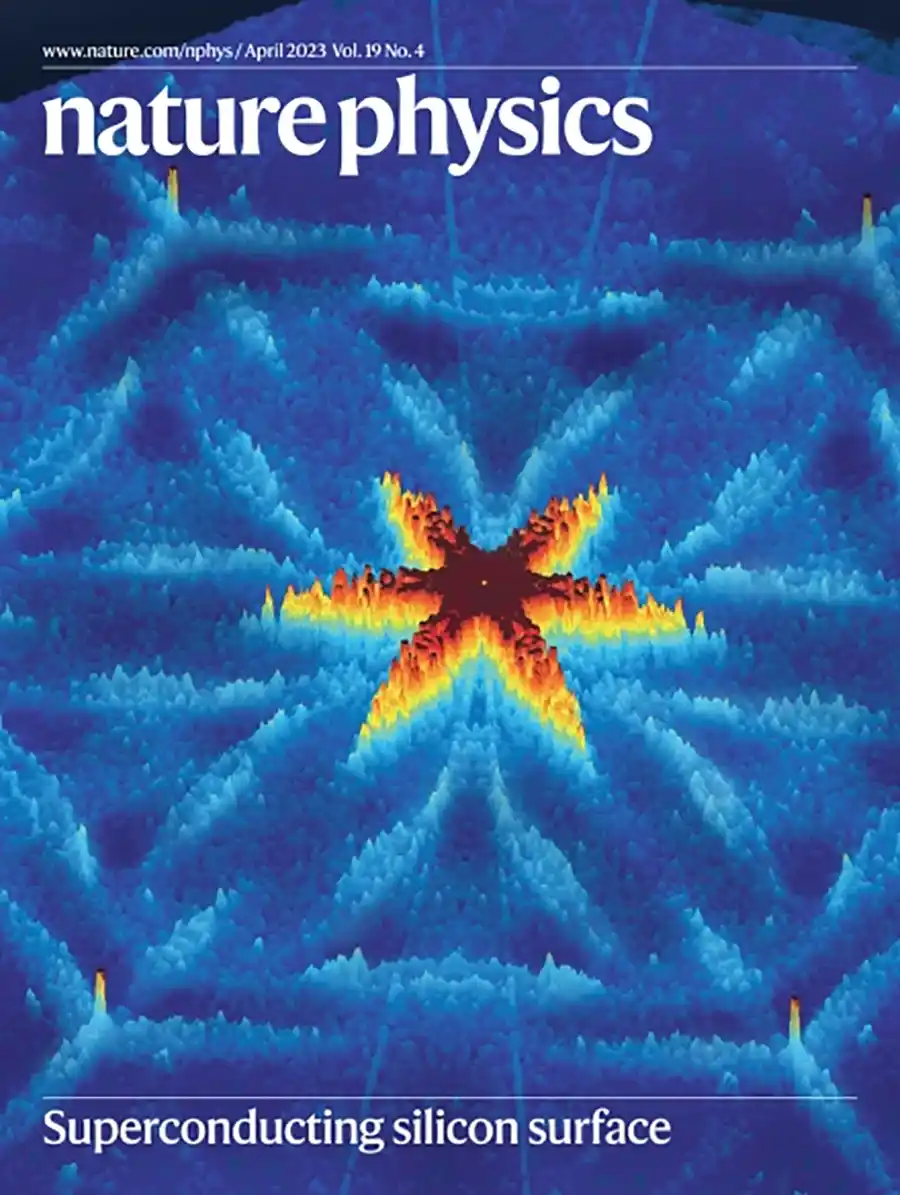
Nature Physics Magazine Cover for the issue that featured the article referenced in this post
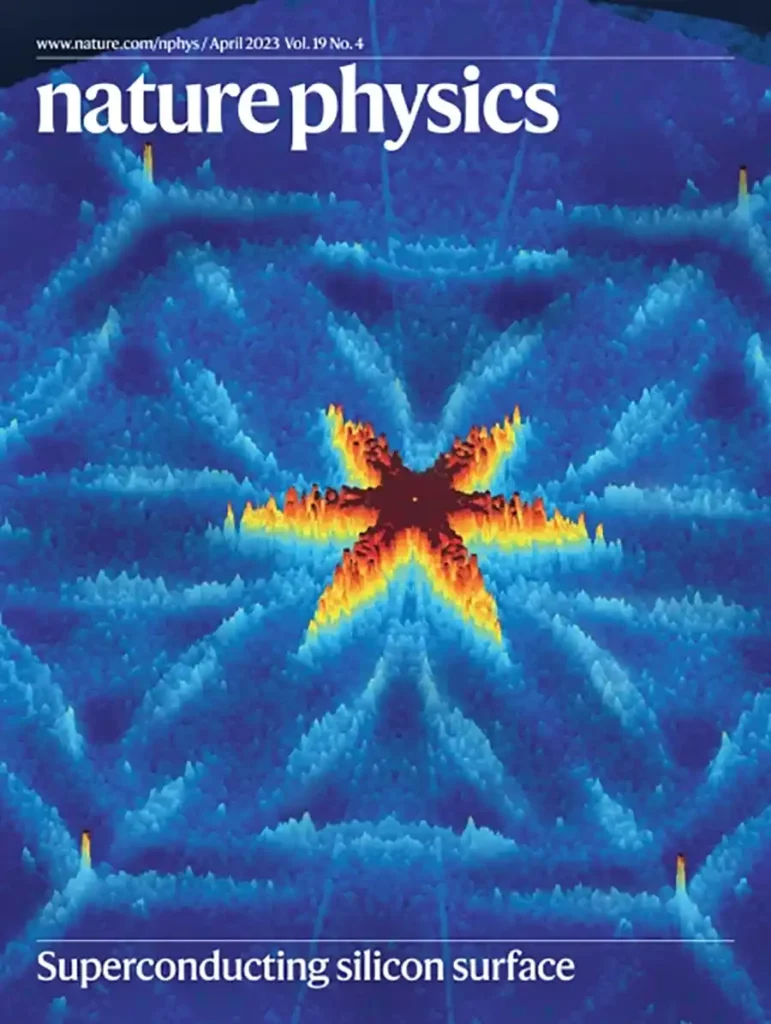
Featured on the April 23 (Vol. 19, No 4) cover of Nature Physics: A 3D rendition of images from the paper.

This is a quasi-particle interference spectrum of a monatomic superconducting tin layer on a silicon substrate. The bright star at the center originates from quasi-particle scattering processes in which time-reversal symmetry is broken. The latter indicates that the superconductivity is topological in nature.

Stealing Electrons

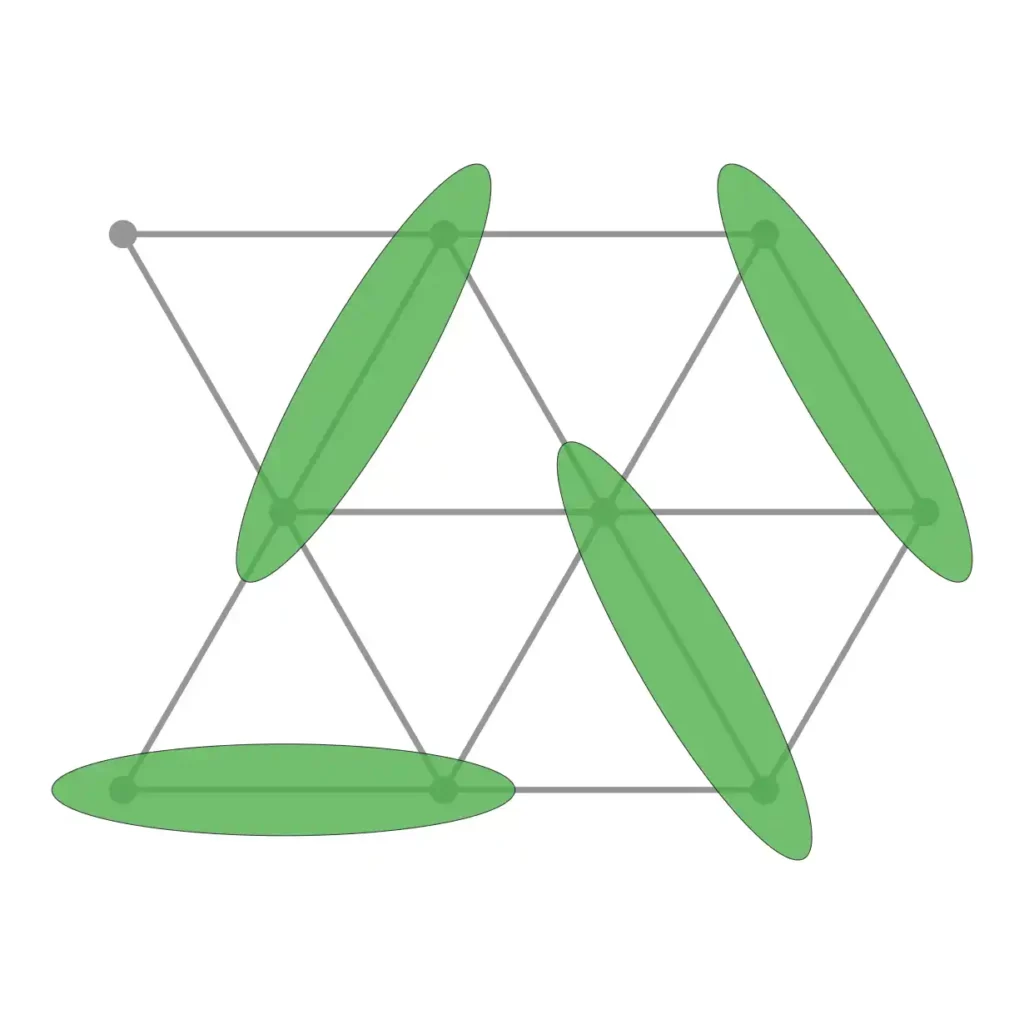
In this work, Professor Hanno Weitering and Associate Professor Steve Johnston and their colleagues in the U.S., Spain, and China replicated cuprate-like physics by growing one-third of a monolayer of tin atoms on a substrate (base layer) of silicon. Think of it as nine silicon atoms in a single layer, with three tin atoms—placed farther apart—stacked in another layer on top. The system is engineered such that the repulsion between the tin electrons is so strong they can’t move and won’t superconduct.

Weitering, Johnston, et al., found a clever workaround by implanting boron atoms in the silicon layer’s diamond-like crystal structure. The boron atoms proceeded to steal electrons from the tin layer (typically about 10 percent) in a process similar to techniques perfected by the semiconductor industry. This gave the remaining tin electrons the freedom to move about. The tin layer thus becomes metallic and even superconducting at a critical temperature exceeding that of nearly all elemental superconductors. Importantly, the phenomenon also scales with the number of boron atoms or stolen electrons, behavior reminiscent of the cuprate superconductors.

Reversing Time and Quantum Computing Applications

While electron theft-based superconductivity is interesting in its own right, the research team found even more intriguing physics suggesting this tin-silicon material hosts chiral superconductivity. This highly exotic state of matter is heavily pursued, in part because of its potential for quantum computing.

In chiral systems, clockwise and counterclockwise rotations are the same and yet different—like how left and right hands are mirror images of each other that can’t be superimposed. In quantum mechanics, the properties of single or paired electrons are encoded in a mathematical wavefunction that can be left-handed, right-handed, or “topologically trivial.” The superconducting wavefunction in the tin layer turns out to be clockwise in parts of the sample and counterclockwise in other parts. If one were to rewind the clock, the clockwise wavefunction would become counterclockwise and vice-versa, but these two wavefunctions are still different, just like the left hand and right hand are different. Or as the physicist would say, time-reversal symmetry is broken.

Time-reversal symmetry breaking is a hallmark of chiral superconductivity. Another is that the system has two one-dimensional conduction channels that run like railroad tracks along the perimeter of the sample material. These channels host exotic particle-like entities (named for Ettore Majorana) where under certain conditions the particle and its antiparticle become indistinguishable. Majorana particles are topologically protected, impervious to what’s going on in the environment around them. They’ve been envisioned as building blocks of future quantum computers, a rapidly emerging technology that could help solve problems too complex for classical computers. The use of Majorana particles implies a safeguard against decoherence, a critical requirement for quantum computation to succeed.

Taken together, the Nature Physics results suggest the possibility of integrating exotic properties with an easily scalable silicon-based materials platform. As such, this would bring futuristic quantum technologies closer to industrial scale production.

January 30, 2023  |  Filed Under: Condensed Matter, Featured News, News

A photo of Jian Liu

Symmetry Breaking in Quantum Systems

December 21, 2022

A photo of Jian Liu
Liu
A photo of Haidong Zhou
Zhou
A photo of Junyi Yang
Yang
A photo of Dongliang Gong
Gong
A photo of Shashi Pandey
Pandey
Lin Hao
Hao
An image of Han Zhang
Zhang

What nature doesn’t readily provide, Associate Professor Jian Liu’s group will create or compel. By designing or controlling a material’s geometry they can tune how its electrons behave. Fundamental research like this is the foundation of everyday electronics we know well. It reveals how phenomena like magnetism, insulation, and superconductivity arise, opening the door to new and exotic properties that drive future discoveries. Graduate students and postdocs play key roles in Liu’s group and have found creative ways to use or alter an atom’s architecture to control electronic behavior.

Breaking Some (But Not All) Rules

How do scientists tune electrons? It starts with the materials they study. Liu and his colleagues focus on samples that have a crystalline structure, and that involves symmetry.

As Richard Feynman explained in his famous lectures, “everyone likes objects or patterns that are in some way symmetrical. It is an interesting fact that nature often exhibits certain kinds of symmetry in the objects we find in the world around us. … The crystals found in rocks exhibit many different kinds of symmetry, the study of which tells us some important things about the structure of solids.”

Researchers have been interested in solid state physics for decades. Simply put, it’s the science of solid materials, where atoms are in close quarters. This proximity gives rise to intriguing interactions, especially where electrons are concerned. That knowledge gave us devices like transistors and semiconductors. Solid state physics is part of what’s now more commonly known as condensed matter physics, which includes materials with the lattice-like, repetitive patterns Liu studies. To get to new and interesting physics, his group has found ways to break that symmetry in quantum materials.

“Condensed matters are complicated due to the large number of constituents, especially when quantum effects are significant,” Liu explained. “While electrons often spontaneously break a certain symmetry, they have to follow the symmetries afforded by the crystal structures. If we can design or control the lattice symmetry as we want, we can tune electron behavior the way we want and even force them to spontaneously break another symmetry that they don’t want to break originally.”

In recent papers his group has outlined a successful strategy to do this, including materials that already exist in nature and “toy model” materials they created on their own.

Top-Down Design and Bottom-Up Synthesis

One of Liu’s interests is the interplay of topology and electron correlation in materials. Topology has to do with systems that don’t change even when you bend, twist, or deform them. Electron correlation is how much an electron’s movement is determined by other electrons in the same system. Topology has been a more recent revolution in understanding quantum materials, but electron correlation isn’t well understood in quantum materials despite being known for a long time. Further, what scientists understand about topology assumes the electrons don’t interact with each other.

To implement topology to correlated electrons in a controllable way, Liu and his colleagues created their own materials from strontium, iridium, calcium, titanium, and oxygen.

“One can pick the desired elements and put them into a structure with the designed symmetries,” he said. “We call this top-down design and bottom-up synthesis.”

In this case, he said they devised a “toy-model material that has the ingredients of both topology and correlation (to) find out what the electrons would actually do.”

That’s how they found new physics in the middle ground: the intermediate coupling of electrons. In their fabricated materials, electrons form an insulator (as expected when correlation is strong) and at the same time exhibit a spontaneous Hall effect (as expected if the electron wave function has topological properties). They occur simultaneously because the correlation is not too strong, but just strong enough, so that electrons can break the designed symmetry by ordering their spins magnetically. The unusual phenomena open a new view on electronic topology and correlation interplay in a largely unexplored regime.

Liu’s group had similar success designing a hybrid structure using most of the same elements. By stacking two sheets of atoms, they brought electron spins close to each other but without direct contact or bonding. He explained they “figure out a way to compromise” and create distinct rotational symmetries.

Same Ends, Different Means

How electrons spin is key to additional symmetry-breaking research the Liu group published with Associate Professor Haidong Zhou.

“The idea is quite simple,” Liu said. “While spins can point to any direction, they have to spontaneously pick a direction when they form a magnetic order. The process depends on the internal symmetry of the material.”

Liu gives this analogy: imagine arranging furniture in a rectangular-shaped office. People typically place a desk against one of the walls even though they don’t have to. Now imagine strain is put on the four walls, making the room oblique. That changes the symmetry, and one may not like having the furniture against the walls anymore. Similarly, researchers can deform a material’s structure so that parallel atomic planes slide past each other, forcing spins to make a new choice.

“There is no obvious choice like before,” Liu said, “so it turns out they spontaneously come up with a new solution where their directions are modulated in space.”

This symmetry breaking hadn’t been seen before in the material they used, which comprised strontium, iridium, and oxygen. The findings are significant, Liu explained, not only because the strain-induced interaction hadn’t been previously observed, but also because two magnetic interactions are competing “just because they want the spins to point along different axes.”

Continuous strain tuning and controllable new phases could be widely applicable to two dimensional materials—those consisting of isolated single layers of atoms—that promise to play an increasingly important role in future technologies.

The Inevitable Experience of Failure, and Why it’s Good

Young scientists in Liu’s group were first or co-authors on all papers stemming from this research. They include Junyi Yang (PhD, 2022; now a postdoc at Argonne National Laboratory), Dongliang Gong (postdoc), Shashi Paney (graduate student), and Lin Hao and Han Zhang (both former UT postdocs).

Liu believes giving students leadership roles is important for the field to advance.

“The students are the future,” he said. “By leading a project, they have to face all the challenges, tackle them, and inevitably experience failure of the experiment during which they actually learn a lot more. This process makes the final success of the experiment much more rewarding. That’s how they become the next generation of physicists.”

December 21, 2022  |  Filed Under: Condensed Matter, Featured News, News

A photo of Elbio Dagotto

Elbio Dagotto Receives APS Adler Award in Materials Physics

October 11, 2022

A photo of Elbio Dagotto
Dagotto

Elbio Dagotto doesn’t necessarily take things at face value, at least not when it comes to materials. He is interested in the complexity often going on below the surface—how electrons move, spin, and interact and what happens as a result, often with competing tendencies leading to unusual patterns and properties. Superconductivity, magnetism, and quantum computing all have ties to the fundamental research Dagotto conducts as both a Distinguished Professor of Physics at UT and a Distinguished Scientist in Oak Ridge National Laboratory’s Materials Science and Technology Division. For his outstanding contributions to materials physics, the American Physical Society (APS) has awarded him the 2023 David Adler Lectureship Award in the Field of Materials Physics.

“Professor Dagotto is a leader in the field of strongly correlated electrons, consistently pushing forward new paradigms and ideas to solve some of the most pressing problems facing the world today,” said Professor and Department Head Adrian Del Maestro. “At the same time, he is well known for his dedication to teaching and mentorship, having trained a large number of successful scientists as well as consistently being a recipient of departmental undergraduate teaching awards. He has a knack for communicating complicated ideas in a pedagogical manner, demonstrated through his popular review papers, and he is always at the top of my list to teach introductory quantum mechanics.”

Dagotto is a condensed matter theorist and uses advanced models and computational tools to predict how correlated electrons behave in a wide variety of materials, as well as nanoscale systems.

“We say electrons are correlated when the properties of one individual electron depend strongly on what the rest of the ensemble of many other electrons is doing, a formidable challenge for calculations,” he explained.

These studies provide the bedrock for understanding at a fundamental level how several properties, such as insulation, magnetism, and superconductivity arise: crucial discoveries for unveiling new exotic materials as well as developing atomic scale devices. Dagotto literally wrote the book on Nanoscale Phase Separation and Colossal Magnetoresistance and co-edited another on Multifunctional Oxide Heterostructures. He has authored or co-authored more than 450 publications that have been cited more than 30,000 times. In 2004 he joined UT and ORNL with a 50-50 percent split appointment; that same year he was listed among the world’s top 250 most Highly Cited Physicists. His research is currently funded by the U.S. Department of Energy, Office of Science, Basic Energy Sciences, Materials Sciences and Engineering Division.

Dagotto’s expertise is so well regarded that he has been invited to weigh in—often as sole author—on the state of condensed matter physics for prestigious journals including Science, Nature, and Reviews of Modern Physics. For four years he was a divisional editor specializing in condensed matter for Physical Review Letters. He has also served on the National Academies’ Solid State Sciences Committee (now the Condensed Matter and Materials Research Committee), a body that helps set the national agenda for materials research.

Dagotto earned a PhD in physics at Instituto Balseiro, Bariloche, in his native Argentina. He has a keen interest in supporting other Hispanic scientists at all stages of their careers. To that end he and Professor Adriana Moreo have organized a series of Hispanics in Physics lunch gatherings for the department, welcoming everyone from undergraduates to senior faculty.

The Adler Lectureship Award will now appear on Dagotto’s CV among a host of other honors, including his election as a Fellow of both the American Physical Society and the American Association for the Advancement of Science. The UT Society of Physics Students has also recently selected him as Teacher of the Year the last two times he taught quantum mechanics for undergraduate students.

Dagotto’s official citation for the Adler Lectureship reads:

“For pioneering work on the theoretical framework of correlated electron systems and describing their importance through elegant written and oral communications.”

The David Adler Lectureship Award in the Field of Materials Physics is awarded annually to a scientist making outstanding contributions to the field of materials physics and who is notable for high quality research, review articles, and lecturing. The honor is named for the late David Adler, a condensed matter physicist and professor at the Massachusetts Institute of Technology. The official award presentation will be next March at the American Institute of Physics meeting, where Dagotto will give an invited talk.

October 11, 2022  |  Filed Under: Condensed Matter, Featured News, News

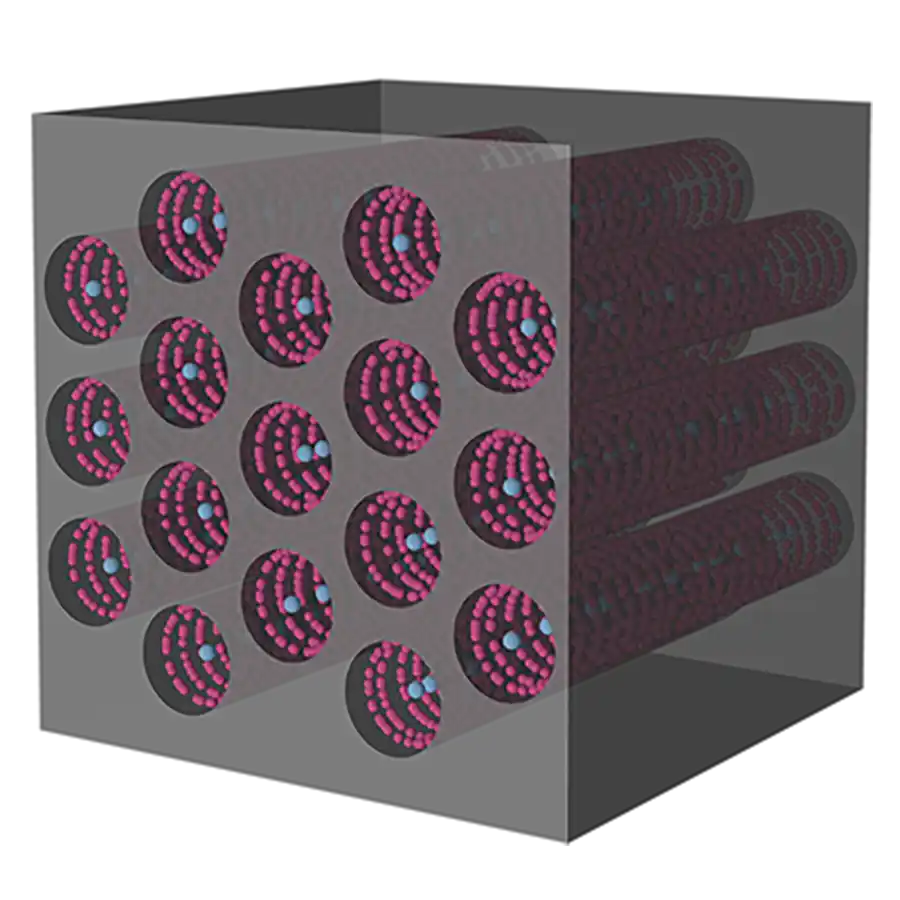
A diagram of helium atoms moving through a 1-D pipe coated with argon.

A Front Row Seat to Quantum Behavior

July 6, 2022

Helium may bring the fun to party balloons but we’re actually more familiar with its serious side. As a liquid it’s crucial to cooling magnets used in magnetic resonance imaging and manufacturing semiconductors. Cooled to a critical temperature it can become a superfluid: flowing with no viscosity and losing no kinetic energy.

For Professor Adrian Del Maestro, helium holds even more exotic charms. Since his postdoctoral days he’s wanted to confine this element to one dimension, where theory predicts it will become a fluctuating phase of matter that’s not exactly a solid, a liquid, or a superfluid. The model itself (a Tomonaga-Luttinger liquid) was first proposed in 1950 and until now has never been seen in a system of strongly-interacting atoms. Del Maestro and his colleagues at Indiana University Bloomington have found a way to squeeze helium down to single-atom thickness and give scientists a front-row seat to observe quantum mechanical behavior.

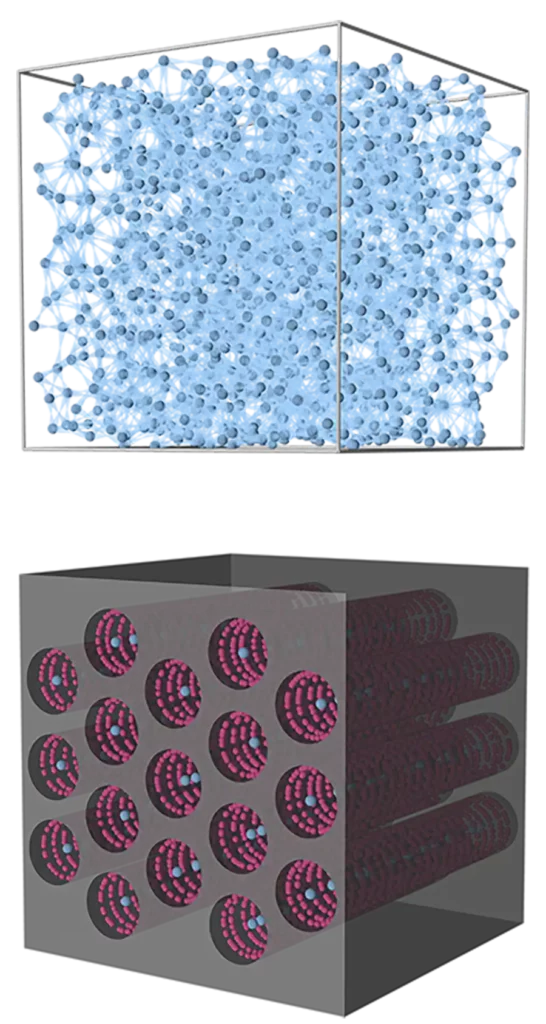
Conceptual image of strongly interacting helium atoms (top)
and helium atoms moving through a 1-D pipe coated with argon.
Conceptual image of strongly interacting helium atoms (top) and helium atoms moving through a 1-D pipe coated with argon.

Building an Atomic Scale Pipe

The promise (and challenge) of quantum science lies in understanding how things work in lower dimensions. Take carbon, for example. In 3-D it’s graphite, the soft stuff that lets a pencil glide across paper. In 2-D it’s graphene, an ultra-light and ultra-strong system.

“A sheet of graphene weighing less than the whisker of a cat could support the cat’s weight,” Del Maestro explained.

Helium has similar differences.

“In 3-D, the same helium atoms that fill balloons can whiz around each other to form a superfluid phase of matter,” he said. “In 1-D, the atoms are forced to interact strongly as they are all made to stand in a line, and they can’t easily exchange places.”

Though its properties make helium an ideal system for getting a glimpse into one-dimensional behavior, confining its atoms to this scale is no trivial task.

“You literally need to make a pipe that is only a few atoms wide,” Del Maestro said. “No normal liquid would ever flow through such a narrow pipe as friction would prevent it.”

Fortunately, in 2015 he met IU’s Paul Sokol at a conference and they merged their theoretical and experimental expertise to build this atomic structure.

“Paul had worked on confining superfluids for years, but just couldn’t get them small enough,” Del Maestro said. “I had done numerical simulations that found the ‘sweet’ spot on the pipe size we needed.”

Del Maestro suggested they paint the inside of a pipe to make it smaller. Sokol came up with the idea to pre-plate it with a rare gas. They took a nanoporous material, whose structure is like a sponge with ordered pores, and coated the inside with a perfect layer of argon to make it angstrom scale (a hundred-millionth of a centimeter). Now they had their 1-D pipe. They filled it with liquid helium, which adsorbed inside the pre-plated nanopores, and then bombarded the helium with neutrons. The resulting excitations told them what phase of matter they had.

“You can think of this as testing whether something is a liquid or solid by asking what happens when you throw something at it,” Del Maestro said. “Does it bounce off, or travel through? The results of the experiments can be modeled with theoretical calculations and simulations to confirm the existence of the Luttinger liquid state of matter.”

The Power of Positive Thinking

Del Maestro explained that helium confined in one dimension holds possibilities that other systems exhibiting 1-D do not.

“It can be adjusted with pressure, all the way from a gas to a solid … and provide the possibility for tuning and optimizing devices exploiting quantum phenomena,” he said.

A one-dimensional pipe filled with liquid helium attached to a device can also sense tiny rotations, pointing to future applications in geo-sensing, gyroscopes, and autonomous navigation in extreme environments where GPS isn’t feasible, such as drones on other planets.

The isotopes helium-3 and helium-4 offer the chance to further test the Luttinger liquid theory that a 1-D liquid of bosons and fermions—particles that make up matter and carry forces—should have similar behavior at low temperatures. Del Maestro and Sokol have opened an avenue for this research with the experimental realization of 1-D helium. The findings, published in Nature Communications, were the result of work from their respective groups, as well as patience, persistence, and positive thinking.

“It’s something I’ve been thinking about for 15 years … and was only possible because of the tight integration of theory and experiment,” Del Maestro said. “I’d ask Paul if something was possible, and he would say ‘No, but I’ll think about it.’ Paul would show me some crazy result and say ‘Do you know what is going on at the atomic level?’ and I would reply with ‘No, but I’ll think about it.’”

Eventually, he said, all the pieces of this 1-D puzzle fit together.

July 6, 2022  |  Filed Under: Condensed Matter, Featured News, News, Quantum Materials

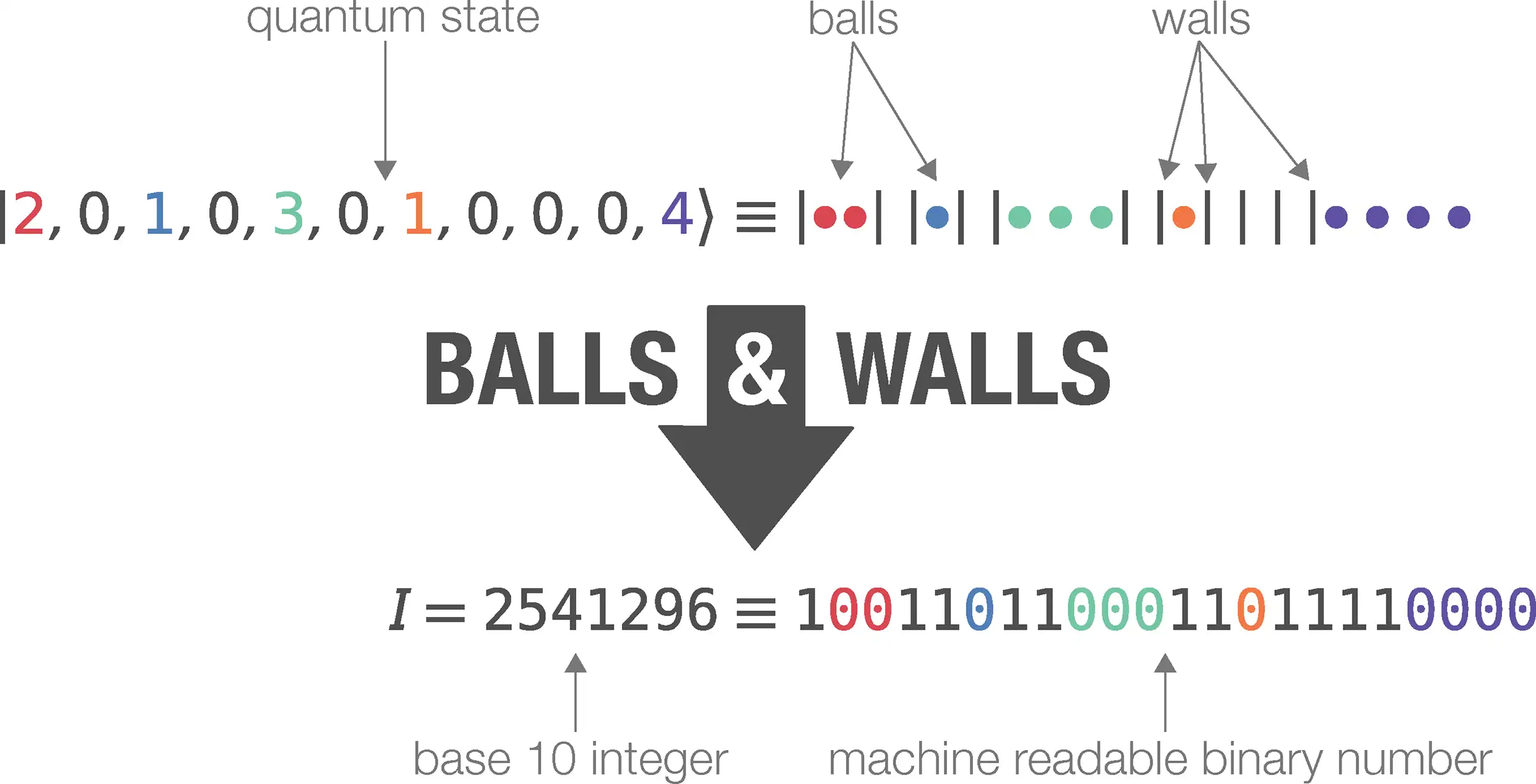
A diagram illustration Adrian Del Maestro's and Hatem Barghathi's counting tool "Balls and Walls."

Building Bridges for the Quantum Era

May 31, 2022

Del Maestro
Photo of Hatem Barghathi
Barghathi

Speed.

Adrian Del Maestro and Hatem Barghathi are talking about speed, and memory, and how many bytes you need to type a single letter. In classical computers those workings are neatly spelled out: things are either on or off. But Del Maestro and Barghathi think in quantum scales, the tiny systems where classical mechanics doesn’t hold up and the multitude of particle configurations is so large, it seems impossible to count and store.

With colleagues from the Tickle College of Engineering, they’ve devised a shorthand to describe these configurations, dramatically speeding up calculations and with them scientists’ ability to predict how quantum systems behave. This kind of innovative thinking sets the stage for quantum materials to take the baton from silicon as new technologies emerge. With investment in the Quantum Materials for Future Technologies cluster, UT is well situated to be a scientific leader in this new era.

The Foundation for a Post-Silicon World

Del Maestro, a professor in both the Department of Physics and Astronomy and the Min H. Kao Department of Electrical Engineering and Computer Science, has been intrigued by quantum science since graduate school. The cluster opportunity brought him to UT from the University of Vermont. Barghathi, a postdoctoral researcher in his group, came along. Counting six new hires and current faculty in physics and engineering, by next year the cluster will have 15 or so active researchers mining the depths of quantum materials. Daunting as they may seem with their rebellion against classical physics and their maddeningly small architecture, leaving that territory unexplored would be both a scientific and economic mistake.

“Fundamental advances in materials led to our current ability to harness technology and that has given us the modern age,” Del Maestro said. “The fact that we have billions of transistors in our pockets in our iPhones is because of that foundational work.

“At the time, people weren’t trying to build iPhones,” he continued. “They were trying to understand the properties of materials. And so what we’re trying to do right now is understand and harness the properties of a new class of quantum materials that can exhibit dizzying non-classical behavior.”

Technology often follows a long path that’s not always obvious. A physicist came up with the principle for a transistor in 1925, engineers developed it in 1947, and in 1961 we had the first silicon chip. Quantum materials could be the next chapter.

“We’re really at the start of that,” Del Maestro said. “The hope is that if we can learn to understand how to first describe, quantify, characterize, and then harness these things we don’t have classical analogs for, then almost by necessity they’ll lead to what we call post-silicon quantum technologies. That’s really the purpose of the cluster. UT was already a leader in this area. We want to move from being a regional leader to being a national or global leader.”

Twenty Times Faster

Leading means solving problems, and quantum materials present plenty. One is that it’s hard to predict what atoms (and their electrons) are going to do in a quantum system. Scientists and engineers know how to control electronic current in an iPhone’s transistors, but that’s classical, not quantum physics.

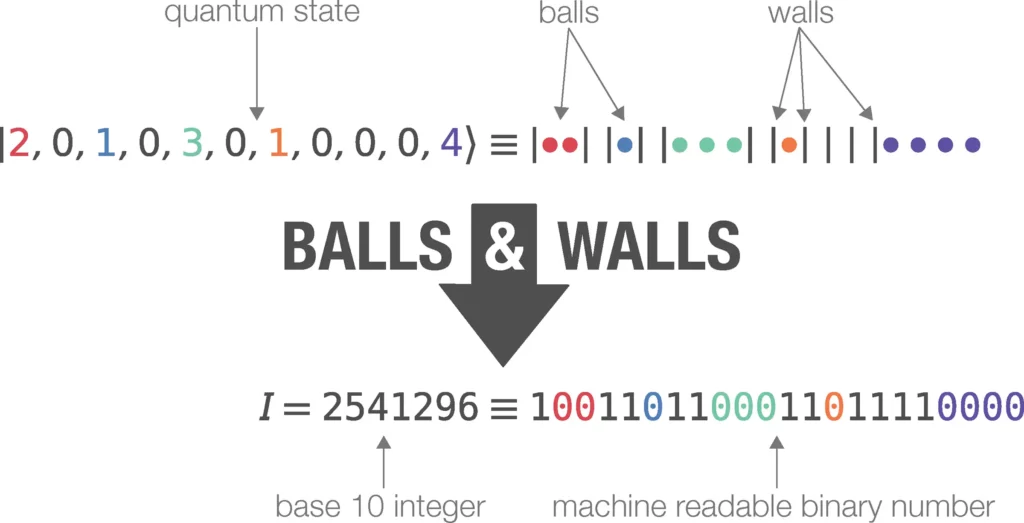
A diagram illustration Adrian Del Maestro's and Hatem Barghathi's counting tool "Balls and Walls."

“Say you have 10 blue balls,” Del Maestro explained. “Classically, you can always tell the difference between macroscopic objects, like two baseballs or billiard balls. If you look hard enough you can tell them apart. One of the absolutely amazing things about quantum mechanics is that if I give you two electrons or two rubidium atoms, there is no experiment that you can do to distinguish them.”

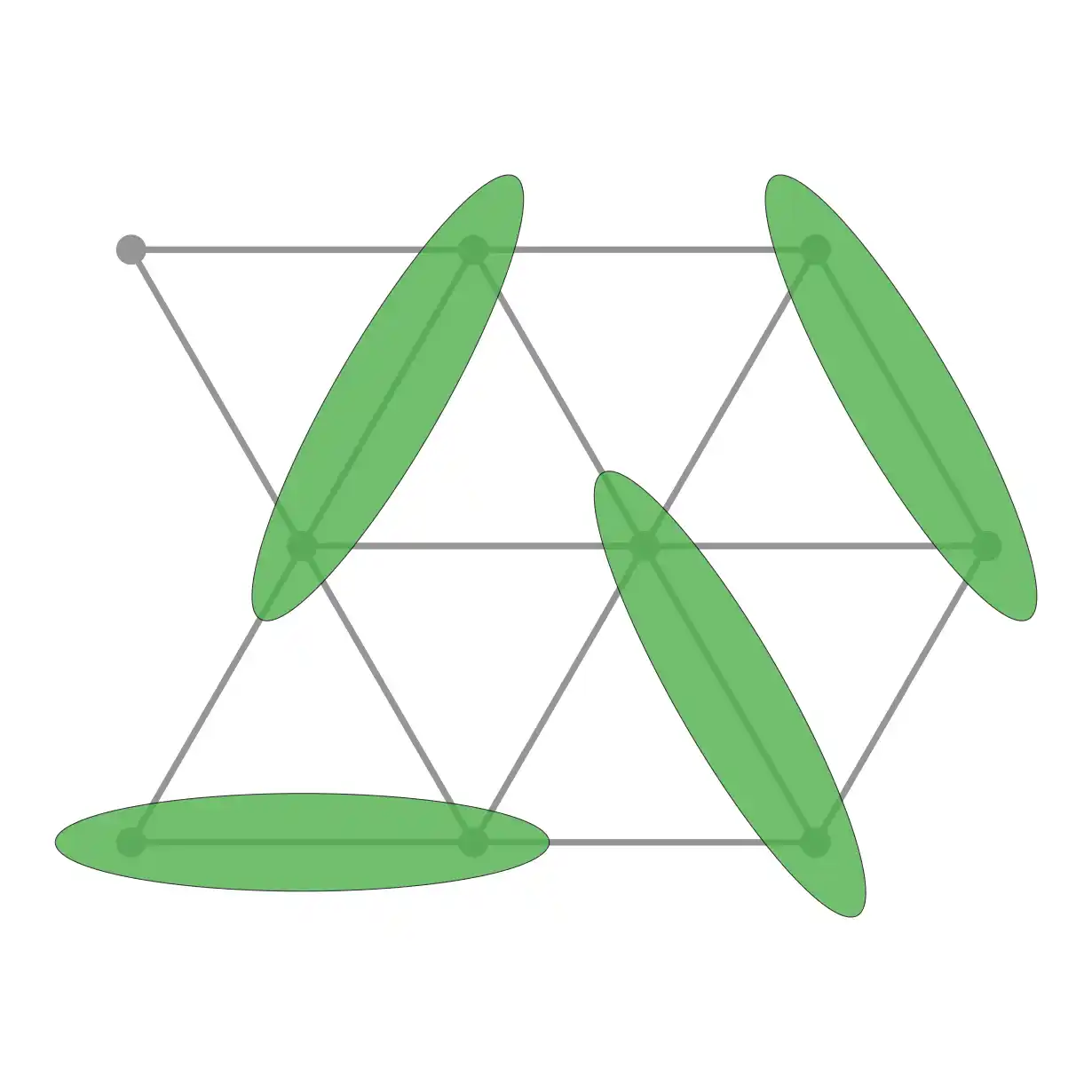
Those atoms are situated on lattice sites—corners, if you will, of the jungle gym-like structure of quantum materials. Complicating matters is that they’re made up of particles that can be fermions or bosons. Fermions sit one to a seat. Bosons can pile on top of each other, causing another headache, especially when you can’t tell them apart. It’s like putting together a football playbook when all the players in front of you have different abilities but look exactly alike, wear identical jerseys, and in some cases hide behind each other.

“I have these atoms and I ask how many different ways can I distribute them. But the atoms are truly indistinguishable. That’s a very hard problem to solve,” Del Maestro said.

To find the possible configurations in this scenario, he and Barghathi adapted a counting tool called “balls and walls.” At its most basic, it’s a mathematical formula to quickly figure out problems like how many combinations are possible if you want to buy a dozen donuts in four available flavors.

In this research, Del Maestro and Barghathi wanted to find how many different particle combinations were possible on lattice sites. They found the trick was to consider the setup as two objects: one as an object itself and the second as the edges of buckets you’re putting those objects into. Combining the objects and edges using a special mathematical formula gives you the number of slots available for the objects you want to count.

“Balls and walls allows me to use a simple counting argument to enumerate all possible configurations,” Del Maestro said. “Why is it important? If you want to know what the most likely configuration is, you need to know how many times it appears. Configurations are the language in which we solve a problem. We need to know the words in that language before we can write a sentence.”

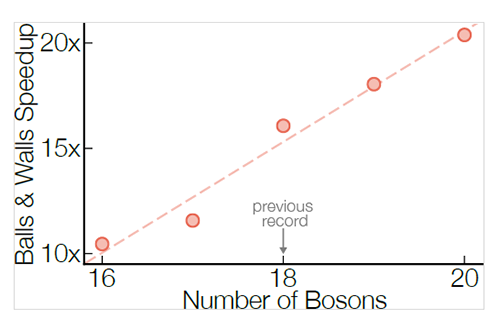
He said the fastest computers in the world have only been able to study 21 fermions on 42 lattice sites, and far fewer bosons. The coding he and Barghathi developed can study 20 bosons on 20 sites: 20 times faster than current methods. Beyond that, it takes much less memory, reducing the needed storage by a factor of the number of sites.

A graph showing the "Balls and Walls" counting tool time scaling.

“Think about how much memory you need for each letter that you store in a computer,” Barghathi said. “It will basically take eight bits. A number is at least going to take the memory of a letter.”

When facing huge numbers of possible configurations, he said, “you need to know how much memory you need to store them and how fast you can deal with them.”

Del Maestro explained that “the number of total configurations you need to store is gigantic, so if you can get a factor of 20 smaller, that’s the difference between being able to solve the problem or not. If something used to take a month, now it can take a day. Modern quantum experiments can start to use these larger system sizes and now we can actually predict what they’re going to measure in the lab.”

Spontaneous Advances

The findings are published in the first paper to come out of two departments from UT’s quantum materials cluster. While Del Maestro and Barghathi brought physics expertise in quantum mechanics, Del Maestro said “to understand this representation at the level of the bits, we needed computer science. This is where our colleagues like Micah Beck, a co-author on the paper, come in.”

The collaboration was a little slow at the beginning, with physicists and engineers speaking different languages about caches and buffers; bosons and symmetries.

“Interdisciplinarity is hard,” Del Maestro said. “It takes time and effort and thoughtfulness to build that bridge.”

The cluster plays a crucial role in that construction.

“Without that, it’s easy to be very fractured, even if we’re all working in quantum materials,” he said.

Del Maestro explained that because the cluster embedded him in engineering and computer science he wasn’t an outsider: he knew who to ask about this problem because he knew Beck was interested in it as well.

“That, I think, is the strength of the cluster,” he said. “It was very much spontaneous. The cluster will enable new types of spontaneous advances. We can’t predict where they’re going to come from because they really come at the interface where different expertise all of a sudden fits together and produces something profoundly new.”

May 31, 2022  |  Filed Under: Condensed Matter, Featured News, News

  • « Previous Page
  • 1
  • 2
  • 3

Recent Posts

  • Public Lecture on Quantum Mechanics
  • Brandi Skipworth Wins GATE Fellowship
  • Research Rock Stars: Thomas Papenbrock Explores the Forces at the Core of Matter
  • Rules for Nuclear Couples
  • Reconciling Fundamental Physics

Physics & Astronomy

College of Arts and Sciences

401 Nielsen Physics Building
1408 Circle Drive
Knoxville TN 37996-1200
Phone: 865-974-3342
Email: physics@utk.edu

Facebook Icon    X Icon

The University of Tennessee, Knoxville
Knoxville, Tennessee 37996
865-974-1000

The flagship campus of the University of Tennessee System and partner in the Tennessee Transfer Pathway.

ADA Privacy Safety Title IX