• Request Info
  • Visit
  • Apply
  • Give
  • Request Info
  • Visit
  • Apply
  • Give

Search

A-Z Index Map

Physics & Astronomy

  • About
    • Honors
    • Administration
    • Faculty Resources
    • Nielsen Spaces
  • Research
    • Research Partners & Facilities
    • Condensed Matter
    • Particle / HEP
    • Biophysics / Soft Matter
    • Nuclear / Astrophysics
    • Quantum Information
  • People
    • Faculty
    • Staff
    • Joint Research & Adjunct Faculty
    • Post Docs
    • Graduate Students
  • Undergraduate
    • Why Physics
    • What Our Grads Do
    • Career Resources
    • Degree Programs
    • Research
    • Scholarships
    • Student Organizations
  • Graduate
    • Join Our Program
    • FAQs
    • Fellowships & Assistantships
    • Bains Fellowship
    • Where Our Grads Go
    • Research
    • Resources
  • News & Events
    • Newsletters
    • News
    • Colloquia Series
    • Events
    • In the Media
  • Outreach
    • Astronomy Outreach
    • Cool Things in the Sky this Month
    • Physics Outreach & High School Lecture Series
  • Alumni
    • Distinguished Alumni Award
    • Giving Opportunities
    • Share Your News
A banner showing a model of an atom and elementary particles

News

Condensed Matter

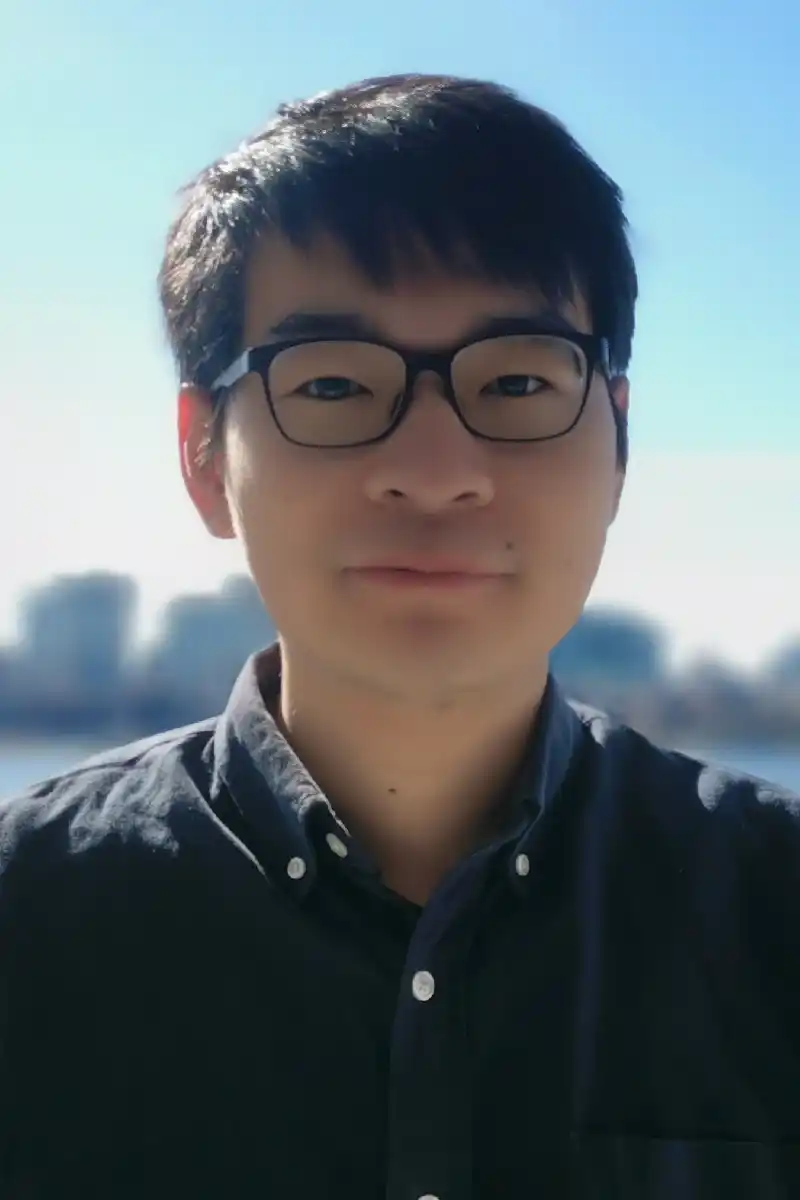
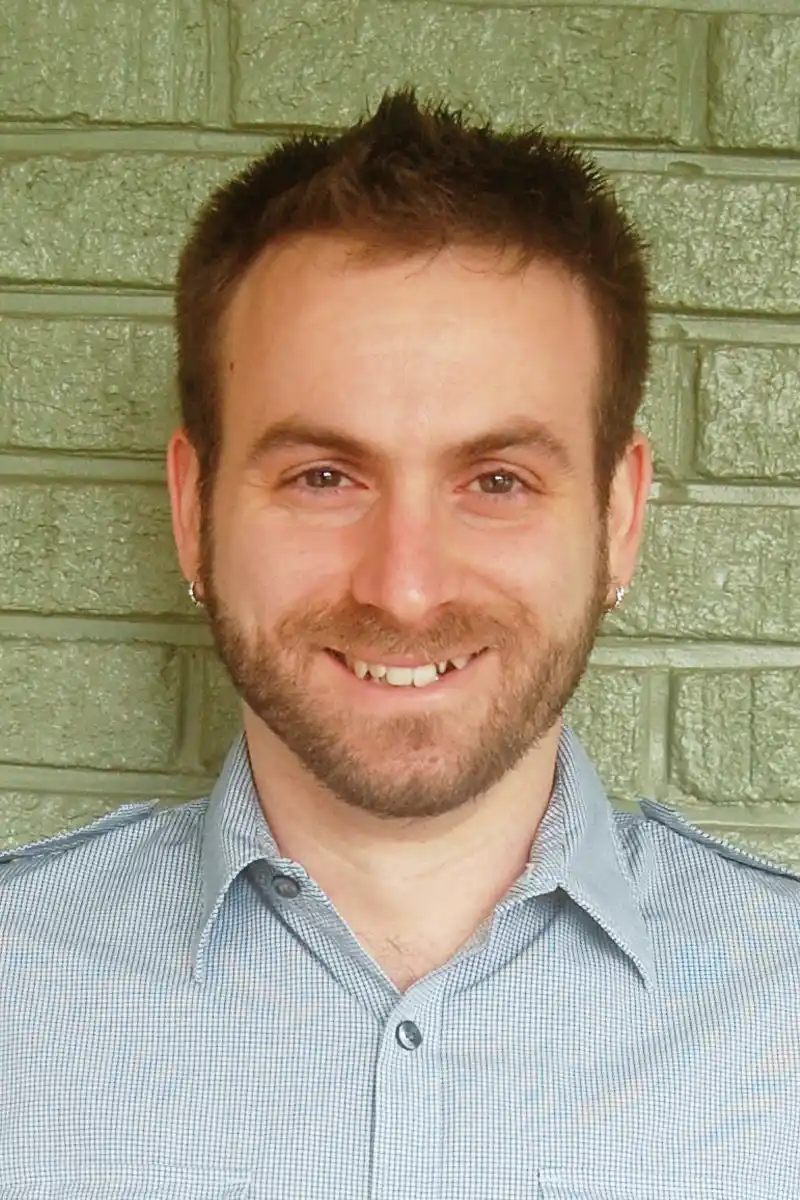
A photo of Jian Lu

Humboldt Fellowship for Jian Liu

June 23, 2025

A photo of Jian Lu

Like different sides of a ledger, how quantum materials work and what everyday applications require are in opposite columns. With support from a prestigious Humboldt Research Fellowship, Associate Professor Jian Liu wants to balance the books with materials and devices that use quantum science to meet practical needs.

Good Friends Make Good Science

Currently Liu is spending the first of three summers at the Leibniz Institute for Solid State and Materials Research Dresden (IFW Dresden) in Germany. He was introduced to scientists there by UT Physics Assistant Professor Yang Zhang.

“He has good connections in Germany,” Liu said of Zhang. “He recommended (to) me that would be a nice place to visit and he connected me to some great colleagues there. We started talking and there was a lot of common interest.”

IFW Dresden focuses on investigating matter’s properties to develop new applications. That’s a great match for Liu, who studies quantum materials for innovative nanotechnologies. While quantum science is a rapidly-growing field for research and industry, it can be tricky ground to cover. Physics in the macroscopic world (the path of a baseball pitch, for example) is very different from the microscopic, or quantum, world (like the spin of an electron). The rules in quantum mechanics differ wildly from the predictable laws of classical mechanics. One key difference is temperature.

“For quantum phenomena to emerge, we need to go to very low temperature,” Liu explained. “If you read articles about quantum computers, you’ll see they have to go extremely low temperatures. That’s when the thermal effects are gone and then the quantum effects really show up. (It’s) the same for materials. If we want to measure the quantum properties of materials we have to go to very low temperatures.”

Very low in quantum-speak means near absolute zero. Liu explained that when things get too warm, quantum properties disappear.

“Thermal effects can de-cohere quantum properties,” he said. “The famous example would be superconductivity, where you need two electrons in a pair. The reason they could pair together is because their wave functions are coherent with each other. They know what the other is doing, so that they can act accordingly. But a thermal effect is going to come in and de-cohere (them). And eventually when you reach high enough temperatures superconductivity disappears.”

As scientists learn more about subatomic systems, they can find advanced uses for them like cyptography for secure communications or sophisticated sensors for precise navigation.

The Dresden group hosting Liu has instruments with the cooling power needed to make devices and measure their quantum properties.

Bridging Basic and Applied Science

Liu said he wants to start by making devices as simple as a Hall bar, which lets scientists measure both longitudinal and transverse voltage in a semiconductor.

“The problem is that in practical materials to measure those two things at the same time is not easy,” he explained. “You want to make a device where your electrodes are extremely symmetric on both sides of a narrow channel. That requires you to do nanofabrication.”

The tools at IFW make that possible and will help Liu build an even stronger research program at UT.

“We’re very strong in materials synthesis and we’re getting very comprehensive in terms of characterizations,” he said. “We can make all these new, amazing materials, but eventually if you want to turn them in to any kind of application, the first step will be to build a device. The device is the bridge between fundamental physics, basic science, to applied science. The problem we have is that we don’t have much device fabrication capability for quantum materials.”

Liu is the scientific director of the Electromagnetic Properties Lab (EMP) at UT’s Institute for Advanced Materials and Manufacturing (IAMM). As a core facility, EMP serves materials researchers from multiple departments and colleges. Liu said UT has invested in quantum science with facility upgrades and new hires and his time in Dresden will help him make the most of those resources and plan for the future.

“We don’t have as much on-campus experience of device fabrication as those folks in Germany,” he said. “One of the things I want to do is learn from them. If I learn device fabrication and see how things work (and) get the know-how, then I could help enhance that capability on our campus for the local community of materials research.”

Physics Professor and Department Head Adrian Del Maestro is among Liu’s colleagues who’ll benefit from this newly-gained expertise. He also studies quantum materials and holds leadership positions at IAMM through the National Science Foundation-supported Center for Advanced Materials and Manufacturing (CAMM).

“Professor Liu is operating at the cutting edge of quantum materials research, and this fellowship will enhance the EMP facility’s quantum device capabilities, moving UT up the technological readiness level scale,” he said. “Humboldt Fellowships are prestigious life-long opportunities that demonstrate the impact UT Physics and Astronomy is having on the international scientific enterprise.”

In true “Everywhere You Look, UT” style, Liu said while he’s abroad he’ll also promote Tennessee’s strengths in quantum science.

“(I’ll) let them know that we’re good—and growing,” he said.

June 23, 2025  |  Filed Under: Condensed Matter, Featured News, News, Quantum Materials

Faculty members Steven Johnston and Tova Holmes at the College of Arts and Sciences Faculty Convocation Award Ceremony on March 31, 2025.

Holmes and Johnston Win CAS Honors

April 4, 2025

Faculty members Steven Johnston and Tova Holmes at the College of Arts and Sciences Faculty Convocation Award Ceremony on March 31, 2025.
Steve Johnston and Tova Holmes

Each year the College of Arts and Sciences honors faculty members who’ve excelled in teaching, advising, outreach, research and creative activity, and other aspects of the college’s mission. The Department of Physics and Astronomy was well-represented at the annual awards ceremony on March 31, when Assistant Professor Tova Holmes and Bains Professor Steve Johnston were recognized as outstanding researchers.

Understanding Matter’s Foundations

Holmes works in elementary particle physics and is deeply involved with research at the Large Hadron Collider at CERN. She started at the ATLAS Experiment and is now part of the CMS Experiment, which sorts through the results of the LHC’s powerful particle collisions to search for new particles (and new physics) using the Compact Muon Solenoid Detector. She’s also turned her attention to the promise of a muon collider to further test the limits of what we understand about the particles and forces that make up all matter. Since joining the physics faculty in 2020, Holmes has won significant support and recognition for her work. In 2022 she was awarded a U.S. Department of Energy Early Career Research Award. In 2024 she won the university’s first-ever Cottrell Award and earlier this year she was named a Sloan Research Fellow. The college presented her with an Excellence in Research and Creative Achievement Award (Early Career.)

Decoding Quantum Materials

While Holmes focuses on particles, Bains Professor Steve Johnston wants to understand how and why quantum materials behave the way they do. As a condensed matter theorist, he applies mathematical models to demystify the complex interactions in quantum systems—those that defy the rules of classical physics models and have the potential to revolutionize science and technology (e.g., superconductivity). Johnston joined the faculty in 2014. Since then he has won a National Science Foundation CAREER Award (2019), a UT Chancellor’s Citation Award for Extraordinary Professional Promise (2020), seen his research featured on the cover of Nature Physics, and played a key role in the university’s successful bid to win NSF funding for the Center for Advanced Materials and Manufacturing (CAMM). Last year the department named him the Elizabeth M. Bains and James A. Bains Professor of Physics and Astronomy, support that enables him to develop and share a collection of codes (called SmoQy) to describe new quantum materials without having to start from scratch. He was honored with the college’s Excellence in Research and Creative Achievement Award (Mid-Career.)

While Holmes and Johnston have both won campus and national honors, the department’s students are equally impressed with their work, having selected Holmes as the Society of Physics Students Research Advisor of the Year and Johnston as the Graduate Physics Society Graduate Teacher of the Year (both in 2023).

In the past 10 years, physics faculty members have won 11 college research and creative achievement awards. Learn more about all the 2025 convocation awardees from the College of Arts and Sciences newsroom.

April 4, 2025  |  Filed Under: Condensed Matter, Featured News, News, Particle, Uncategorized

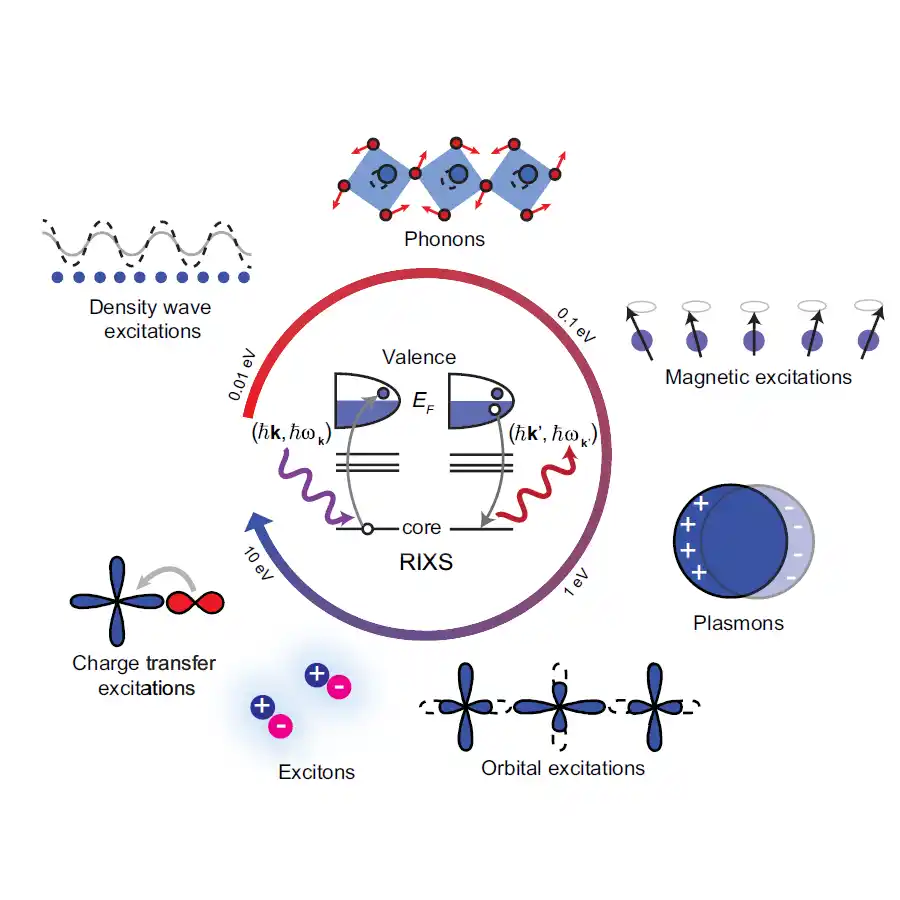
The Kramers-Heisenberg process for resonant inelastic x-ray scattering (RIXS) and the different excitations that it can probe.

UT Physicists Share RIXS Potential for Novel Materials in PRX Perspectives

January 13, 2025

Quantum materials have the potential to transform technology just as transistors did, but before that can happen scientists have to understand how their components interact—and how those interactions are manifested. UT’s physicists and their colleagues were asked for their expertise on how one experimental method can play a defining role in those discoveries. 

UT Physics Bains Professor Steven Johnston and Adjunct Professor Mark Dean (a physicist with the distinction of tenure at Brookhaven National Laboratory), along with their colleagues Matteo Mitrano (Harvard University) and Young-June Kim (University of Toronto), have published an authoritative perspective piece in Physical Review X on applications of resonant inelastic x-ray scattering (RIXS) to quantum materials.

PRX Perspectives judiciously survey and synthesize existing fields with a forward-facing outlook on how the technique can address significant questions for the field and are commissioned by the journal’s editors. The article “Exploring quantum materials with resonant inelastic x-ray scattering” marks the third in the series since its launch in 2022.

Understanding quantum materials—solids in which interactions among constituent electrons yield many novel emergent quantum phenomena — is a forefront challenge in modern condensed matter physics. This Perspective article highlights the potential for RIXS, which has experienced rapid growth as a probe of quantum materials, to explore these novel materials. Progress in instrumentation means that we are now at a watershed period of being able to apply RIXS with time and energy resolutions that match the fundamental energy scales of many quantum materials and solve key problems in this major area of condensed matter physics.

The article is available through open access and can be downloaded at  https://journals.aps.org/prx/abstract/10.1103/PhysRevX.14.040501.

–Courtesy of Bains Professor Steven Johnston

The Kramers-Heisenberg process for resonant inelastic x-ray scattering (RIXS) and the different excitations that it can probe.

Above: The Kramers-Heisenberg process for resonant inelastic x-ray scattering (RIXS) and the different excitations that it can probe. The RIXS process, shown in the center, involves the resonant absorption of an x-ray photon, creating an intermediate state with a core hole and a valence excitation, before the hole is filled via the emission of another x-ray photon. By measuring the energy and momentum change of the x rays, one can infer the properties of the excitations created in the material. Around the outside, we illustrate the many different types of excitation that RIXS can probe, arranged clockwise in order of increasing energy scale, as denoted by the red-to-blue circular arrow.

January 13, 2025  |  Filed Under: Condensed Matter, Featured News, News, Quantum Materials

CMP theory research image

Understanding Cuprates of All Stripes

December 11, 2024

Steve Johnston doesn’t judge materials by their extended relatives. The department’s Bains Professor investigates how their physics can be different on a family-by-family basis as he studies what gives rise to superconductivity—electric current flowing with no resistance. Studies like these make crucial steps toward designing the quantum materials that will drive future technologies and economies.

In findings published in the Proceedings of the National Academy of Sciences (PNAS), Johnston and colleagues report how they used advanced computational modeling to show that not all families are alike and what those differences mean.

Single-Band Limits

Among the best-known high-temperature superconductors are cuprates—materials made from copper and oxygen. Discovered in 1986, they’ve been widely studied but still present a lot of unanswered questions. Theorists like Johnston have seen that the underlying properties—spin and charge and how those correlate—can be inconsistent across cuprate families. Sometimes the physics assists with superconductivity; sometimes it competes with it.

Johnston explained that in basic terms what happens in these materials is that copper and oxygen atoms form a plane. The standard for describing that system is the single-band Hubbard model.    

“You can think of it as removing oxygen from the plane to get this sort of effective copper-only description,” he said. “For years, people thought that really describes the physics.”

He said the model captures a lot of details that experiments have discovered about cuprates. It does a good job of showing how the electrons’ spins and charges form an alternating pattern of rows, or “stripes.” It accounts for the addition or subtraction of electrons from cuprate planes (called doping) that causes them to superconduct.

Yet there are limits to what this framework can do, especially in showing material-specific characteristics among different cuprate families.

“Everyone focused on these single-band descriptions because they’re easier to handle computationally,” Johnston said. “(If) you put the oxygen back in, it becomes a more complex problem and you need even more computational resources to solve it.”

Collaborating with partners from the University of Illinois and Oak Ridge National Laboratory (ORNL), Johnston and Research Assistant Professor Benjamin Cohen-Stead approached this complexity with the three-band Hubbard model, and used advanced algorithms and computing power to get a more detailed picture of the system.

Common Elements; Different Families

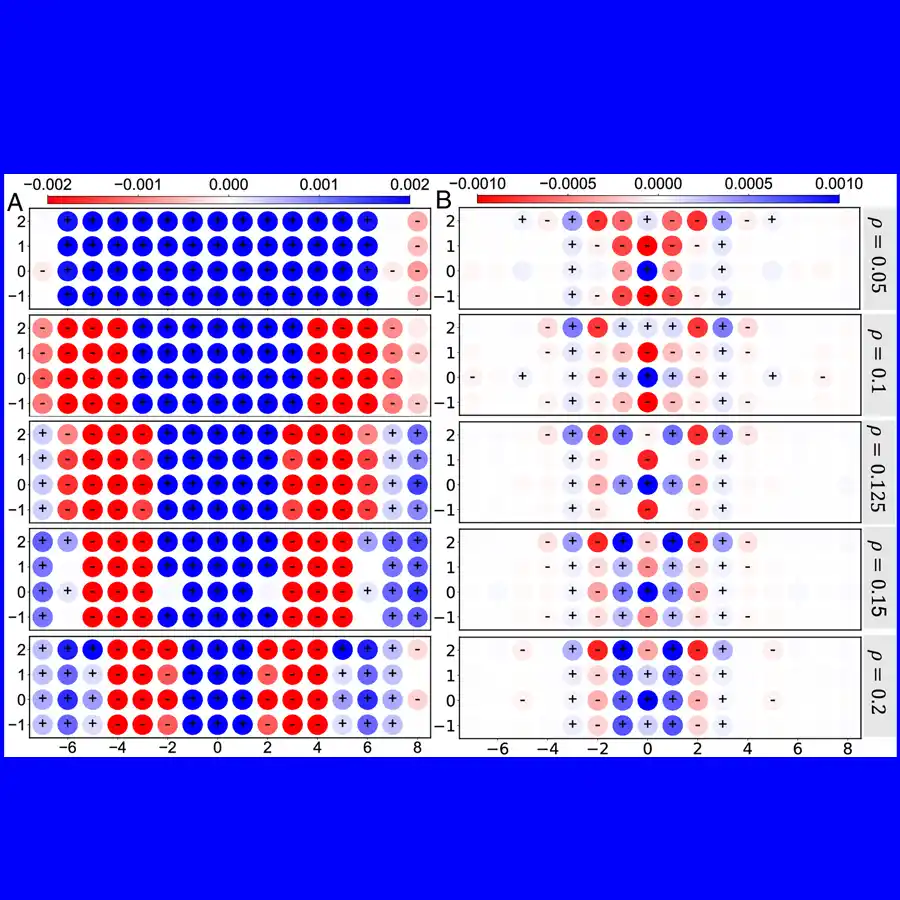
The single-band model predicts a reliable pattern for electronic charge and magnetism in cuprates. As Johnston explained, you can picture the “stripes” in cuprates as a kind of atomic board with alternating rows. One row will have lots of holes left by removing electrons while the next row will have no holes at all, and so on, in a repeating pattern. The phases of the charge in the hole-rich region and magnetism in the hole-depleted rows are locked with the neighboring regions.

“So, when the period of one changes, the period of the other changes,” he said. “That’s what’s seen experimentally in a lot of these systems and that’s what the single-band model predicts.”

The work he and fellow scientists reported in PNAS found something different.

Staggered spin (A) and charge (B) correlations at different hole densities in cuprates.

“What we’re finding in the three-band model is that (the stripes) are no longer coupled,” Johnston explained. “The spin and charge start to split apart; they’re no longer intertwined,” so you can independently change spin and charge modulations.

“If you take the single-model Hubbard model at face value, you basically expect all cuprates to be the same,” he said. “And we know that doesn’t happen experimentally. What this is telling you is that once you put the oxygen back in, you can start accounting for some of these differences that appear between bismuth-, lanthanum-, and yttrium-based cuprates. You can sort of understand these material-dependent factors. It’s an important step in separating out what’s universal and what’s material-specific.”

Knowing how different superconducting materials behave is the key to putting them to work.

“If we understand what makes a high-temperature superconductor superconduct, we have a better chance of engineering them,” Johnston explained. “In the end, we want to design materials and control the properties of these quantum systems with a high degree of precision.”

Efficient Teamwork

What makes this research possible is writing and running computational models to help scientists define a material’s properties. Johnston has long worked with colleague Thomas Maier of ORNL’s Computational Sciences and Engineering Division, who was a co-author on the PNAS paper. Maier is also a co-principal investigator on a National Science Foundation Elements grant Johnston won earlier this year. That award will help them expand a suite of codes called SmoQy that Johnston’s group developed.

Instead of coming up with a new model whenever a new material comes out, this library has codes ready to use from the get-go. (The SmoQy suite played a starring role in the PNAS research.) Johnston and Maier will build this collection further with another time saver. They’ll model a small part of an infinite system, then embed that model with an average approximation for the remainder of the system to account for all the quantum mechanics involved.

“We’re a computing university,” Johnston said of UT. “We’re very well-known for computing, so it makes sense that we develop these software stacks and help push the field forward using these tools.”

Technological progress like this includes the hard work of building a strong foundation. Two years ago, Johnston and Professor Hanno Weitering created a monolayer superconductor that landed on the cover of Nature Physics.

“That really grew out of our microscopic understanding of the Hubbard model and the physics of cuprate-like materials,” Johnston explained. “If you go back and look at the physics of semiconductors, the same thing happened there. Semiconductors were developed by people really trying to understand quantum theories of matter. That foundation has formed the basis for our entire modern economy. And it wouldn’t have happened without that fundamental research.”

December 11, 2024  |  Filed Under: Condensed Matter, Featured News, News

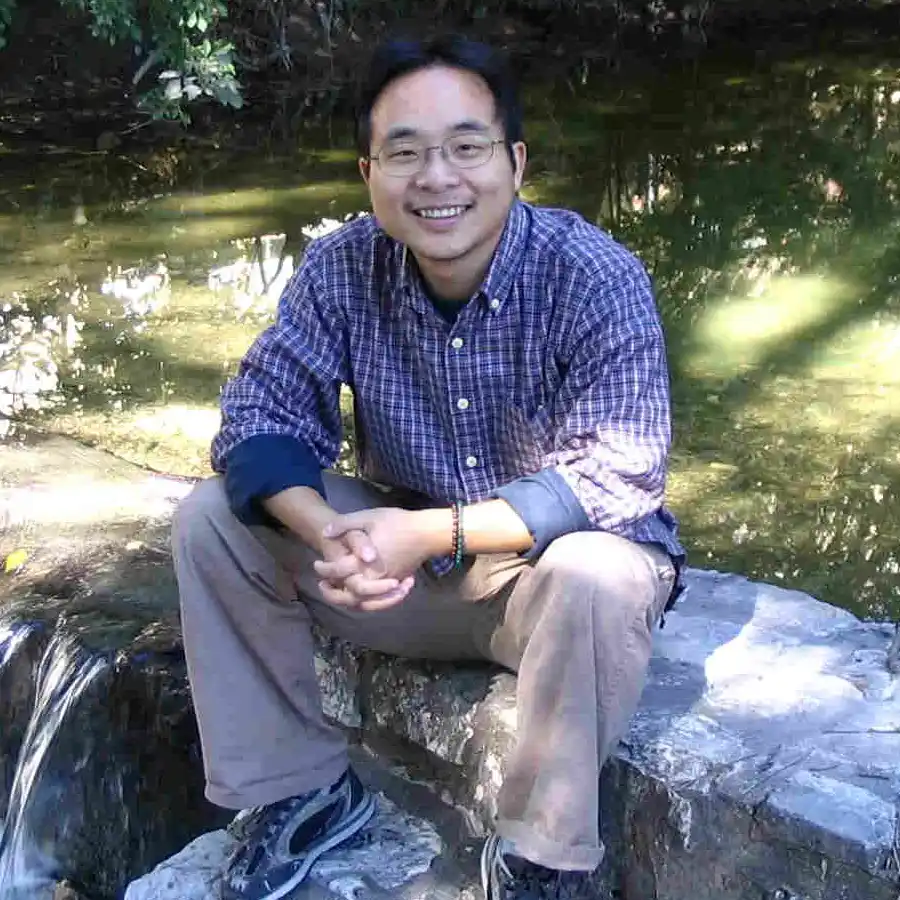
A photo of Haidong Zhou

Haidong Zhou Elected APS Fellow

October 9, 2024

A photo of Haidong Zhou

Haidong Zhou has a gift for navigating frustration, a skill that’s earned him election to the 2024 class of American Physical Society Fellows.

A Positive Spin on Frustrating Circumstances

Zhou, professor of physics, believes that technology’s future depends on the creation of new materials and the novel properties they offer. It’s an interest he developed as an undergraduate at the University of Science and Technology of China, where he worked with Professor Xiaoguang Li. That’s where he started studying manganites, materials that exhibit giant magnetoresistance—an effect that’s found a home in applications as varied as data storage, biosensors, and food safety. He continued those studies with his doctoral work at the University of Texas at Austin with Professor (and Nobel Laureate) John Goodenough.

It was his next stop, as a postdoc at the National High Magnetic Field Laboratory, where Zhou was introduced to geometrically frustrated magnets by his supervisor, Professor Chris Wiebe.

How can a magnet experience frustration? It has to do with electrons. Every electron has a spin. For materials whose atoms are arranged in a square lattice (kind of like a jungle gym), the electrons at each corner spin in alternating directions—up, down, up, down. That’s not the case for materials that have a lattice structure shaped like a triangle, where the electrons get frustrated because there’s always an odd spin out, so to speak.

“The idea is that in certain materials, the spins of the materials are arranged on a certain sublattice, such as three spins occupying a triangular lattice,” Zhou explained. “With such (a) lattice, the magnets tend to exhibit exotic magnetic properties related to strong spin fluctuations.”

Taking advantage of those exotic properties advances our understanding of how materials function, spurring the development of next-generation breakthroughs in fields like quantum computing.

Try, Fail, Succeed

Zhou, who joined the physics faculty in 2012, has been creating these magnets throughout his career. Atom by atom, he chooses the elements and grows the crystals that his colleagues study (at UT and elsewhere).

“We are extremely excited for Professor Zhou to receive this well-deserved honor from his peers,” said Adrian Del Maestro, professor and department head. “The groundbreaking quantum materials made in his lab are studied by researchers worldwide and could revolutionize future quantum technologies.”

In electing him a Fellow, the APS cited Zhou for his “outstanding contributions to the synthesis and understanding of frustrated magnetic materials.”

However, creating these magnets can itself be an exercise in frustration, even for an expert.

“The difficult part is the try and fail before you succeed,” Zhou said. “For each new sample, it takes time to get the right procedure to make it.”

Eventually, though, the payoff is worth it, even if the finished product is incredibly small.

“The best part of the work is to hold the crystals made in the lab, from millimeter size to centimeter size,” he said.

That dedication to research has won Zhou numerous honors. In 2014 he won a National Science Foundation Early Career Award and in 2017 UT’s College of Arts and Sciences presented him with an Award for Excellence in Research/Creative Achievement.

With this latest recognition, Zhou becomes the 11th APS Fellow on the current physics faculty and the department’s third elected APS Fellow in the past three years.

October 9, 2024  |  Filed Under: Condensed Matter, Featured News, News

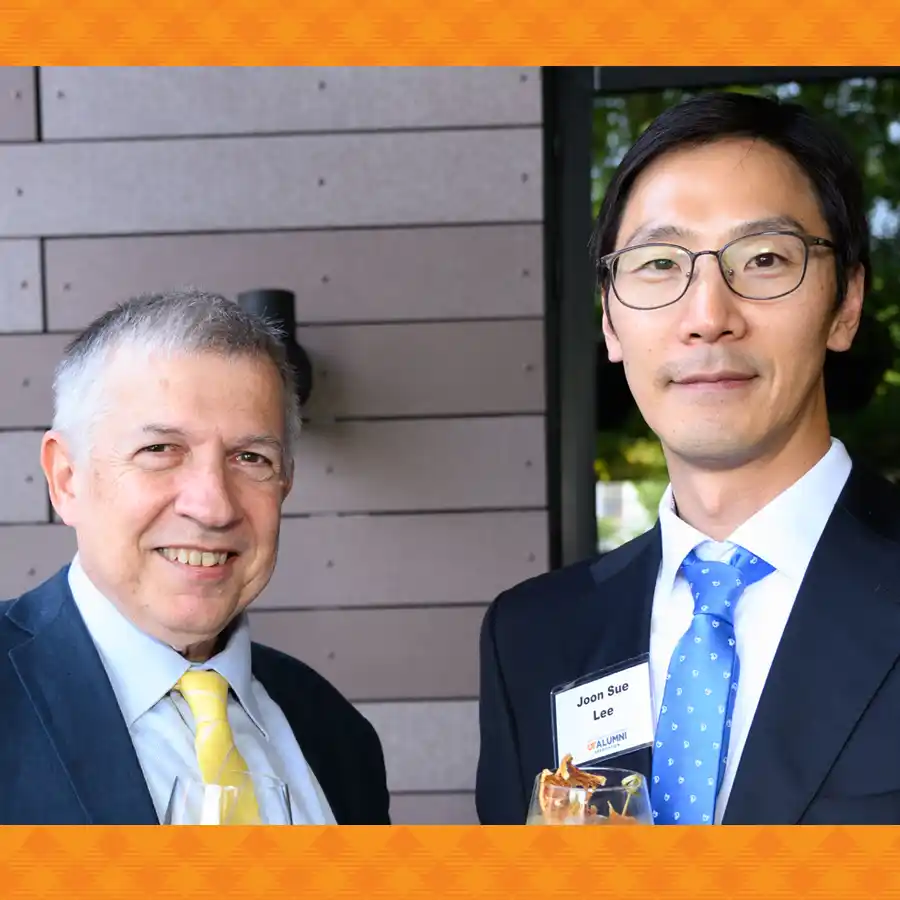
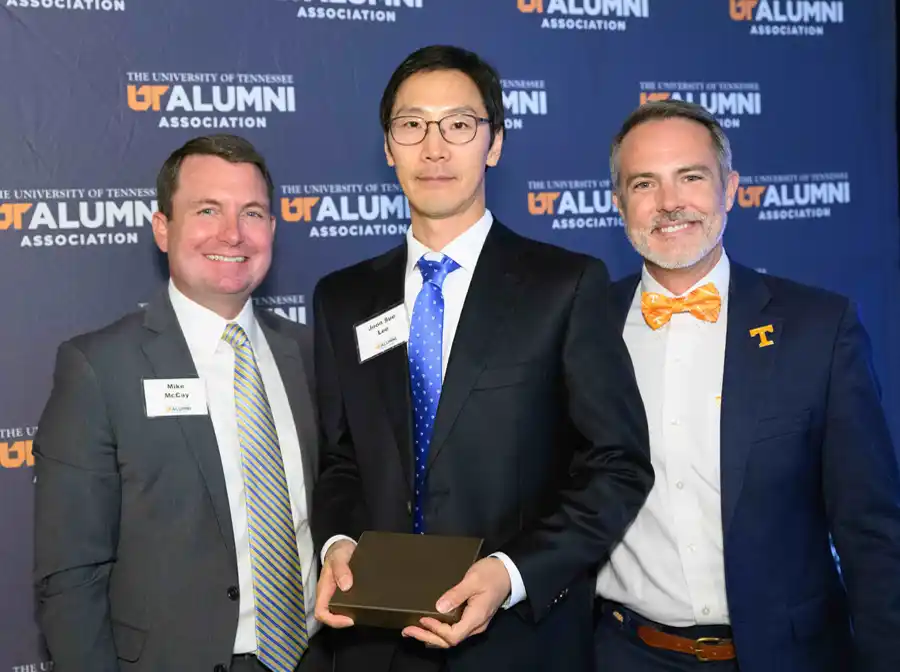
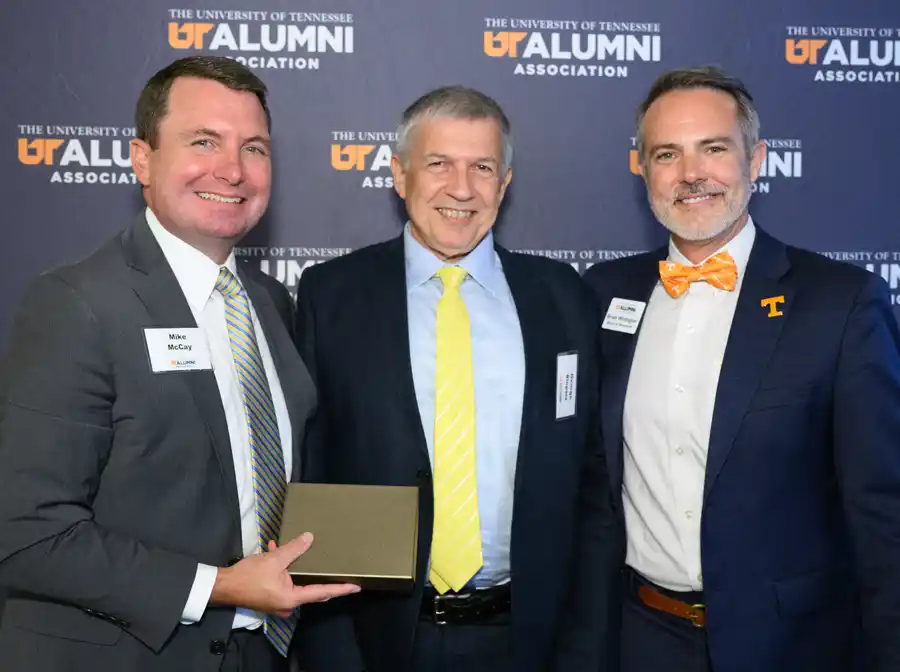
George Siopsis and Joon Sue Lee

Alumni Association Honors Lee and Siopsis for Teaching and Distinguished Service

July 12, 2024

Joon Sue Lee with Mike McKay and Brian Winbigler at UTAA Faculty Awards Ceremony
Joon Sue Lee (center) with Mike McKay (UTAA) and Brian Winbigler (UTAA Board of Governors)
George Siopsis with Mike McKay and Brian Winbigler at UTAA Faculty Awards Ceremony
George Siopsis (center) with Mike McKay (UTAA) and Brian Winbigler (UTAA Board of Governors)

Joon Sue Lee and George Siopsis joined UT nearly three decades apart, but their shared commitment to the university’s mission transcends generations. The University of Tennessee Alumni Association (UTAA) has honored that dedication by recognizing Lee with an Outstanding Teacher Award and Siopsis with a Distinguished Service Professorship.

“The department was delighted to learn about the well-deserved alumni recognitions for Assistant Professor Joon Sue Lee and Professor George Siopsis, who both exemplify our training and knowledge-creation mission,” said Adrian Del Maestro, professor and department head. “Their passion for teaching and research in quantum technologies has played a large role in UT’s growing national and international prominence in this exciting area crucial for U.S. competitiveness.” 

Developing Self-Reliant Thinkers

This is the second teaching honor this year for Lee, an assistant professor. UT’s College of Arts and Sciences presented him with an Excellence in Teaching Award at the annual faculty convocation. Since joining the physics faculty in 2020, Lee has taught undergraduates enrolled in Thermal Physics, Electricity and Magnetism, Electronics Lab, and Modern Physics Lab. His approach—especially to teaching labs—equips students with an understanding of physics fundamentals as well as the hands-on experience they need for careers in academe, technology, and industry.

“What has surprised me most about teaching is the impact that a collaborative and supportive learning environment can have on students’ engagement and development,” he said. “I have seen how nurturing critical thinking and fostering a dynamic partnership can transform the learning experience, and witnessing this has been greatly rewarding.”

Lee’s teaching isn’t limited to the classroom. His research centers on developing quantum materials and devices. Students in his group learn from and contribute to the work.

“What I like best about teaching is the opportunity to guide students as they navigate complex concepts and develop into self-reliant thinkers,” he said. “Mentoring students in my research lab and seeing them grow into independent researchers through the continuous exchange of ideas and collaborative processes is deeply fulfilling.” 

Because the UTAA awardees are selected by a committee comprising alumni, Student Alumni Associates, and prior honorees, Lee and Siopsis were chosen in part by their peers, which Lee said is profoundly meaningful.

“The acknowledgement from my fellow faculty members, who understand the complexities and challenges of teaching, affirms the dedication and effort I put into creating an effective learning environment,” he said. “Additionally, being chosen by UT graduates highlights the impact of my teaching, extending beyond the classroom and into the students’ lives as alumni.”

Nurturing the Next Generation

For Siopsis, the UTAA Distinguished Service Professorship has encouraged him to reflect on his many accomplishments while thinking about what comes next.

“Receiving this distinguished faculty award makes me feel deeply honored and appreciated,” he said. “It’s a mix of gratitude, validation, pride, humility, motivation, and a sense of responsibility. This recognition not only celebrates past achievements but also inspires me to continue making meaningful contributions to my field, the broader academic community, and the UT family.”

Siopsis came to UT Physics in 1991 and has balanced teaching, research, and service ever since. He’s taught courses from the fundamental (Elements of Physics) to the complex (Quantum Field Theory). He’s served as director of the Governor’s School for the Sciences and Engineering. A theoretical particle physicist, he specializes in quantum computing and networking, which heavily influences his current priorities. He’s built strong collaborations with partners from other universities, industry, and national laboratories with two aims in mind: developing quantum network applications and drawing on this emerging field to foster economic and technological growth in Appalachia.

Of all his endeavors, Siopsis said he is most proud of his leadership role in the Appalachian Quantum Initiative (AQI) and his work to bring UT to the forefront of emerging quantum technology. The AQI connects university researchers in the Southeast with industry partners to develop quantum software for scientific and engineering applications. This includes a quantum curriculum and workforce development component in partnership with other universities, industry, and national labs. In that vein, he and colleagues from the University of Georgia won $3M from the National Science Foundation to launch an interdisciplinary training program for graduate students. Siopsis develops and teaches classes and seminars in quantum technologies and is currently supervising or co-supervising the work of 11 graduate students.

This, he said, is part of his dedication to “nurturing the next generation of scientists in the emerging quantum field.”

Siopsis also draws on his expertise to lead a university-national laboratory project to develop a quantum regional network and pointed out that the Knoxville Chamber included the installation of a quantum network from Oak Ridge National Laboratory to UT as a goal in their 2030 Protocol plan.

Siopsis and Lee were recognized with their fellow awardees at a Faculty Awards Dinner on May 31. The UTAA presented 11 Outstanding Teacher Awards, two Public Service Awards, and six Distinguished Service Professorships this year, honoring outstanding faculty from across the University of Tennessee family. The association serves more than 445,000 graduates of the UT system through networking opportunities, legislative advocacy, career services, and alumni benefits, among other initiatives.

July 12, 2024  |  Filed Under: Condensed Matter, Featured News, News, Particle

A photo of Yang Zhang

Yang Zhang Wins Prestigious IUPAP Early Career Scientist Prize

June 20, 2024

A photo of Yang Zhang

Assistant Professor Yang Zhang hadn’t planned to go to Greece this summer, much less prepare an invited lecture. But when he learned he’d been chosen for the 2024 International Union of Pure and Applied Physics (IUPAP) Early Career Scientist Prize in Computational Physics, he was happy to put together some last-minute travel plans.

Watching Galaxies Form

The IUPAP comprises 20 international Commissions representing different subfields of physics. Each Commission recognizes outstanding physicists in the first stages of their careers with the Early Career Scientist Prize. C20, the Commission on Computational Physics, selected Zhang for this year’s award. He was cited “for his significant and innovative achievements in computational study of topological bands and quantum anomalous Hall states in two-dimensional semiconductors.”

As the C20 website explains, computational physics is where a computer becomes the basic tool for exploring natural laws. When experiments are impossible or impractical, computation provides simulated studies with closely-controlled conditions. Where data are overwhelming or unwieldy in terms of volume or intricacy, computational codes and models can work through them more easily.

Zhang has been intrigued by the field’s possibilities since his early studies.

“I first got interested in computational physics during my undergraduate research internship with Dr. Sverre Aarseth” of the University of Cambridge Institute of Astronomy, he said. “Seeing a galaxy form on the computer screen was mesmerizing. I learned to tweak parameters and to optimize the program even at hardware level, gaining a deeper understanding of the physics and computational techniques involved. The blend of physical intuition, mathematical rigor, and computational creativity ignited my passion for the field and set me on the path to further studies and research in computational physics.”

Zhang has taken that passion and applied it quantum materials, helping build UT’s research and teaching expertise in this growing and critical field.

Physics Professor and Department Head Adrian Del Maestro explained that Zhang “is driving innovation in quantum materials research by translating the latest advances in artificial intelligence and applying them to extraordinarily challenging problems in strongly interacting quantum systems.”

He added that with his strong collaboration network, Yang’s research has a truly global impact, while at the same he has a unique gift for developing new algorithmic methods and communicating these discoveries to UT’s undergraduate and graduate students.

Del Maestro works with Zhang through their leadership roles in UT’s Center for Advanced Materials and Manufacturing, a National Science Foundation-supported Materials Research Science and Engineering Center (MRSEC). Both hold joint appointments in the Department of Physics and Astronomy and the Min H. Kao Department of Electrical Engineering and Computer Science.

An Unexpected Honor

Zhang joined UT in 2023 after a postdoctoral appointment at the Massachusetts Institute of Technology following completion of a PhD at the Max Planck Institute Dresden. He has won several awards, including two Overall Winner Awards in the World Supercomputing Contest, the SFB Best Doctoral Thesis Award, the Tschirnhaus Medal from the Leibniz Association, and the Otto-Hahn Medal of the Max Planck Society. Now he adds the prestigious IUPAP Early Career Scientist Prize to that list.

“Receiving this award means a great deal to me,” Zhang said. “It recognizes my hard work and dedication in computational quantum matter and highlights the importance of my method development, as well as my contributions in semiconductor superlattice. This recognition motivates me to continue pushing the boundaries of knowledge in developing methods for large-scale quantum systems and inspires me to mentor future scientists.”

Zhang was surprised to learn he had won the prize, as nominees may have up to eight years of research experience after finishing a doctoral degree and he was about four years past his PhD when he learned he had been nominated.

“This award was an unexpected but deeply appreciated honor,” he explained. “I believe recent breakthroughs in fractional quantum anomalous Hall effects played a significant role in earning this recognition, and I am grateful for the support and acknowledgment of my work in this exciting field.”

Zhang will accept the prize at the 35th IUPAP International Conference on Computational Physics (CCP2024) to be held in Thessaloniki, Greece, July 7-12. As part of his recognition, he’s invited to deliver a lecture. Though his summer agenda hadn’t included the conference, he said he “quickly organized my travel arrangements and prepared for the event.”

About IUPAP

The International Union of Pure and Applied Physics (IUPAP) was established more than a century ago in Brussels with 13 member countries, holding its first General Assembly in 1923 in Paris. That number has grown to 60 member countries, with the Union being the only international physics organization run by the physics community itself. IUPAP’s mission is “to assist in the worldwide development of physics, to foster international cooperation in physics, and to help in the application of physics toward solving problems of concern to humanity.”

June 20, 2024  |  Filed Under: Condensed Matter, Featured News, News, Quantum Materials

A photo of Steve Johnston

Steve Johnston Named Bains Professor

March 4, 2024

A photo of Steve Johnston
Johnston

Steve Johnston wants to save time. And though he never met them, Elizabeth and Jim Bains are going to help.

Johnston knows that while silicon has long played a dominant role in industry, quantum materials will shape technology’s future. The challenge is that these atomic-scale materials are hardly straightforward. Like any good mystery, they come with intricacies, entanglements, and surprises that require case-by-case study. A theorist working in condensed matter physics, Johnston and his research group are developing a library of codes to simplify those investigations. Now, as the Elizabeth M. Bains and James A. Bains Professor of Physics and Astronomy, he’ll have resources to build that library faster.

Tennessee SmoQy Codes

While Johnston’s appointment as the Bains Professor began February 1, he first joined the physics faculty in 2014 as an assistant professor. He’s been busy ever since. He directs the department’s graduate program and teaches graduate-level courses. He’s won a National Science Foundation CAREER Award, secured funding to design quantum materials, and played a role in UT’s successful proposal for the NSF-funded Center for Advanced Materials and Manufacturing (CAMM). His work with Chancellor’s Professor Hanno Weitering on chiral superconductivity made the cover of Nature Physics.

Now, with a professorship supported by an endowed bequest from Elizabeth and Jim Bains, he’ll have additional funding to work in areas beyond the confined focus of funding agencies.

“What I’m really looking forward to is using (this support) for exploratory work,” Johnston said. “If I’m interested in pursuing some new line of research, this gives me a little bit of flexibility to do that. My group is investing a lot of time and effort in developing some open source software and, at least for this first year, I’m planning on using (funding) to shore up that effort.”

The heart of this effort is the SmoQy Suite, a collection of codes to help map the quantum landscape.

Scientists confront a host of challenges in defining the properties of quantum materials, one of the first steps in figuring out how and where they’ll be useful. The problem is that the quantum world doesn’t abide by the laws and equations that physicists have spent generations refining. Among the trickier issues is the many-body problem. In microscopic systems, how particles interact is much more complex than in macroscopic environments. And the more particles you have (especially electrons), the more unwieldy the situation becomes. So as researchers developed new quantum materials, physicists were spending more and more time calculating their properties.

“We used to do things (where) our codes were written to simulate one-off models,” Johnston said. “Whenever a new material comes out, we figure out what model it actually needs, then we have to re-write that code for that model. It’s very reactive.”

The SmoQy codes are a much more proactive approach.

“You build the tools upfront and that way when new discoveries come along we’re able to jump on them immediately and do more right away,” Johnston explained. “It’s also an attempt to make a version-control record of these things.”

His postdoc, Benjamin Cohen-Stead, is the lead developer on SmoQy. The Bains Professorship will allow Johnston to support him as he continues to develop resources and make them available to other scientists working in quantum materials.

“He invested a lot of time building a very versatile code and a bunch of frameworks that we can now use to build other codes,” Johnston said.

In true It Takes a Volunteer fashion, he added the group “would like to get some of the many-body methods that we’re using to a stage where anyone can download and use them. We’re trying to really highlight this as a good tool for the community. We’ve also begun to go after new funding to further expand these codes.”

If you’re wondering how the name SmoQy came about, there’s a Volunteer connection there too.

“We wanted something that was in line with the Tennessee spirit,” Johnston said.

They chose to feature the Smoky Mountains, but with a q to highlight the quantum many-body problem. Johnston explained that SmoQy is actually a play on another many-body software package called ALPS (Algorithms and Libraries for Physics Simulations).

“All many-body codes appear to have to be named after mountain ranges, so we decided to stick with that,” he said.

(Johnston noted that he’s also gotten quite a few emails from people asking him about Smokey, UT’s beloved mascot.)

Johnston’s group is spearheading the SmoQy effort, but he said eventually he’d like to involve more students and partner with UT’s Min H. Kao Department of Electrical Engineering and Computer Science on code development. He’s already working with Physics Professor and Department Head Adrian Del Maestro (who holds a joint appointment with that department) to add codes to the SmoQy library.

“Professor Johnston has an incredible impact across the teaching, research, and service mission of the department,” Del Maestro said. “As the Elizabeth M. Bains and James A. Bains Professor of Physics and Astronomy, I look forward to his transformative contributions to quantum materials research that will help shape future technologies for Tennesseans and beyond.”

These opportunities to expand the department’s quantum materials portfolio are possible because of a young couple who met five decades ago not far from Johnston’s office in the Nielsen Physics Building.

When Liz Met Jim

When Elizabeth (Liz) Miller enrolled in the master’s program in the mid-1960s her primary interests were atomic and nuclear physics. She changed her life—and many others’—when she decided to pursue ultrasonics instead. That’s where she got serious with fellow graduate student Jim Bains. The couple married and earned PhDs before settling in Texas to pursue their careers. When Liz and Jim passed away (in 2015 and 2020, respectively), they left the physics department its largest-ever gift.

In the fall of 2022 that bequest funded the first Bains Graduate Fellowship, which helped Shruti Agarwal get an early start on research. Now the Bains Professorship will help Johnston accelerate quantum materials research and in turn help the broader materials community.

“I’m very appreciative to the college and the department for giving me this,” he said. “As we’re trying to look at all kinds of new materials, we want our codes to respond to those materials. It’s not just about the problems I care about solving but also the problems that other people care about solving.”

With the new appointment Johnston becomes the third faculty member to hold a named professorship, alongside Cristian Batista (Lincoln Chair Professor) and Anthony Mezzacappa (Newton W. and Wilma C. Thomas Endowed Chair).

March 4, 2024  |  Filed Under: Condensed Matter, Featured News, News

A photo of Elbio Dagotto

Elbio Dagotto Wins SEC Faculty Achievement Award

February 23, 2024

A photo of Elbio Dagotto
Dagotto

Elbio Dagotto is a condensed matter theorist who hears “football” and automatically thinks “soccer.” Now he’s a Southeastern Conference champion, not for football (American or otherwise), but for his outstanding work as a professor.

Since 2012 the SEC has acknowledged one exceptional faculty member from each member university to celebrate their success in teaching, research, and service. Dagotto, a distinguished professor of physics and a distinguished scientist at Oak Ridge National Laboratory, is this year’s University of Tennessee, Knoxville, recipient of the SEC Faculty Achievement Award. He will be among the 14 professors considered for the 2024 SEC Professor of the Year honor, to be announced later in the spring.

“I am deeply honored to be selected among so many distinguished faculty to represent the University of Tennessee for the SEC academic award,” Dagotto said. “I am proud to be a Volunteer, proud to be a faculty member of the department of physics and our wonderful university at large, proud of my state of Tennessee, and proud to live in the South of the USA.”

As Adrian Del Maestro, professor and department head, remarked, “Professor Dagotto represents all the best qualities of a university professor and member of the SEC community where ‘it just means more.’ He is a dedicated teacher, beloved by his students, and he is internationally recognized for his fundamental research on how materials can be coaxed to exhibit astounding and useful quantum phenomena that enable the modern technologies we use every day.”

Dagotto joined the faculty in 2004, bringing with him a research program dedicated to understanding strongly correlated electrons: the effects when the properties of one individual electron depend strongly on what the rest of the ensemble of many other electrons is doing. These interactions can be especially difficult to calculate, and untangling them is Dagotto’s specialty. The findings are particularly useful to figure out quantum systems, where the parameters may include only a few atoms and traditional laws of physics don’t apply. In terms of devices and applications, quantum science will take over where silicon meets its limits, and Dagotto’s work is important for exploring this new frontier. He lends his expertise to UT’s research cluster on Quantum Materials for Future Technologies, as well as ORNL’s Materials Science and Technology Division.

“In my 20 years here, I have witnessed the steep positive trajectory of our academic efforts in many fields of research,” he said. “Everybody in the national and international scientific community now knows that ‘something big is brewing’ in East Tennessee, in conjunction with our partner institution, Oak Ridge National Laboratory.”

The SEC award is one of many on Dagotto’s long list of honors. In 2022 he won the American Physical Society’s Adler Award in Materials Physics for his pioneering work on the theoretical framework of correlated electron systems and his gift for describing their importance through elegant written and oral communications. (His top five publications have been cited more than 11,000 times, and in 2004 he was listed among the 250 most highly-cited physicists.) A Fellow of both the American Physical Society and the American Association for the Advancement of Science, he has written or edited numerous works on condensed matter physics principles, properties, and potential applications; including books, journals, and invited review articles.

Dagotto shares his knowledge in the classroom and has impressed students with his teaching ability, especially in the introductory quantum mechanics course for undergraduates. Last spring he won the UT Society of Physics Students Teacher of the Year Award for the third time in five years (2019, 2021, 2023). At the 2023 Academic Honors Banquet UT recognized Dagotto’s university contributions with the Alexander Prize. Named for former UT president and Tennessee senator Lamar Alexander and his wife, Honey, the award honors a faculty member who is “an exceptional undergraduate teacher whose scholarship is also distinguished.”

A native of Argentina who earned undergraduate and graduate degrees in physics at the Instituto Balseiro in Bariloche, Dagotto’s service extends beyond research and teaching. Along with Professor Adriana Moreo, he helps organize campus lunches for Hispanic physicists at all levels so they feel welcome both in the department and in the field. They also like to discuss what Dagotto good-naturedly calls “real football” (meaning soccer). And he’s pleased with the evolving perception that the SEC no longer means just sports.

“The SEC is slowly but surely transforming from an athletic conference to a broader powerhouse that certainly includes the STEM (science, technology, engineering, and math) arena,” he said. “Our future is bright, and I am happy to have contributed to these developments.”

February 23, 2024  |  Filed Under: Condensed Matter, Featured News, News

An illustration of the lattice examined by Phil Anderson in the early '70s.

Finding the Elusive Quantum Spin Liquid by Taking the Road Less Traveled

December 7, 2023

A photo of Alan Tennant
Tennant
A photo of Cristian Batista
Batista

They couldn’t hide forever.

With combined expertise and sophisticated tools, scientists like UT’s Alan Tennant and Cristian Batista are revealing even the most well-concealed secrets of quantum materials.

An illustration of the lattice examined by Phil Anderson in the early '70s.
An illustration of the lattice examined by Phil Anderson in the early ’70s. Shown as green ellipses, pairs of quantum particles fluctuated among multiple combinations to produce a spin liquid state. Credit: Allen Scheie/Los Alamos National Laboratory, U.S. Dept. of Energy (via ORNL)

Professors Tennant and Batista are part of the scientific team that confirmed the presence of quantum spin liquid (QSL) behavior in a new material: KYbSe2. QSLs are an elusive state of matter with a promising role to play in next-generation quantum information technologies. They’re also notoriously hard to find.

So what, exactly, is a QSL? It’s a bit of a magnetic outlier. Typical magnetic materials like iron or nickel arrange their magnetic moments (the source of their magnetic fields) in an ordered pattern. Things are messier and a bit more free-flowing in QSLs (hence “liquid” in the name). Here, magnetic moments exist in a highly entangled, fluctuating state. To complicate the picture, QSLs also come with exotic quasiparticles, which aren’t actually particles but instead are the collective behavior of particles in close quarters. All this makes it extraordinarily difficult to locate a QSL state in a material.

Tennant and Batista were joined by a collaboration of scientists from national laboratories, universities, and institutes to track down a QSL by taking the road less traveled. Many studies go searching for these exotic states by looking for what’s not there: missing magnetic order, for example. They decided instead to look for what they call “positive evidence”—a highly-entangled state or exotic quasiparticles. They found both in a material comprising potassium, ytterbium, and selenium by using powerful neutron science facilities at Oak Ridge National Laboratory and combined theorical, experimental, and computational resources. The findings were published in Nature Physics.

The teamwork approach to solving problems is nothing out of the ordinary for Tennant and Batista, both of whom are part of UT’s research cluster on Quantum Materials for Future Technologies, the Shull Wollan Center, and the Quantum Science Center (which is one of five US National Quantum Information Science Centers run by the Department of Energy). Each of these initiatives pools resources to solve complex problems and draws on the unique convergence of scientific talent and tools in East Tennessee.

As Tennant pointed out, “Quantum problems like these are too hard for individual researchers to solve alone. The combination of the best research facilities with forefront researchers is vital and East Tennessee is starting to be recognized as a leader for this kind of team science.”

December 7, 2023  |  Filed Under: Condensed Matter, Featured News, News

  • « Previous Page
  • 1
  • 2
  • 3
  • Next Page »

Recent Posts

  • Public Lecture on Quantum Mechanics
  • Brandi Skipworth Wins GATE Fellowship
  • Research Rock Stars: Thomas Papenbrock Explores the Forces at the Core of Matter
  • Rules for Nuclear Couples
  • Reconciling Fundamental Physics

Physics & Astronomy

College of Arts and Sciences

401 Nielsen Physics Building
1408 Circle Drive
Knoxville TN 37996-1200
Phone: 865-974-3342
Email: physics@utk.edu

Facebook Icon    X Icon

The University of Tennessee, Knoxville
Knoxville, Tennessee 37996
865-974-1000

The flagship campus of the University of Tennessee System and partner in the Tennessee Transfer Pathway.

ADA Privacy Safety Title IX