
• Request Info
  • Visit
  • Apply
  • Give
  • Request Info
  • Visit
  • Apply
  • Give

Search

A-Z Index Map

Physics & Astronomy

  • About
    • Honors
    • Administration
    • Faculty Resources
    • Nielsen Spaces
  • Research
    • Research Partners & Facilities
    • Condensed Matter
    • Particle / HEP
    • Biophysics / Soft Matter
    • Nuclear / Astrophysics
    • Quantum Information
  • People
    • Faculty
    • Staff
    • Joint Research & Adjunct Faculty
    • Post Docs
    • Graduate Students
  • Undergraduate
    • Why Physics
    • What Our Grads Do
    • Career Resources
    • Degree Programs
    • Research
    • Scholarships
    • Student Organizations
  • Graduate
    • Join Our Program
    • FAQs
    • Fellowships & Assistantships
    • Bains Fellowship
    • Where Our Grads Go
    • Research
    • Resources
  • News & Events
    • Newsletters
    • News
    • Colloquia Series
    • Events
    • In the Media
  • Outreach
    • Astronomy Outreach
    • Cool Things in the Sky this Month
    • Physics Outreach & High School Lecture Series
  • Alumni
    • Distinguished Alumni Award
    • Giving Opportunities
    • Share Your News
A banner showing a model of an atom and elementary particles

News

Featured News

A photo of Haocun Yu

Reconciling Fundamental Physics

June 1, 2026

A photo of Haocun Yu

Assistant Professor Haocun Yu is something of a scientific diplomat. In a recent Physical Review Letters (PRL) publication, she and colleagues show how a tabletop experiment can bring together two bedrock physics theories that have never been fully reconciled.

Subatomic Gravity?

More than a century ago Albert Einstein gave us the theory of general relativity, describing gravity in relation to space and time on large scales. Within a decade, physicists were developing a deeper knowledge of quantum mechanics: the laws that govern the subatomic world, including atoms, photons, and other microscopic systems.

“Quantum mechanics and general relativity are two of the most successful theories in physics, but they describe nature in very different ways,” Yu explained. “To understand nature at its deepest level, we need experiments that probe where these two frameworks overlap. Studying gravitational effects in genuinely quantum systems can help reveal whether the two theories remain fully compatible in that regime, and it may point the way toward new physics.”

She said the challenge in those studies is that compared to other physical effects, gravity is “extraordinarily weak” at the scale of single quantum particles. This gives it an extremely small signature that’s difficult to gauge. To overcome that obstacle, she and colleagues built a highly-stable 50-kilometer optical interferometer using compact fiber coils and tested it with single photons. The entire apparatus can fit on a tabletop.

An optical interferometer splits a beam of light, then recombines the resulting beams to create an interference pattern that makes precision measurements. Most lab-based interferometers lack the sensitivity required to pick up the elusive signal of gravity in a quantum system. In this experiment, the team’s unique design successfully detected a gravitationally-induced phase signal small enough to reach the regime needed for laboratory-scale measurements of gravitational redshift (a prediction of general relativity) with quantum light.

“Experiments involving both general relativity and quantum mechanics are necessarily at the cutting edge of precision measurement,” Yu explained. “Experiments simply did not have the stability, size, and phase sensitivity needed to reach that regime. Our work helps bring these tests closer to experimental reach.”

Quantum Phenomena on a Human Scale

Yu is a PhD graduate of the Massachusetts Institute of Technology (MIT) and the PRL research comes from her work as a Marie-Curie Postdoctoral Fellow at the University of Vienna. She joined the UT Physics faculty in January 2026 and is drawing on her experience to create new research opportunities.

“I am building a quantum optics and sensing research program with broad applications, where advancing and developing new quantum tools for fundamental science is a central part of that vision,” she said.

Her work complements the department’s strong quantum science program. Physics faculty played key roles in the university’s quantum cluster hiring initiative and in securing National Science Foundation funding for the Center for Advanced Materials and Manufacturing, where they’re taming the complexity of quantum materials with artificial intelligence.

Yu is actively looking for students and postdocs to join her research group and contribute to work she said has long fascinated her.

“What especially drew me in is that fragile quantum effects can be harnessed as practical tools for precision measurement,” she said. “In return, these enhanced experiments can reveal mesoscopic and macroscopic quantum behavior in measurement devices — bringing quantum phenomena closer to human scales and advancing quantum science itself.”

June 1, 2026  |  Filed Under: Condensed Matter, Featured News, News, Quantum Info

Illustration of alpha decay of tellurium-104 over an illustrated image of the RIBF at RIKEN

Measuring What Comes Before Alpha

May 27, 2026

Illustration of alpha decay of tellurium-104 over an illustrated image of the RIBF at RIKEN
Illustration of alpha decay of tellurium-104 over the RIBF at RIKEN, Credit: Robert Grzywacz

University of Tennessee physicists and their colleagues have made critical measurements of the lifetime and decay energy of tellurium-104 (Te-104), an important step in answering a century-old question and understanding how hundreds of nuclei decay. The results are published in Nature.

A Particle Determined to Escape

Professor Robert Grzywacz led the experimental team at the Radioactive Isotope Beam Factory (RIBF) at RIKEN in Japan. He explained how the results match decades-old predictions that tellurium-104 is a special case in alpha decay, a process where an alpha particle (a strongly-bound system of two protons and two neutrons) tunnels through the barrier surrounding the nucleus where it resides. Though alpha radioactivity was discovered more than 125 years ago, where the particle comes from is still a mystery, especially in nuclei that have large numbers of protons and neutrons.

“Alpha decay is the oldest decay mode,” Grzywacz said. “The big question is how the alpha particle forms in heavy nuclei, which are known to have uniform matter distribution. There must be a mechanism which causes local ‘clump’ or ‘cluster’ formation.”

Clustering is connected to how a nucleus is structured. Called preformation, it’s a signal an alpha particle is about to make a break for it.

“Once formed,” Grzywacz explained, “the alpha particle will escape from the nucleus.”

He said that this emission is a well-understood quantum mechanical tunneling process that depends on available energy. Since the 1960s scientists have thought that one nucleus—tellurium-104—has a special enhancement that could better explain how it happens.

Following the Decay Chain

While tellurium lives among the metalloids on the periodic table and can be found in nature, the isotope tellurium-104 has to be synthesized. Creating these nuclei is a challenge for multiple reasons. First, they only live for a few nanoseconds. Second, they’re a result of the decay of xenon-108, which in itself is difficult to produce. In this experiment, the team overcame these still-formidable obstacles with technological advances at RIBF. Using four coupled cyclotrons, they accelerated a beam of xenon-124 into a beryllium target. The collision produced fragments of xenon-108, whose decay populates tellurium-104, which is followed in this decay chain by tin-100.

“We have measured the lifetime and energy of this decay and found that the preformation probability is much larger than expected based on predictions, which used available experimental knowledge,” Grzywacz said. “We also found that tellurium-104 is the shortest known alpha particle radioactive nucleus with a 7.2 nanosecond half-life. This very short half-life, corrected for decay energy, gives unusually high alpha particle preformation. It will likely be a single case like that among all nuclei.”

He added the only other case is the well-studied decay of polonium-212 to lead-208, which has preformation probability 10 times smaller than that of tellurium-104.

Grzywacz said that more than half a century ago scientists pictured tellurium-104 having a brief existence as a molecule comprising tin-100 and an alpha particle. Tin-100 is a doubly-magic nucleus, meaning it’s strongly bound, as is an alpha particle. He and the research team attribute tellurium-104’s high preformation to its relation to doubly-magic tin, creating favorable conditions to form an alpha particle.

A Trail Blazed at Oak Ridge

Years of previous studies made these findings possible. Much of that work was rooted at the U.S. Department of Energy’s Oak Ridge National Laboratory (ORNL), where researchers have been at the forefront of exploring the island of alpha-emitting nuclei near tin-100 for decades. In 2006, a team including Grzywacz and ORNL physicists Krzysztof Rykaczewski and Carl Gross used the Recoil Mass Spectrometer at ORNL’s historic Holifield Radioactive Ion Beam Facility (HRIBF) to discover the neighboring xenon-109 to tellurium-105 to tin-101 alpha-decay chain. The measurement suggested that alpha-particle preformation was growing as nuclei approached doubly-magic tin-100. This strengthens the case that tellurium-104 would be the definitive test of the “superallowed” prediction, where the parent nucleus is essentially the doubly-magic plus a preformed alpha particle.

Independently, a 2018 experiment at Argonne National Laboratory (ANL) achieved the first observation of the xenon-108 to tellurium-104 to tin-100 chain, though the two decays could not be fully separated, leaving the individual half-life and energy of tellurium-104 unmeasured. In parallel, the detector technology pioneered at Holifield—fast-response scintillator crystals coupled to position-sensitive photomultiplier tubes—was further developed by Grzywacz’s group and ORNL collaborators at Japan’s Advanced Science Research Center, and proved essential for the present RIKEN experiment.

Rykaczewski, a Distinguished Senior Researcher in ORNL’s Physics Division and co-spokesperson for the RIKEN experiment, played a central role in designing and executing the measurement. Toby King, a UT physics graduate now on ORNL’s staff, was instrumental in building and operating the detection system and data acquisition. Additional ORNL support came from James Allmond and Thomas Ruland, who provided supplemental equipment and on-site experimental assistance.

“The path from the Holifield discovery of the tellurium-105 decay chain to this definitive measurement of tellurium-104 spans nearly two decades of sustained effort between UT and ORNL,” Rykaczewski said. “Each step—new isotopes, new detectors, new accelerator capabilities—brought us closer to this singular nucleus.”

A Strong Foundation for Students

Ian Cox (PhD, 2024) was the paper’s lead author. Now a postdoctoral appointee with ANL, he began working on the project as an undergraduate physics major and handled most of the experimental analysis “in record time,” according to Grzywacz.

“Studying nuclei on the edge of existence presents significant challenges but can also produce profound results,” Cox said.  “It has been a pleasure to start my research career with a result that can greatly impact the field.”  

Following in his footsteps, current Graduate Students Nico Braukman and Donnie Hoskins (physics), as well as Benjamin Kreider (engineering) were all co-authors on the Nature publication.

“Getting exposure to the kind of work that goes into producing high-impact physics results is an important part of being a grad student,” Braukman said. “I’m glad to have had the opportunity to participate in this experiment early in my grad school career.”

Hoskins shared similar sentiments.

“As a graduate student, one of our goals is to learn and participate in research to prepare us for our futures,” he said. “Exposure in prestigious journals, like Nature, increases visibility for me as an independent scientist to set up my own research in the future with a proven strong foundation in nuclear physics.”

The experimental effort included UT Physics Research Assistant Professor Z.Y. Xu, along with partners from ORNL, RIKEN, the University of Tokyo, the University of Warsaw, the National Centre for Nuclear Research (Poland), the Universität zu Köln (Germany), Universidad Complutense de Madrid (Spain), Lawrence Livermore National Laboratory, and the Japan Atomic Energy Agency.

The U.S. Department of Energy Office of Science and the National Science Foundation helped support this work.

May 27, 2026  |  Filed Under: Featured News, News, Nuclear

A photo of Jack Peltier

Jack Peltier Wins NSF Graduate Research Fellowship

May 19, 2026

A photo of Jack Peltier

Physics Major Jack Peltier is one of 12 UT students and alumni to win a prestigious 2026 National Science Foundation Graduate Research Fellowship. These competitive honors go to outstanding students pursuing graduate education in science, engineering, math and technology. Peltier is from Franklin, Tennessee, and graduated with the spring 2026 class. He will begin graduate studies at Brown University this fall.

As a freshman Peltier started making 3D-printed parts for Professor Robert Grzywacz’s group in experimental nuclear physics. His sophomore year he added data analysis to his portfolio. His work analyzing the beta-delayed neutron emission of Fluorine 25 led to a paper in Physics Letters B, where he was first author. (This project is the basis of his NSF Fellowship.) Peltier completed similar studies for Cesium 147-149 and Niobium 109-111.

“Working in his (Professor Grzywacz’s) lab has been a fantastic experience,” Peltier said. “I have had nearly complete freedom over what I am investigating at any point, without the limitations of a lack of experimental data, etc., while also receiving mentorship about the most effective ways to extract interesting results. I believe in his lab I have received the right balance of mentorship and freedom in my research to situate myself in researching what projects I find most interesting while also making an impact on the field.”

He added that one of his favorite undergraduate memories was going whitewater rafting with the Grzywacz group.

Peltier’s research experience also includes a summer working at Fermilab, testing a protype detector for the Compact Muon Solenoid outer tracker while working with Assistant Professor Larry Lee. In tandem with his physics contributions, Peltier put his second major in math to work as well. As a sophomore he joined Professor Tuoc Phan’s group, where he has focused on regularity theory for nonlinear elliptic partial differential equations. He’ll continue this work at Brown in the applied math program.

The NSF Fellowship is the latest in a string of honors for Peltier. In 2025 he won a Barry Goldwater Scholarship. In 2025 he won the physics department’s Robert Talley Award for Outstanding Undergraduate Research, while this spring he won the James W. McConnell Award for Academic Excellence.

Peltier’s NSF Fellowship is the fifth to go to a UT Physics student or graduate in the past seven years. Bachelor’s graduates Lindsey Hessler and James Rogers were also honorable mentions in this year’s cohort.

May 19, 2026  |  Filed Under: Featured News, News

A photo of Elle Brinkman in UT cap and gown

Elle Brinkman: A Physics Vol for Life

May 19, 2026

When spring 2026 physics graduate Elle Brinkman visited UT for the first time, she immediately fell in love with the campus. When she learned about all the physics department has to offer (including close ties to Oak Ridge National Laboratory), she knew Rocky Top was the place for her.

Now, with strong faculty connections and a publication under her belt, she’s ready to continue her journey toward a PhD in physics.

May 19, 2026  |  Filed Under: Featured News, News

An image with photos of Christine Nattrass, Dien Nguyen, Jian Liu, and Alan Tennant

Excellence Across the Board

May 12, 2026

From undergraduates to distinguished faculty, the Department of Physics and Astronomy has enjoyed a strong showing as the university bestows spring 2026 honors.

At the College of Arts and Sciences annual awards ceremony the department claimed four faculty honors, including research awards at every level.

A photo of Christine Nattrass
Christine Nattrass
A photo of Dien Nguyen
Dien Nguyen
A photo of Jian Liu
Jian Liu
A photo of Alan Tennant
Alan Tennant

Professor Christine Nattrass won an Excellence in Teaching Award for Senior Level faculty. Her innovation and leadership in physics education have set her apart as she connects students with research opportunities, internships, and career resources. As director of the undergraduate program, she strives to make sure all students find a place in the department so they can succeed.

Physics faculty members also won three Excellence in Research and Creative Achievement Awards.

A rising star in experimental nuclear physics, Assistant Professor Dien Nguyen was recognized at the Early Career level for her growing list of achievements, including two DOE awards, national laboratory partnerships, and exceptional mentoring.

Professor Jian Liu was honored in the Mid-Career category. A Humboldt Fellow, he has helped burnish the university’s reputation through his work investigating quantum materials for innovative technologies.

Professor Alan Tennant added a Senior Level research and creative achievement award to his long list of distinguished honors. His pioneering research on quantum magnetism and neutron scattering has profoundly advanced our understanding of strongly correlated electron systems. Tennant played a key role in securing National Science Foundation funding for the university’s Center for Advanced Materials and Manufacturing, a Materials Research Science and Engineering Center (MRSEC) where he serves as director.

Earlier this semester Chancellor’s Professor Hanno Weitering was named the 2026 Macebearer, the university’s highest faculty honor.

Outstanding Student Research

While the department celebrated students at the annual Honors Day ceremony, many physics majors also won recognition at the university’s undergraduate research events.

At the Arts and Sciences Undergraduate Research Symposium (ASUReS):

  • Jullian Watts, First Place Award (Mentor: Associate Professor Tova Holmes) for “Optimizing Electron Reconstruction for a 10 TeV Muon Collider”
  • Jack Peltier, Second Place Award (Mentor: Math Professor Tuoc Phan) for “On ABP Estimates for a Class of Quasi-linear Elliptic Equations in Divergence Form and Applications”
  • Dinesh Gangavarapu, Second Place Award (Mentor: Professor Yuri Efremenko) for “Additive Manufacturing and Geant4 Simulations for Background Reduction in LEGEND-1000”

At the 2026 Exhibition of Undergraduate Research and Creative Achievement (EURēCA), three physics majors won achievement awards for their posters:

  • Cassidy Fleenor (Mentor: Thomas Chair/CAS Excellence Professor Anthony Mezzacappa) for “Searching for Instability in Core-Collapse Supernovae”
  • Amelia Sandoval (Mentor: Assistant Professor Dien Nguyen) for “Polarized 3He via Metastability Exchange Optical Pumping Development”
  • Madeleine Sorrell (Mentor: Professor William R. Hix) for “Studying Nucleosynthesis in Three-Dimensional Models of Core-Collapse Supernovae”

Adapted in part from original text by Randall Brown

May 12, 2026  |  Filed Under: Condensed Matter, Featured News, News, Nuclear

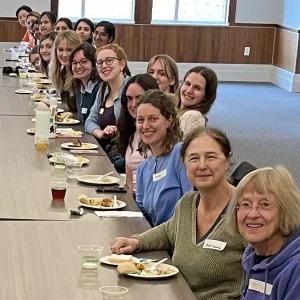
A group of physics students, faculty, and postdocs sitting at a long table.

WiP Spring 2026 Lunch

May 8, 2026

A photo of physics students, faculty, and postdocs at a long table.

Our Women in Physics group hosted their spring 2026 lunch on May 7, welcoming all members of the department. Undergraduates, graduate students, post-docs, and faculty closed out the semester with another record turnout. The goal of these gatherings is to help anyone who wants to participate build a strong physics network. Hope to see you at our Fall Lunch on December 3, 2026!

May 8, 2026  |  Filed Under: Featured News, News

A photo of seven people in front of an illuminated Physics Honors sign

Physics Celebrates Honors Day 2026

May 7, 2026

The Department of Physics and Astronomy had plenty to celebrate at the annual Honors Day ceremony on May 4. Held as the academic year’s final colloquium, the event brought students, faculty, staff, friends, and family to the Student Union to reflect on another successful year and present awards for outstanding service, research, and academic performance. Students honored faculty members for exceptional teaching and advising and the department acknowledged key contributions from staff.

Undergraduate Awards

The undergraduate awards recognize students who have excelled in the classroom, research, and service.

Corey Fox, Dinesh Gangavarapu, Zachary Garman, Andrew Goans, Benjamin Hebert, Lindsey Hessler, Aidan Hill, Langa Lunga, Abigail Larson, Daniel Metcalf, Jack Peltier, Dylan Stewart, Nathan Whittington, and Ellie Wood were all nominated for their accomplishments.

The Outstanding First Year Student Awards went to Andrew Goans, Abigail Larson, and Langa Lunga for exceptional achievement in their first year of physics studies.

A photo of Andrew Goans with his 2026 UT Physics Honors Day certificate
Andrew Goans
A photo of Abigail Larson with her 2026 UT Physics Honors Day certificate
Abigail Larson
A photo of Langa Lunga with his 2026 Physics Honors Day certificate
Langa Lunga

Robert Talley was a distinguished physics alumnus who invested in the department with a generous gift to support scholarships and awards. The Robert Talley Award for Outstanding Undergraduate Research recognizes a physics major who has done exceptional work in research. This year’s honoree was Daniel Metcalf, a double major in nuclear engineering and physics who has worked in experimental low-energy nuclear physics, formatted data for the Experimental Nuclear Reaction Data database, and served as a technical lead on research at the Oak Ridge National Laboratory Spallation Neutron Source.

The James W. McConnell Award for Academic Excellence, which recognizes seniors who have excelled in the classroom throughout their undergraduate studies, went to three students. Zachary Garman has done research with both the high energy physics group and the neutron physics group at Oak Ridge National Laboratory while maintaining a stellar GPA. Jack Peltier works in both nuclear physics and mathematics and won a 2026 National Science Foundation Graduate Fellowship. Dylan Stewart is part of the Haslam Leadership Scholars minor program, whose mission is to attract, cultivate, and retain Tennessee’s future leaders.

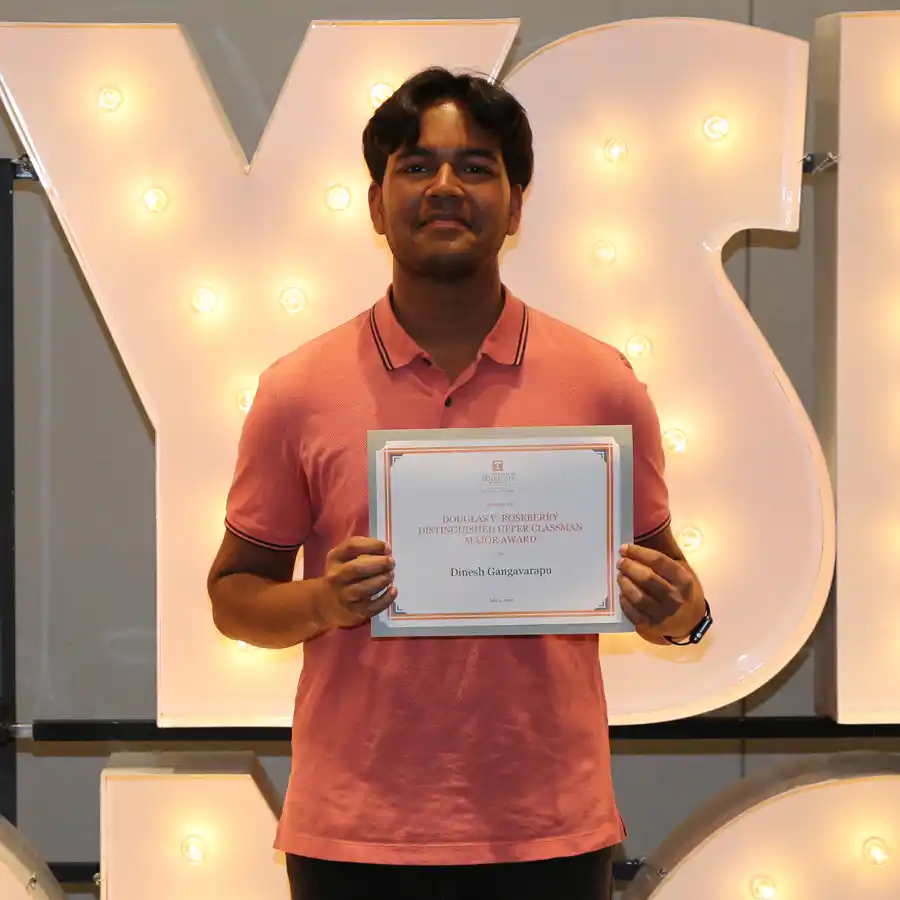
The Douglas V. Roseberry Distinguished Upper Classman Major Award is the most prestigious of the department’s undergraduate honors. Established by his fraternity brothers and supported by the generosity of his family, the award honors Doug Roseberry, who died unexpectedly as an undergraduate. Every year the department recognizes a student who follows his example of outstanding academic, research, and leadership accomplishments. This year’s awardee was Dinesh Gangavarapu. A Volunteer Scholarship and Physics General Scholarship recipient, he is part of the LEGEND experiment at Oak Ridge National Laboratory and serves as vice-president of UT’s Society of Physics Students chapter. He also founded the e-learning STEM platform Astro Pioneers to inspire young adults from across the world to explore the sciences.

A photo of Daniel Metcalf with his 2026 UT Physics Honors Day certificate
Daniel Metcalf
A photo of Dylan Stewart with his 2026 UT Physics Honors Day certificate
Dylan Stewart
A photo of Zachary Garman
Zachary Garman
A photo of Dinesh Gangavarapu with his 2026 UT Physics Honors Day certificate
Dinesh Gangavarapu
A photo of Jack Peltier
Jack Peltier

Sigma Pi Sigma Induction

Sigma Pi Sigma is the physics honor society and exists to honor outstanding scholarship in physics and astronomy, encourage interest in physics and astronomy among students at all levels, promote an attitude of service, and provide a fellowship of persons who have excelled in physics and astronomy. This year six UT students joined their ranks: Allie Dabney, Zachary Garman, Daniel Metcalf, Amelia Sandoval, Madeleine Sorrell, and Jullian Watts.

Service Awards

The service awards recognize students who have made meaningful contributions to the department’s teaching and laboratory program. This year’s nominees were: Aubrey Augustine, Landon Boone, Mackenzie Henley, Lucas McBee, Mousumi Mitra, Josie Swann, and Samantha Wilder.

The Robert W. Lide Citation honors the late Bob Lide, who served as director of undergraduate laboratories and volunteered his help even after retirement. Samantha Wilder was recognized for providing invaluable support setting up and maintaining the undergraduate physics labs.

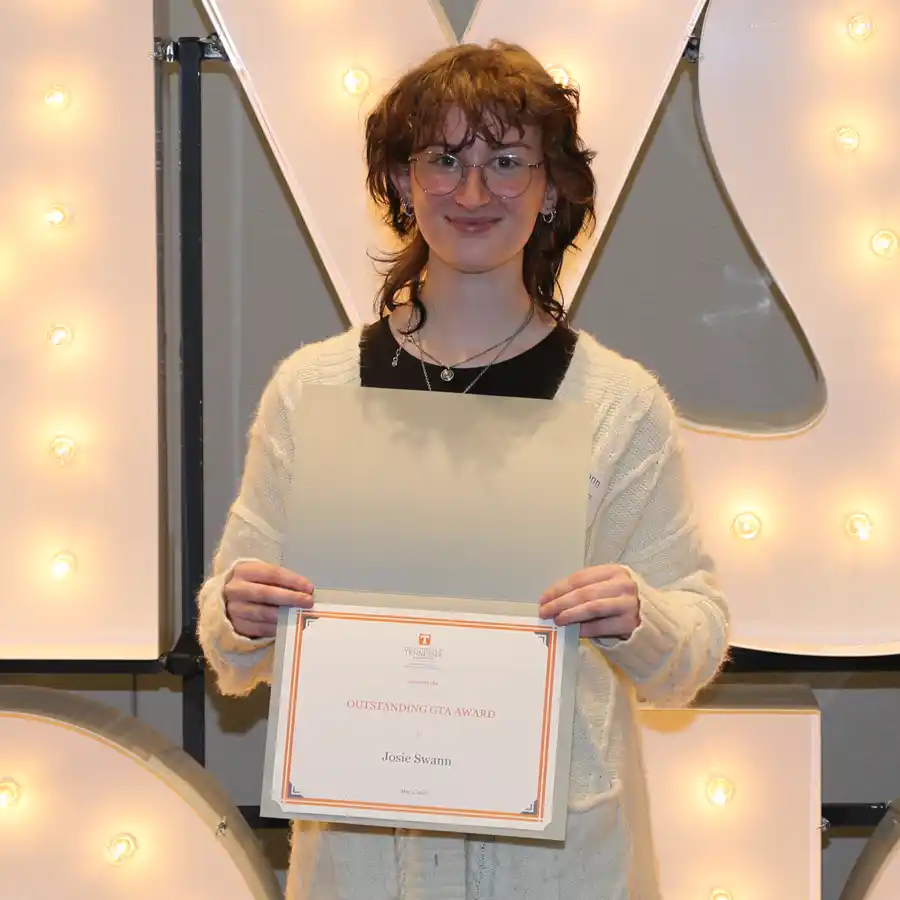
The Outstanding Graduate Teaching Assistant Awards go to GTAs who have gone above and beyond to support students enrolled in physics and astronomy labs. This year’s honorees were Aubrey Augustine, Landon Boone, Mousumi Mitra, and Josie Swann.

The Manley family established the James E. Parks Award in honor of physics alumnus and long-time lab director Jim Parks. The honor recognizes students for creative and innovative contributions to the undergraduate physics labs. This year’s award went to Lucas McBee for exceptional work improving coding skills in the physics 137/138 labs.

Wayne Kincaid was a physics graduate and research staff member. The Wayne Kincaid Award honors a student who shares his love for astronomy and astrophysics and who has made exceptional educational contributions through technology, writing, or other innovations. Mackenzie Henley won the 2026 honor for helping lead planetarium programs, rooftop observing, astrophotography, and planetarium renovations.

A photo of Samantha Wilder holding her 2026 UT Physics Honors Day certificate
Samantha Wilder
A photo of Aubrey Augustine with her UT Physics 2026 Honors Day certificate
Aubrey Augustine
A photo of Landon Boone
Landon Boone
A photo of Mousumi Mitra and Shaun Vavra with Mousumi's award certificate from UT Physics Honors Day
Mousumi Mitra (left)
A photo of Josie Swann with her 2026 UT Physics Honors Day certificate
Josie Swann
A photo of Lucas McBee with his 2026 Physics Honors Day certificate
Lucas McBee
A photo of Mackenzie Henley with her 2026 Physics Honors Day certificate
Mackenzie Henley

Graduate Awards

The graduate awards recognize outstanding research, professional promise, and departmental citizenship.

This year’s nominees were Iftekhar Ahmed, Chathuddasie Amarasinghe, Debshikha Banerjee, Nico Braukman, Peter Dyszel, Ben Johnson-Toth, Christal Martin, Jordan O’Kronley, and Max Rothman.

The Paul Stelson Fellowships are a tribute to Paul Stelson, who had a long and distinguished career at Oak Ridge National Laboratory. He was also an adjunct professor in the physics department for three decades and mentored many students in that time. His family established these fellowships to support and encourage young scientists.

The Stelson Fellowship for Outstanding Beginning Research went to Ifti Ahmed for his expertise on a highly complex detector subsystem and for assuming significant responsibility for the success of the MVTX, a subdetector in sPHENIX. Ifti works with Professor Christine Nattrass.

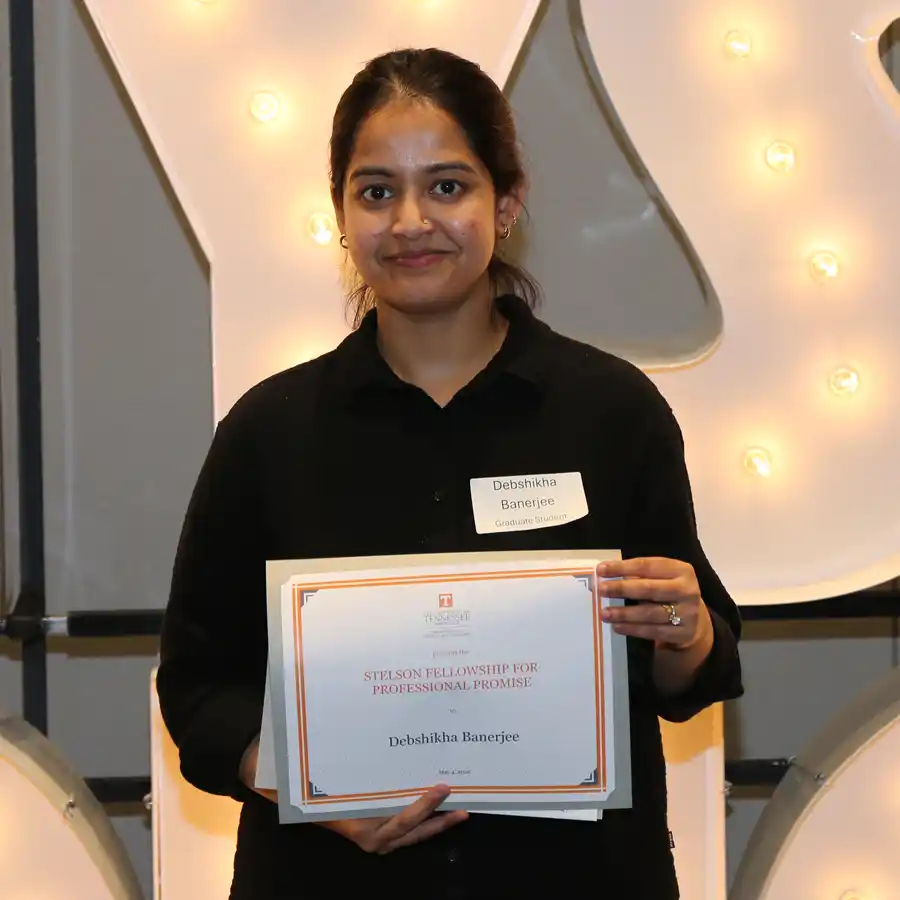
The Stelson Fellowship for Professional Promise went to Debshikha Banerjee for outstanding theory contributions in strongly correlated systems. She works with Bains Professor Steve Johnston and has co-authored seven papers with him, serving as first-author on four, including a first-author PRL.

The Fowler-Marion Outstanding Graduate Student Award goes to a student who excels in scholarship, research, and departmental citizenship. This year’s honoree was Jordan O’Kronley, who works with Professor Nadia Fomin. His research in medium energy nuclear physics at Jefferson Lab earned a Department of Energy Graduate Student Research award. He has also been an active member of UT’s Graduate Physics Society and has met with congressional delegations to advocate for science.

A photo of Iftekhar Ahmed with his 2026 UT Physics Honors Day certificate
Iftekhar Ahmed
A photo of Debshikha Banerjee with her 2026 UT Physics Honors Day certificate
Debshikha Banerjee
A photo of Jordan O'Kronley
Jordan O’Kronley
A photo of Cheryl Huskey with her 2026 Physics Honors Day certificate
Cheryl Huskey

Staff Honors

Cheryl Huskey, who coordinates the department’s undergraduate program and events, won the Extraordinary Departmental Service Award for her outstanding work transforming the undergraduate experience through student engagement and high impact communication.

Faculty Awards

Each year the Society of Physics Students (SPS) and the Graduate Physics Society (GPS) select outstanding teachers and research advisors. This year the awardees were:

A photo of Dien Nguyen
Dien Nguyen

Society of Physics Students Teacher of the Year: Elias Kokkas

Society of Physics Students Research Advisor of the Year: Dien Nguyen

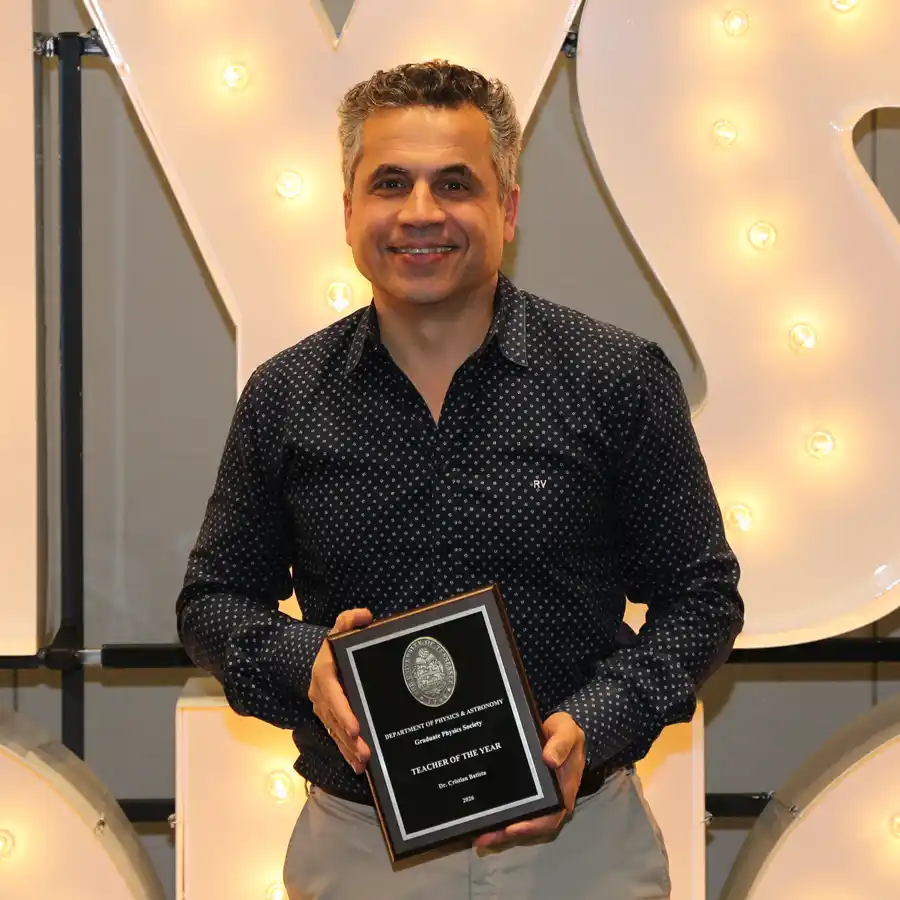
A photo of Cristian Batista with his 2026 GPS Teacher of the Year plaque
Cristian Batista
Nadia Fomin with two students, holding her GPS Research Advisor of the Year plaque
Nadia Fomin (center)

Graduate Physics Society Teacher of the Year: Cristian Batista

Graduate Physics Society Research Advisor of the Year: Nadia Fomin

May 7, 2026  |  Filed Under: Featured News, News

Four panels of quasiparticle interference imaging of a tin-silicon system with a flower-like pattern

Finding Chiral Superconductivity’s Fingerprint

April 23, 2026

With a carefully-designed experiment and a handful of tin atoms, UT’s physicists have found a long-sought form of superconductivity, taking one more step toward creating custom quantum materials.

Twists and Turns

Scientists have known about superconductivity for more than a century. At low temperatures, resistance in certain materials vanishes and they carry electrical current without losing any energy. Superconductors are part of particle accelerators and magnetic resonance imaging machines. While they need extremely cool environments to work, the mechanism that drives them is quite well-understood: electrons, which normally repel each other, form pairs and carry the current.

Chiral superconductivity is another story. Here, electron pairs reject the typical symmetry and twist into a signature left or right “handedness.” Scientists have searched for this phase for decades because it has promise for quantum technologies.

In 2023 Chancellor’s Professor Hanno Weitering and Bains Professor Steve Johnston published findings in Nature Physics reporting that strategically scattering tin atoms across a silicon base could give rise to a superconductor. They proposed the system could also be a potential chiral superconductor. This latest work, outlined in Physical Review X, provides the evidence.

The research team carefully deposited one-third layer of tin atoms on a silicon substrate, then used sophisticated imaging to pick up distinctive chiral superconductivity patterns.

Four panels of quasiparticle interference imaging of a tin-silicon system with a flower-like pattern
The center of each image (a) and (b) shows a substitutional silicon defect. The pronounced dark spot at the center of panels (a) and (c), indicated by blue arrows, is a key signature of a chiral superconducting order parameter.
The top two panels are experimental data; the lower two panels are theoretical simulations.
DOI: https://doi.org/10.1103/jmmf-mpr8

Simply Beautiful Interference

Weitering said the structural and electronic simplicity of the tin-silicon material is the key to seeing chirality. More complex materials have overlapping states and multiple interactions that can mask the telltale patterns.

In this system, one-third layer of tin means a controlled deposition of atoms placed relatively far apart on a silicon layer. Those atoms spontaneously organize into a nicely ordered triangular lattice. The geometry is important.

“Chirality is non-existent in high-temperature cuprate superconductors because they have a square lattice,” Weitering said, which gives you a different phase. “But in the tin layer, it exists because the lattice isn’t square. It’s a triangle.”

To see chiral superconductivity’s distinctive fingerprint he and his colleagues turned to quasiparticle interference imaging, or QPI.

“In condensed matter these particles always are moving in a surrounding that effects their behavior, so they’re not really a single entity anymore,” Weitering said. “They’re all under the influence of their surroundings. That’s why we call them quasiparticles.”

If you picture electrons behaving like waves, he explained, and think about throwing stones in a pond, one after another in different spots, you’ll see waves start to run into each other.

“We call those interference patterns, he said. “This is where the interference comes from: quasiparticle interference. With the scanning tunneling microscope (STM) we can see those waves. Quasiparticles interfere and give these beautiful patterns.”

The calling card for chirality is encoded in these patterns surrounding a point defect; a single atom defect to be precise.

“That could be a missing tin atom; it could a tin atom that has been replaced by a silicon atom because there’s a big reservoir of silicon underneath and sometimes atoms do that,” Weitering said. “You can never get a crystal perfect. There are always some defects in there. One crucial point in this system is that with the STM we can see each and every point defect in the tin layer.”

This research could serve as a template for using QPI to find other forms of unconventional superconductivity.

“Most superconductors are discovered through serendipity,” Weitering said. “This was all by design.”

Customizing materials is an important step on the long journey to possible applications.

“Quantum materials are usually not very useful unless you can make devices out of them,” he explained. “To make devices you usually need to make thin films and interfaces.”

He said that chiral superconductors are topological, and “people are excited about topological systems because we could use topological superconductors to build, for instance, qubits for quantum computing.”

Qubits store or process information that’s highly sensitive to outside influences like temperature, everyday radiation, etc.

“Topological systems are interesting in a sense that topological property is not something that’s local,” Weitering said. “It’s global. By making it global it’s much less sensitive to perturbations.”

Showing Off for Friends

Though the tin-silicon system was designed with intention, recognizing the chirality pattern actually did involve a little bit of serendipity.

Weitering’s former postdoctoral research associate, Fangfei Ming, is now a professor in China. He sent QPI images of the material taken by his group, showing how the detail has improved over time—specifically patterns that resemble flowers.

Weitering was impressed and showed the results to Assistant Professor Ruixing Zhang.

“Ruixing looked at this pattern and saw something very striking that was at the center of the page,” he said.

Zhang went back to his office and had his graduate students (Zhuo Chen and Yuchang Cai) do some numerical and analytical calculations, proving that only chiral superconductivity will result in the flower-like QPI pattern with an atomic-size hole at the center—chiral fingerprints.

“Ruixing saw that and his intuition was right,” Weitering said, admitting that, at first, he was more focused on the sharpness of the images when he shared them with Zhang.

“I was just showing off,” he joked.

Having friends to work with (and impress) is a critical element to moving fundamental research forward.

“If you do science by yourself, you’re never going to get there,” Weitering said.

He, Zhang, Johnston, Chen, and Cai all contributed to the PRX research, along with colleagues from China. He and Zhang are also reviewing patterns from QPI images and plan to create a database. They hope to train a machine learning program to recognize the intricate details of those patterns.

“It’s really part of the MRSEC (the university’s Materials Research Science and Engineering Center, funded by the National Science Foundation),” Weitering said. “It’s using AI to analyze data. It’s curating data. You need to train AI with data. It’s not just theory; it’s also experimental data. Then there’s the validation component of theory predictions.”

Verifying where the theory leads next is a big part of his work. First there was the Nature Physics research; now the PRX findings.

“We found superconductivity,” Weitering said. “Then we found chiral superconductivity. Every time we get a step further.”

April 23, 2026  |  Filed Under: Condensed Matter, Featured News, News

A photo of Deb Crawford and Hanno Weitering

Hanno Weitering Named 2026 Macebearer

April 8, 2026

A Photo of Hanno Weitering
Hanno Weitering learns he is the 2026 Macebearer

Chancellor’s Professor and Professor of Physics Hanno Weitering is the University of Tennessee, Knoxville, 2026 Macebearer. The honor is the highest bestowed on UT faculty members and recognizes outstanding service to the university, its students, and the greater society.

Keeping with tradition, the new Macebearer was surprised by an entourage, this year comprising Vice Chancellor for Research Deb Crawford, College of Arts and Sciences (CAS) Divisional Dean Kate Jones and Associate Dean Todd Moore, and Weitering’s wife Carol, who had been following his location on her phone to make sure he made it to the physics colloquium in time for the announcement.

Weitering said he was running a bit late and didn’t think much of the texts and calls checking that he was on his way.

“Then the deans and the vice chancellor suddenly came in with Carol, which felt completely bizarre,” he said. “Everything happened very quickly.”

As Professor and Head Adrian Del Maestro shared later in a departmental message: “For those of you who joined us for Colloquium today, you witnessed a truly surprised Hanno accepting the award from Vice Chancellor Crawford! Congratulations to a member of our faculty who truly embodies the volunteer spirit!”

Robert Hinde, Executive Dean and Herbert Family Dean’s Chair for the College of Arts and Sciences, added praise for Weitering’s selection.

“Hanno’s record of teaching, research, and service, combined with his personal dedication to the physics and university community, make him an ideal choice for Macebearer,” said Hinde.

On what being Macebearer means to him, Weitering said he “can only reflect with deep gratitude on the tremendous support I’ve had throughout my career. I’m fortunate to be part of a strong physics department with wonderful colleagues, and to have benefited from the guidance and support of mentors, colleagues, and department heads. As head, I had the privilege of serving under an inspirational dean during a period of significant progress for the university. It gave me the opportunity to give back by helping position the department for new challenges and opportunities. Now, I’m glad to be back focused on teaching and research—being an academic truly is a privilege.”

Small Systems with Big Potential

Weitering joined the university in 1993 as part of the physics department’s condensed matter research program. His work explores materials at the microscopic level, focusing on their structure and the behavior of conduction electrons, particularly at surfaces and interfaces. By scattering small numbers of tin atoms across a silicon substrate, he has created idealized material systems that revealed a novel form of superconductivity—the long-sought chiral superconducting state.

While many superconductors have historically been discovered through serendipity, Weitering takes a deliberate, theory-driven approach. Because theoretical models often simplify the complex physics of real materials, he creates precisely engineered material systems that faithfully represent those models. These nanoscale realizations allow him to directly test and validate their predictions. Each step in uncovering the subtle physics of these atomic-scale designs brings researchers closer to identifying and controlling phases with potential applications in quantum technologies.

Weitering has published more than 100 original research papers that have been cited nearly 7,800 times, and was recognized by the College of Arts and Sciences with the 2023 Distinguished Research Career Award.

A True Volunteer Family

Weitering’s contributions to the university go far beyond atomic creativity. In 2012 he began a decade of leadership as head of the physics department, a position that for several years overlapped with a 10-year position as deputy director of UT’s Joint Institute for Advanced Materials (JIAM) (now the Institute for Advanced Materials and Manufacturing, or IAMM). Among his proudest accomplishments is the number of scientists involved in quantum science who joined the university during that time (including Del Maestro). He has also supervised or co-supervised 15 PhD students (including four new PhD alumni in the past four years) and 13 postdocs. He’s taught courses including Thermal Physics, Structure of Matter, and Introduction to Quantum Mechanics, as well as a capstone course for physics majors. He and Carol are also parents of two UT CAS alumni: Bart, who graduated in 2013 with a double major in geological sciences and physics; and Hanneke, who graduated in 2014 with a physics degree.

Carrying the Mace, and a Legacy

Weitering earned both master’s and doctoral degrees in chemistry at the University of Groningen in his native Netherlands. He moved to physics when he accepted a Benjamin Franklin Postdoctoral Fellowship at the University of Pennsylvania. From there he joined the UT faculty. The Macebearer is one of many honors he’s won during his tenure. In addition to selection as a Chancellor’s Professor and the CAS Distinguished Research Career Award, he has been recognized with the JIAM Chair of Excellence, election as a Fellow of the American Physical Society, and election as a Fellow of the American Association for the Advancement of Science.

Weitering will be formally recognized as Macebearer at the Chancellor’s Honors Banquet later this month. He will carry the symbolic mace during the spring 2026 commencement ceremonies, following in the footsteps of former physics professors chosen for the honor: Alvin Nielsen, Bill Bugg, Lee Riedinger, and Soren Sorensen.

April 8, 2026  |  Filed Under: Condensed Matter, Featured News, News

A photo of Larry Lee and Tova Holmes

Tova Holmes and Larry Lee Selected as Fermilab Distinguished Researchers

March 9, 2026

A photo of Larry Lee and Tova Holmes

Not everyone would willingly head north in the middle of winter, but Associate Professor Tova Holmes and Assistant Professor Larry Lee were happy to go. In January they left Knoxville to spend the year as senior Distinguished Researchers at Fermilab, located about 40 miles west of Chicago.

One of the U.S. Department of Energy’s national laboratories, Fermilab is dedicated to accelerator and particle physics and runs experiments to explain what can’t be observed directly. Most of the matter and energy in the universe are still a mystery. Fermilab scientists build large, complex tools to detect subatomic particles that hold clues about this dark matter and dark energy. Studying the smallest components of the universe also helps physicists understand what holds it together, as well as its history and what its future might be.

This is the sort of physics that intrigues Holmes and Lee. Both are part of the Compact Muon Solenoid (CMS) experiment, which searches for new particles (and new physics) at CERN’s Large Hadron Collider (LHC). Fermilab is home to the LHC Physics Center (LPC), whose Distinguished Researcher program chose them for its 2026 cohort of three senior scientists.

There are 700 U.S. physicists in the CMS collaboration. To support their research, the LPC develops analyses looking for new physics, runs working groups on various technical challenges, develops core software, and hosts seminar series and workshops.

“The LPC serves as a collaboration hub for all of the U.S. members of the CMS experiment,” Holmes explained. “It also helps bring people physically together to do hardware work centered at Fermilab.”

For her and Lee, that includes work on the CMS outer tracker upgrade. Combined with an inner tracker, the outer tracker recreates the paths of charged particles as they travel through the detector. The LHC will upgrade to high-luminosity by 2030, ratcheting up the number of collisions and data it can produce. The upgrade will put more strain on the detector, so improving the trackers’ capabilities will ensure the CMS can keep up with the demand.

“In addition to that, I’m excited to start thinking concretely not just about how to build this upgraded detector, but how we can fully take advantage of its new capabilities,” Holmes said. “I’d like to bring people together at Fermilab to work on developing a trigger menu (a list of signatures that will be used to select the ~.03% of collisions stored for analysis) that will enable us to target new physics in the coming years.”

In their Distinguished Researcher roles, she and Lee will work on the CMS upgrade, as well as search for new particles and plan for future colliders. Fermilab is the top candidate for a muon collider and Holmes and Lee help lead that effort. Holmes said the laboratory is a great environment for the project, with leadership and a critical mass of talent already in place.

The pair is actively encouraging more interest in this work, especially among up-and-coming physicists. Lee was chosen to give an inspirational talk as part of the Distinguished Researcher program, with an April workshop scheduled on machine learning for muon colliders. UT Physics Graduate Student Adam Vendrasco is working with him at Fermilab, and Postdoctoral Associate Daisy Kalra is there full-time to work with him and Holmes. They plan to host more students this summer for hands-on learning opportunities.

While Holmes and Lee will be at Fermilab 75 percent of the time this year, the balance will be spent with their campus research group to strengthen connections between the university and the national lab, a goal Holmes described as essential.

“Our job will be to help make the LPC the hub that it’s intended to be by bringing our students and postdocs with us and drawing in other users with exciting programming,” she said.

March 9, 2026  |  Filed Under: Featured News, News, Particle

  • « Previous Page
  • 1
  • 2
  • 3
  • 4
  • …
  • 12
  • Next Page »

Recent Posts

  • Nadia Fomin Elected APS Fellow
  • Reading and Learning the Meaning of the Sky
  • Poster Prizes for Particle Physics Students
  • The Sun, the sky, the seasons: What’s it all about? Come find out!
  • A SULI Summer for Physics Undergraduates

Physics & Astronomy

College of Arts and Sciences

401 Nielsen Physics Building
1408 Circle Drive
Knoxville TN 37996-1200
Phone: 865-974-3342
Email: physics@utk.edu

Facebook Icon    X Icon

The University of Tennessee, Knoxville
Knoxville, Tennessee 37996
865-974-1000

The flagship campus of the University of Tennessee System and partner in the Tennessee Transfer Pathway.

ADA Privacy Safety Title IX